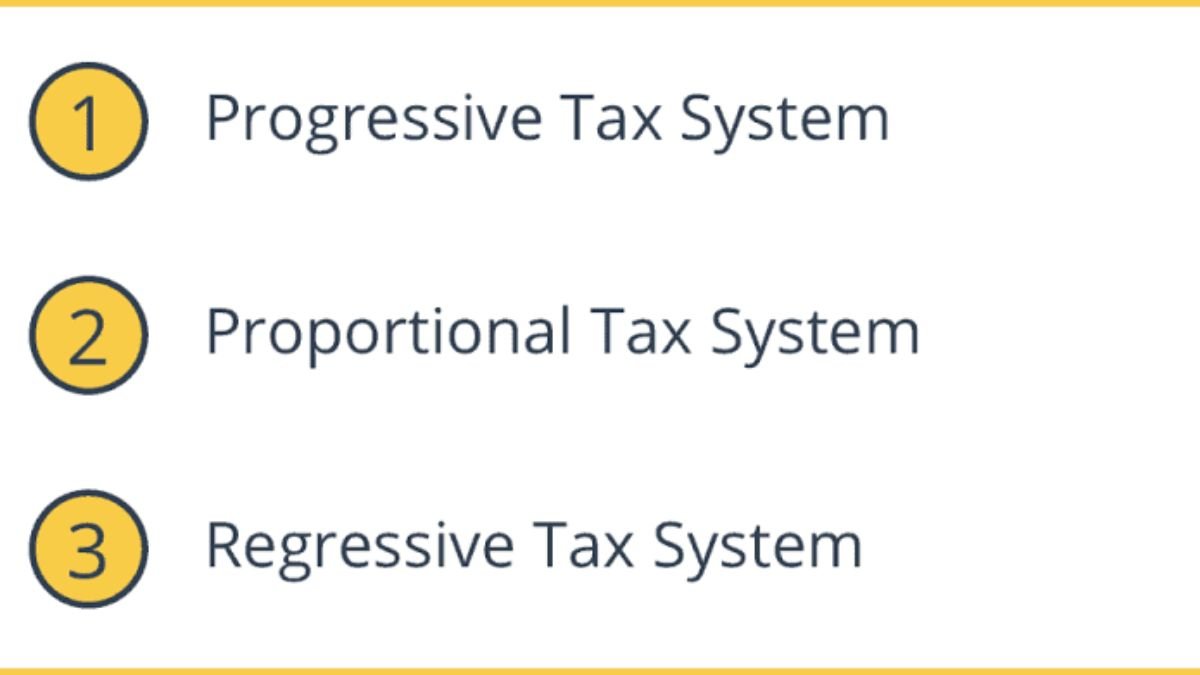
Flat, regressive, and progressive tax are the three primary types of tax systems used by governments. Different types of tax systems are used by different governments, with regressive taxes being more common at the state level. Find out more about the different tax systems, how they work, and how they impact your taxes.
NEW TAX LAW CHANGES
The One Big Beautiful Bill that passed includes permanently extending tax cuts from the Tax Cuts and Jobs Act, including increasing the cap on the amount of state and local or sales tax and property tax (SALT) that you can deduct, makes cuts to energy credits passed under the Inflation Reduction Act, makes changes to taxes on tips and overtime for certain workers, reforms Medicaid, increases the Debt ceiling, and reforms Pell Grants and student loans. Updates to this article are in process. Check our One Big Beautiful Bill article for more information.
Different types of taxes
The taxes you pay on your income and purchases can take several forms, including progressive tax, regressive tax, and flat taxes. But what is a progressive tax? And how does it compare to a regressive or flat tax?
What is a progressive tax?
A progressive tax is when the tax rate you pay increases as your income rises.
In the U.S., the federal income tax is progressive. There are graduated tax brackets, with rates ranging from 10% to 37%.
For the 2026 tax year (tax returns filed in 2027), those tax brackets are:
| Tax Rate | 10% | 12% | 22% | 24% | 32% | 35% | 37% |
| Filing Status | Taxable Income | ||||||
| Single | Up to $12,400 | $12,4001 to $50,400 | $50,401 to $105,700 | $105,701 to $201,775 | $201,776 to $256,225 | $256,226 to $640,600 | Over $640,600 |
| Head of Household | Up to $17,000 | $17,701 to $67,450 | $67,451 to $105,700 | $105,701 to $201,750 | $201,751 to $256,200 | $256,201 to $640,600 | Over $640,600 |
| Married Filing Jointly | Up to $24,800 | $24,801 to $100,800 | $100,801 to $211,400 | $211,401 to $403,550 | $403,551 to $512,450 | $512,451 to $768,700 | Over $768,700 |
| Married Filing Separately | Up to $12,400 | $12,401 to $50,400 to $ | $50,401 to $105,700 | $105,701 to $201,750 | $201,751 to $256,225 | $256,225 to $384,350 | Over $384,350 |
In 2026, if you file as Single and have $25,000 of taxable income, you’re in the 12% tax bracket, while if you file as Single and have taxable income of $700,000, you’re in the 37% tax bracket.
But this doesn’t mean that all your income is taxed at that rate, as there’s a difference between a marginal tax rate and an effective tax rate. If you have $20,600 of taxable income, you have a 12% marginal tax rate, but your effective tax rate is lower. That’s because when your income enters a higher tax bracket, only the income that falls into that higher bracket is taxed at the higher rate.
In 2026, you would calculate your tax bill as follows:
- 10% on the first $12,400 of income = $1,240
- 12% on the next $8,200 of income = $984
Your total tax bill comes to $2,224. While there are a few ways to calculate effective tax rate, the simplest way is to divide your total tax by your taxable income. tax Assistant calculates effective tax rate in a more sophisticated way by adjusting for various recaptured taxes and tax credits.
- Let’s say you have taxable income of $20,600 and no non-refundable credits.
- That would make your effective tax rate 10.8% (=$2,224/$20,600).
For the 2025 tax year (tax returns filed in 2026), those tax brackets are:
| Tax Rate | 10% | 12% | 22% | 24% | 32% | 35% | 37% |
| Filing Status | Taxable Income | ||||||
| Single | Up to $11,925 | $11,926 to $48,475 | $48,476 to $103,350 | $103,351 to $197,300 | $197,301 to $250,525 | $250,526 to $626,350 | Over $626,350 |
| Head of Household | Up to $17,000 | $17,001 to $64,850 | $64,851 to $103,350 | $103,351 to $197,300 | $197,301 to $250,500 | $250,501 to $626,350 | Over $626,350 |
| Married Filing Jointly | Up to $23,850 | $23,851 to $96,950 | $96,951 to $206,700 | $206,701 to $394,600 | $394,601 to $501,050 | $501,051 to $751,600 | Over $751,600 |
| Married Filing Separately | Up to $11,925 | $11,926 to $48,475 | $48,476 to $103,350 | $103,351 to $197,300 | $197,301 to $250,525 | $250,526 to $375,800 | Over $375,800 |
Progressive tax pros and cons
Progressive taxes are popular because they shift the burden of paying taxes to those who are likely most able to pay.
Like federal income tax, progressive tax systems typically allow several deductions and credits. These tax breaks provide additional relief for low-income taxpayers, as is the case with the Earned Income Credit. They can also encourage certain behaviors. For example, the mortgage interest deduction encourages homeownership, and the American Opportunity Tax Credit encourages people to pursue higher education.
But some tax breaks can also make it possible for high-income taxpayers to pay less tax than lower-income people. For example, preferential rates on long-term capital gains sometimes result in wealthy taxpayers paying a lower rate overall than their middle-class counterparts.
Inflation can also cause “bracket creep.” This is when taxpayers are pushed into a higher tax bracket, even though their higher income doesn’t give them more buying power.
What is a regressive tax?
A regressive tax is the opposite of a progressive tax because you pay a higher tax rate as your income decreases. There are two types of regressive taxes.
Proportional tax
Proportional taxes are when everyone pays the same tax rate, regardless of income.
Sales taxes are typically regressive proportional taxes because everyone pays the same rate, regardless of income.
- For example, say Darnell and Myra buy the same TV for $1,000 and each pay 7% in sales tax, which amounts to $70.
- But Darnell’s monthly income is $2,000, while Myra’s monthly income is $5,000.
- In this situation, the $70 sales tax makes up 3.5% of Darnell’s monthly income but only 1.4% of Myra’s monthly income.
Flat tax
Flat taxes are when everyone pays the same amount, regardless of income. Flat taxes are typically a flat rate rather than a flat dollar amount.
Some states add a flat excise tax to car registrations. For example, say Myra and Darnell are both registering their cars, and the state adds a flat fee of $100 to every car registration. That $100 flat tax makes up 5% of Darnell’s monthly income but only 2% of Myra’s monthly income.
Pros and cons of tax structures
Flat taxes are appealing because they’re simple: You pay a flat rate, and your tax calculations are done. But as illustrated in the examples above, regressive taxes place more of the tax burden on people with lower incomes — many of whom currently pay little or no income tax at all.
For that reason, most “flat tax” proposals are a modified proportional tax. While the details vary from plan to plan, these proposals often:
- establish a minimum income threshold under which no taxes are paid
- keep some tax credits, such as the Child Tax Credit and Earned Income Credit
- allow a small number of deductions, such as those for donations to charity or home mortgage interest
For most of us, paying taxes is inevitable. But the impact they have depends on the tax system used and your income.
In a progressive tax system, the tax rate increases as your income increases, meaning higher earners pay a higher percentage of their income in taxes. In contrast, a flat (proportional) tax applies the exact same percentage rate to everyone, regardless of whether they earn $20,000 or $200,000.
No. The federal progressive tax system uses marginal tax rates, which means only the portion of your income that falls within a specific tax bracket is taxed at that bracket’s rate.
Example (2026 Single Filer with $20,600 taxable income): The first $12,400 is taxed at 10% ($1,240), and only the remaining $8,200 is taxed at the 12% rate ($984). Your total tax is $2,224, giving you an effective tax rate of 10.8%, even though your marginal rate is 12%.
Sales tax is a flat percentage rate, but it is considered regressive in practice because it takes a larger percentage of total income from low-income individuals than from high-income earners.
Example: If two people each pay a $70 sales tax (7%) on a $1,000 item, that $70 represents 3.5% of a person earning $2,000 per month, but only 1.4% of someone earning $5,000 per month.
Under the new tax law changes (“One Big Beautiful Bill”), the $10,000 cap on deducting state and local income, sales, and property taxes has been temporarily raised to $40,000 for tax year 2025 (and indexed to $40,400 for 2026). However, to claim the SALT deduction, taxpayers must choose to itemize their deductions rather than taking the standard deduction.
The new legislation introduces dedicated deductions for qualifying workers: eligible taxpayers can deduct up to $25,000 in tip income and up to $12,500 in overtime compensation ($25,000 for married couples filing jointly), subject to eligibility criteria and income-based phase-out thresholds.

Manoj Sharma is a Senior Writer on the banking team at Tax Assistant. He provides information on budgeting, bank accounts, the banking industry, and other related topics. Using original data and methodologies, he helps you identify the best financial institutions, accounts, and products tailored to your needs. Manoj holds a degree in Journalism and Political Science from Syracuse University. All articles are strictly reviewed and fact-checked by our panel of expert Chartered Accountants, including CA Devendra Saini, CA Nikhil Khunteta, and CA Ankit Goyal