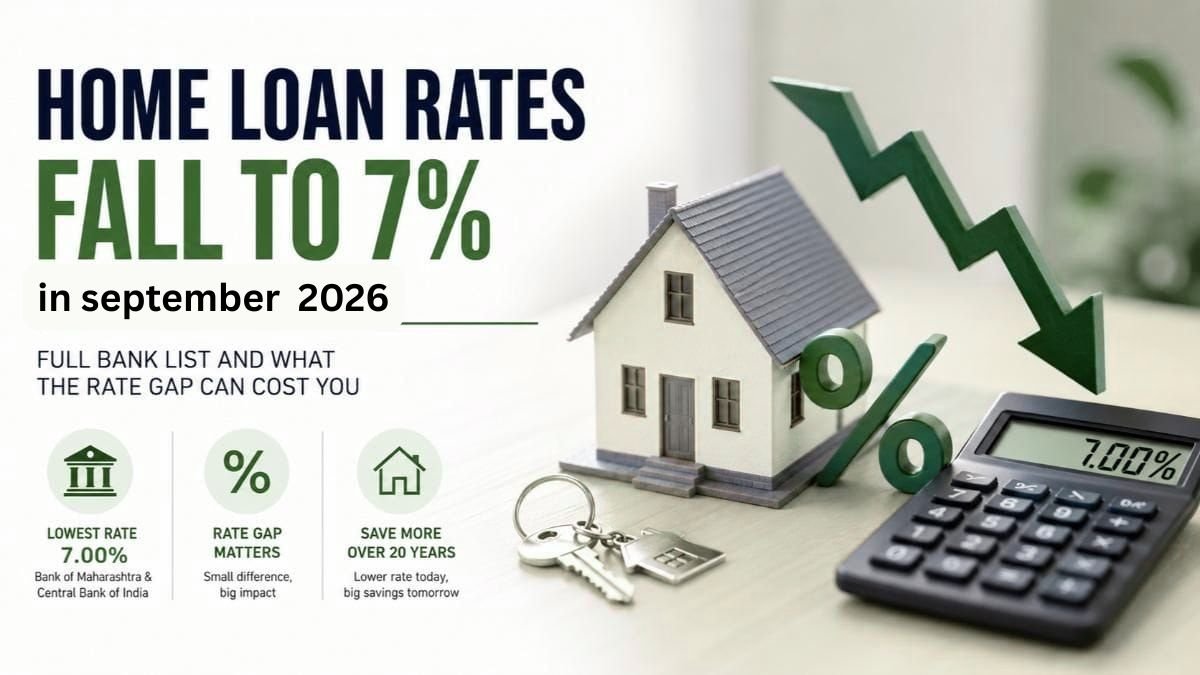
According to Zillow lender marketplace rates, mortgage rates today, Sunday, September 20, 2026, are much higher compared to last week. The current 30-year fixed rate is up 13 basis points to 7.04%, the 20-year fixed rate increased by 3 basis points to 6.82%, and the 5/1 ARM is up 19 basis points to 7.04%.
Today’s mortgage rates
Here are the current mortgage rates today, Sunday, September 20, 2026, according to the latest Zillow data:
- 30-year fixed: 7.04%
- 20-year fixed: 6.82%
- 15-year fixed: 6.56%
- 5/1 ARM: 7.04%
- 7/1 ARM: 6.51%
- 30-year VA: 6.48%
- 15-year VA: 6.12%
- 5/1 VA: 6.34%
Remember, these are the national averages and are rounded to the nearest hundredth.
Today’s mortgage refinance rates
These are today’s mortgage refinance rates, Sunday, September 20, 2026, according to the latest Zillow data:
- 30-year fixed: 7.01%
- 20-year fixed: 6.78%
- 15-year fixed: 6.42%
- 5/1 ARM: 7.04%
- 7/1 ARM: 6.67%
- 30-year VA: 6.69%
- 15-year VA: 6.73%
- 5/1 VA: 5.84%
Again, the numbers provided are national averages rounded to the nearest hundredth. Mortgage refinance rates are often higher than rates when you buy a house, although that’s not always the case.
Monthly mortgage payment calculator
Use the mortgage calculator below to see how various mortgage terms and interest rates will impact your monthly payments.
Calculate Your Monthly Payment
You can bookmark the tax assistant mortgage payment calculator and keep it handy for future use. It also considers factors like property taxes and homeowners insurance when determining your estimated monthly mortgage payment. This gives you a more realistic idea of your total monthly payment than if you just looked at mortgage principal and interest.
30-year vs. 15-year fixed mortgage rates
The average 30-year mortgage rate today is 7.04%. A 30-year term is the most popular type of mortgage because by spreading out your payments over 360 months, your monthly payment is lower than with a shorter-term loan.
The average 15-year mortgage rate is 6.56% today. When deciding between a 15-year and a 30-year mortgage, consider your short-term versus long-term goals.
A 15-year mortgage comes with a lower interest rate than a 30-year term. This is great in the long run because you'll pay off your loan 15 years sooner, and that's 15 fewer years for interest to accumulate. But the trade-off is that your monthly payment will be higher as you pay off the same amount in half the time.
Let's say you get a $300,000 mortgage. With a 30-year term and a 6.41% rate, for example, your monthly payment toward the principal and interest would be about $1,878.48, and you'd pay $376,254 in interest over the life of your loan — on top of that original $300,000.
If you get that same $300,000 mortgage with a 15-year term and a 5.80% rate, for example, your monthly payment would jump to $2,499.27. But you'd only pay $149,869 in interest over the years.
Fixed-rate vs. adjustable-rate mortgages
With a fixed-rate mortgage, your rate is locked in for the entire life of your loan. You will get a new rate if you refinance your mortgage, though.
An adjustable-rate mortgage keeps your rate the same for a predetermined period. Then, the rate will go up or down depending on several factors, such as the economy, and the maximum amount your rate can change according to your contract. For example, with a 7/1 ARM, your rate would be locked in for the first seven years, then change every year for the remaining 23 years of your term.
Adjustable rates typically start lower than fixed rates, but once the initial rate-lock period ends, your rate may increase. Lately, though, some fixed rates have been starting lower than adjustable rates. Talk to your lender about its rates before choosing one or the other.
How to get a low mortgage rate
The best mortgage lenders typically offer the lowest mortgage rates to borrowers with larger down payments, excellent credit scores, and low debt-to-income ratios. So, if you want a lower rate, try saving more, improving your credit score, or paying down some debt before you start shopping for homes.
Waiting for rates to drop probably isn't the best method to get the lowest mortgage rate right now. If you're ready to buy, focusing on your personal finances is probably the best way to lower your rate.
How to choose a mortgage lender
To find the best mortgage lender for your situation, apply for mortgage preapproval with three or four companies. Just be sure to apply to all of them within a short time frame — doing so will give you the most accurate comparisons and have less of an impact on your credit score.
When choosing a lender, don't just compare interest rates. Look at the mortgage annual percentage rate (APR) — this factors in the interest rate, any discount points, and fees. The APR, which is also expressed as a percentage, reflects the true annual cost of borrowing money. This is probably the most important number to look at when comparing mortgage lenders.
On a $300,000 loan, opting for a 15-year fixed mortgage at 6.56% instead of a 30-year fixed mortgage at 7.04% saves $249,490.48 in total interest over the life of the loan. However, because you are paying off the principal in half the time, your monthly principal and interest payment increases by $617.89 (from $2,003.95/month to $2,621.84/month).
Your interest rate is the base cost to borrow the principal balance. The APR (Annual Percentage Rate) represents the broader yearly cost of borrowing, incorporating both the interest rate and extra upfront expenses such as mortgage lender fees, discount points, and closing costs. Comparing loan offers using the APR gives a more accurate picture of the total borrowing expense.
Traditionally, ARMs start with lower initial interest rates than fixed-rate loans because borrowers take on future rate risk. However, when yield curves invert or economic uncertainty rises, short-term borrowing costs can match or exceed long-term fixed rates. In these conditions, locking in a fixed-rate loan often provides both a lower rate and predictable payments.
No. Basic mortgage calculators typically compute only Principal & Interest (P&I). Your total monthly housing payment (often referred to as PITI) generally includes:
Property Taxes: Local municipality assessments.
Homeowners Insurance: Hazard and liability coverage.
PMI/MIP: Private mortgage insurance required for low-down-payment loans.
HOA Fees: Monthly dues for condominiums or managed communities.
Lenders offer the lowest interest rates to borrowers who present the lowest risk. You can secure a better rate by:
Improving your credit score: Pay down existing balances and check credit reports for errors.
Lowering your Debt-to-Income (DTI) ratio: Pay off recurring monthly obligations like credit cards or auto loans.
Increasing your down payment: Putting down 20% or more lowers loan-to-value ratios and eliminates PMI requirements.
Buying discount points: Pay upfront fees at closing to permanently buy down your interest rate.

Manoj Sharma is a Senior Writer on the banking team at Tax Assistant. He provides information on budgeting, bank accounts, the banking industry, and other related topics. Using original data and methodologies, he helps you identify the best financial institutions, accounts, and products tailored to your needs. Manoj holds a degree in Journalism and Political Science from Syracuse University. All articles are strictly reviewed and fact-checked by our panel of expert Chartered Accountants, including CA Devendra Saini, CA Nikhil Khunteta, and CA Ankit Goyal