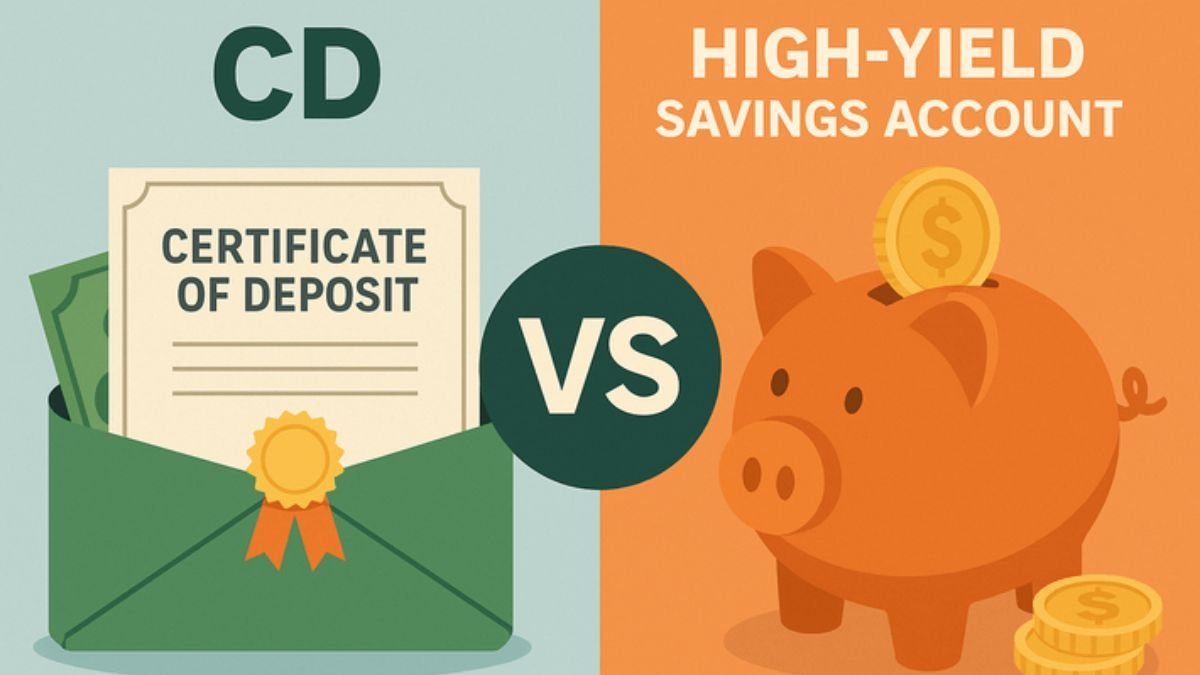
If you’re thinking about how to maximize your savings, chances are you’ve come across high-yield savings accounts (HYSAs) and certificates of deposit (CDs). Both can offer competitive interest rates that drastically outpace those of traditional savings accounts. But which account — an HYSA or a CD — will earn you more in one year?
Here’s a look at how the earnings on a $10,000 deposit compare over 12 months, based on the interest rate and account type.
How much can $10,000 in a savings account earn in one year?
On average, savings accounts currently earn just 0.38% APY. However, traditional savings accounts and HYSAs can offer vastly different yields.
For example, a savings account from Chase Bank earns 0.01% APY. Meanwhile, some of the best HYSAs earn above 4% APY.
Let’s compare earnings in an average savings account to those in an HYSA. Here’s what those different interest rates could mean for a $10,000 deposit after one year:
| ACCOUNT TYPE | APY | TOTAL INTEREST EARNED | BALANCE AFTER 1 YEAR |
|---|---|---|---|
| Average savings account | 0.38% | $38 | $10,038 |
| High-yield savings account | 4% | $407 | $10,407 |
As you can see, putting your money in an HYSA earning 4% would result in an extra $369 after one year, without any additional work on your part. And that’s assuming you don’t make any more contributions on top of your initial $10,000 deposit.
How much can $10,000 in a CD earn in one year?
CD rates can vary widely by bank and term. However, CDs consistently offer higher rates compared to traditional savings accounts. According to the FDIC, a 12-month CD currently earns an average of around 1.71% APY. The most competitive 12-month CDs, however, are earning upwards of 4%. For example, Bask Bank’s 12-month CD currently earns 4.15% APY.
Here’s how much $10,000 would earn in two different 12-year CDs over one year: one earning the average rate, and one earning a more competitive rate.
| ACCOUNT TYPE | APY | TOTAL INTEREST EARNED | BALANCE AFTER 1 YEAR |
|---|---|---|---|
| Average 1-year CD | 1.71% | $171 | $10,171 |
| Competitive 1-year CD | 4.15% | $415 | $10,415 |
In this example, your $10,000 would earn $415 in a competitive 12-month CD — $244 more than you’d earn in a CD with an average rate.
Savings account vs. CD: Which is a better option for $10,000?
While the 12-month earnings differ slightly in the examples above, HYSAs and CDs currently offer very similar rates. This means deciding between one or the other comes down to your preferences and goals rather than rates alone.
For instance, HYSAs have variable interest rates. That means rates can rise or fall throughout the year depending on the larger economic landscape. Even if you open an account currently earning 4%, that rate could change at any time in the future — up or down.
On the other hand, CDs lock in a guaranteed APY for the entire term. With a 1-year CD, you’d earn a fixed rate for the entire 12 months. The tradeoff, though, is liquidity. With a CD, you generally can’t touch your deposit until the end of the term. If you do, you may owe an early withdrawal penalty, which can wipe out some or all of your interest earnings.
Here’s how this can play out in two different interest rate scenarios:
- If interest rates rise after opening an account: An HYSA is advantageous. You could benefit from rising rates if your bank also decides to increase the rates it offers, increasing your earnings.
- If interest rates fall after opening an account: A CD is advantageous (assuming you don’t make early withdrawals). Even if interest rates drop, you’re locked into the higher rate for the duration of your CD’s term.
Other factors to consider when choosing between an HYSA vs. CD
Beyond earning potential and account structure, there are several other factors to consider when deciding where to park your $10,000. Here are a few things you’ll want to know when it comes to comparing different CDs and HYSAs:
- Minimum deposit requirements: Some bank accounts require an up-front deposit when you open the account. CDs tend to have higher minimum balance requirements than HYSAs, but there are plenty of exceptions. Alternatively, some accounts may let you open an account with any deposit amount, but won’t pay the highest posted interest rate unless you maintain a certain balance.
- Promotional vs. ongoing APYs: When comparing interest rates across different accounts, pay close attention to promotional APYs. A high rate might catch your eye, but the fine print could reveal it only lasts for the first few months after opening an account.
- Interest compounding frequency: The more frequently interest compounds (or how often interest is calculated and added to your balance), the faster your money will grow. So, how do you easily compare different rates and compounding frequencies? Look at the APY, which accounts for compounding, not the base interest rate.
- Fees: Don’t open an account without understanding the fees that can eat into your earnings. HYSAs and CDs tend to have few fees, but look out for monthly maintenance fees, excess transaction fees, and early withdrawal fees.
Can you use both an HYSA and a CD?
When deciding the best place for your $10,000, you might end up choosing both a CD and an HYSA — there’s no rule that says you can’t. But consider your plans for your savings before deciding where to put those funds.
For example, an HYSA is ideal for your emergency fund. There generally aren’t any fees for withdrawals, so you can access your cash whenever you need it.
CDs, on the other hand, work well for goals with fixed timelines. For instance, if you want to lock in a high APY while saving for a purchase you know is at least 12 months out, a CD can make a lot of sense. Just be sure you won’t need to access any cash in a CD before the term ends.
Another strategy to consider is CD laddering. This involves opening multiple CDs with staggered maturity dates. This allows you to take advantage of higher rates, but ensure a portion of your savings becomes available on a regular basis. This gives you the predictability of a fixed interest rate while introducing a little more liquidity than a single CD can offer.
If you withdraw money from a CD prior to its maturity date, you will usually be charged an early withdrawal penalty. Depending on the financial institution, this penalty is typically calculated as a set number of months’ worth of interest (e.g., 3 to 6 months of earned interest). In some cases, if you withdraw early in the term, the penalty can even eat into your principal balance.
Yes. Unlike CDs, HYSAs have variable interest rates. This means the financial institution can raise or lower the APY at any time based on broad market trends, economic shifts, or Federal Reserve benchmark rate changes. While your starting APY might be 4.00%, it could fluctuate higher or lower over the course of a 12-month period.
Yes. The interest you earn on both HYSAs and CDs is treated as taxable income by the IRS and must be reported on your federal and state tax returns for the year it was earned. Your bank will typically issue a Form 1099-INT at the end of the year if you earn $10 or more in interest.
CD laddering involves dividing your total deposit (e.g., $10,000) across multiple CDs with staggered maturity dates rather than locking all of it into a single term. For example, you could put $2,500 each into 3-month, 6-month, 9-month, and 12-month CDs. As each CD matures, you can either cash out that portion if you need liquidity or roll it over into a new 12-month CD to maintain continuous high yields.
Yes, provided you open the account with an FDIC-insured bank (or an NCUA-insured credit union). Both HYSAs and CDs are federally insured up to $250,000 per depositor, per insured bank, for each account ownership category. This makes both options extremely safe compared to market-based investments like stocks or mutual funds.

Manoj Sharma is a Senior Writer on the banking team at Tax Assistant. He provides information on budgeting, bank accounts, the banking industry, and other related topics. Using original data and methodologies, he helps you identify the best financial institutions, accounts, and products tailored to your needs. Manoj holds a degree in Journalism and Political Science from Syracuse University. All articles are strictly reviewed and fact-checked by our panel of expert Chartered Accountants, including CA Devendra Saini, CA Nikhil Khunteta, and CA Ankit Goyal