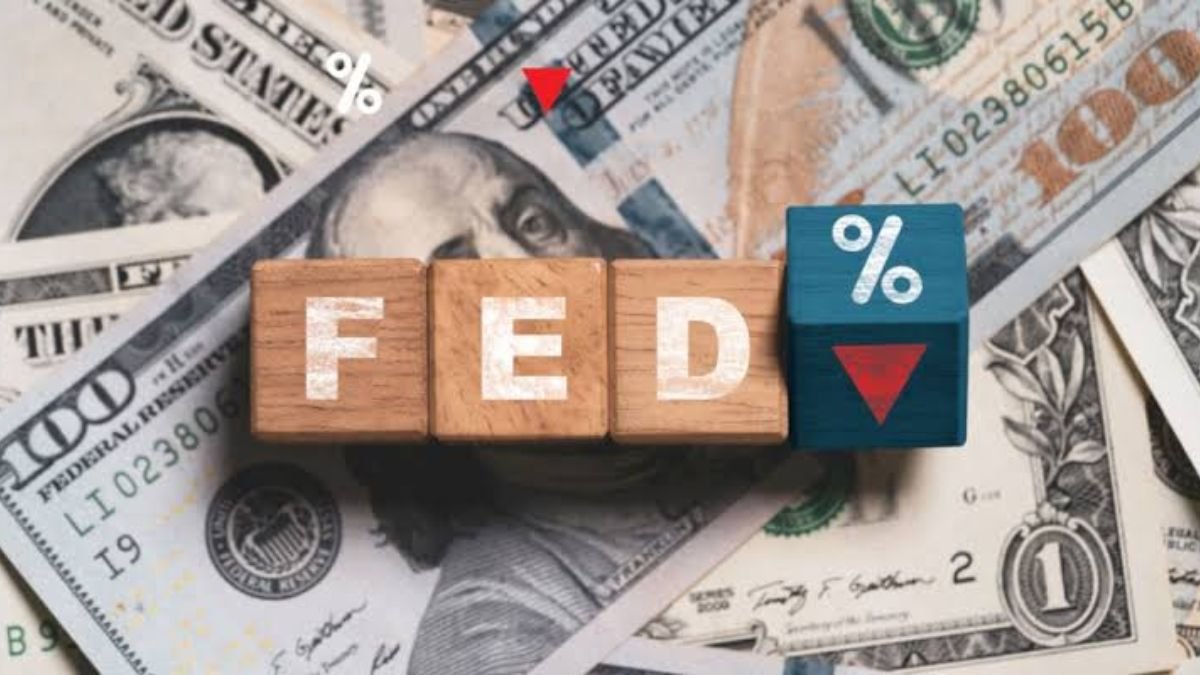
The Federal Reserve — the country’s central bank — periodically adjusts its target rate to keep the economy running smoothly and consumer prices in check. When the federal funds rate moves up or down, so do the interest rates on bank accounts and loans.
In other words, changes in the Fed’s rate impact how much your savings can grow and how much you pay to borrow money.
So how does today’s federal funds rate compare to past years? Here’s a look at historical Fed interest rates so you can better understand how your bottom line is affected.
What is the federal funds rate?
The federal funds rate is set by the Federal Reserve and dictates what a bank can charge another bank for ultra-short-term loans (usually overnight) in order to meet reserve requirements. It’s expressed as a range, and financial institutions can negotiate a specific rate between each other within that range.
The Fed’s target rate also impacts the interest rates individual financial institutions set for financial products such as deposit accounts, bonds, loans, and credit cards.
Historical Fed interest rate: How it’s changed over 50 years
FEDERAL FUNDS RATE
Upper bound, since 1976
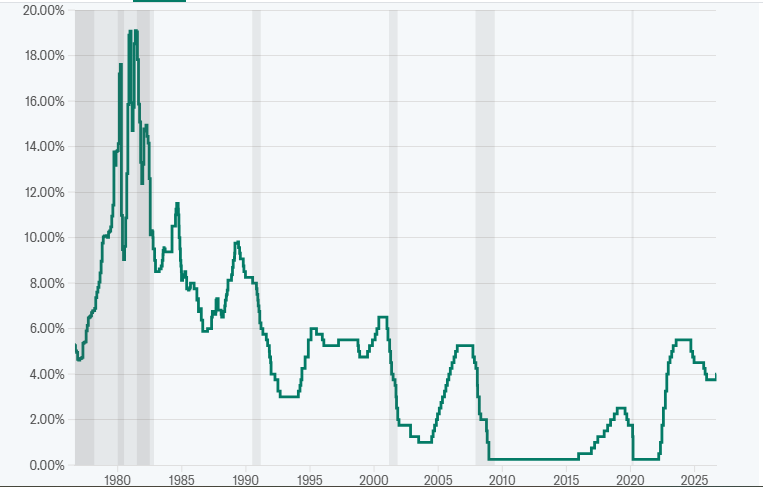
The federal funds rate soared in the early 1980s when inflation hit more than 13%, the highest level recorded. This marked the end of a macroeconomic period known as the “Great Inflation,” which economists believe was brought on by Federal Reserve policies that led to an overgrowth in the supply of money.
In response, the Fed raised interest rates, and the federal funds rate reached more than 19%.
In the late 1990s and into the early 2000s, there was another major economic shift when the Fed began bringing the federal funds rate down. This move was fueled by the dot-com bubble burst — a period of economic instability when investors poured capital into internet-based companies, which led to an overvaluation of many of these start-ups. Unfortunately, not all of these companies were profitable, and the fallout of this bubble burst led to many bankruptcies and a recession.
Then, following the terrorist attacks of Sept. 11, 2001, the Fed cut rates further due to widespread uncertainty and a slowdown in economic activity.
In 2007, the housing market crash prompted the Fed to once again lower its target rate to 2%. A series of rate cuts followed, eventually bringing the target range down to a range of 0%-0.25% — effectively zero — by December 2008.
As the economy recovered from the Great Recession, the Fed began slowly increasing rates again. But in 2020, the COVID-19 pandemic rocked the U.S. economy and brought about challenges such as supply-chain issues, reduced economic activity, and high unemployment. In March 2020, the Fed once again slashed rates to a range of 0%-0.25%.
Beginning in 2022, the Fed pivoted sharply as inflation surged to a 40-year high. It raised the rate aggressively through 2022 and 2023, eventually peaking at 5.25%–5.5%, the highest level in over two decades. By late 2024, however, inflation had eased, and the Fed began gradually cutting rates again.
The target rate remained steady at 4.25%–4.5% until September 2025, when the Fed finally cut its rate again by 25 basis points. It made another 25 bps cut in October, and another in December.
The Fed held rates steady for most of 2026. However, persistent inflation led to a rate hike of 25 basis points in September.
“Economic activity is expanding at a solid pace. While uncertainty remains elevated owing, in part, to geopolitical developments, domestic spending has been resilient. Productivity growth is strong, and capital investment is robust. Job gains have kept pace with the workforce, and the unemployment rate has changed little. Inflation remains elevated. Today’s policy action will support a timelier return to the Committee’s 2 percent goal. The Committee will deliver price stability.,” the Fed said in a statement explaining the decision.
The target range now stands at 3.75%-4%.
What to expect from the Fed moving forward
The next Fed meeting is slated for October 27-28, 2026, when the Fed will decide whether or not to further adjust the federal funds rate.
Many experts expect the Fed to hike rates again this year. However, the CME Fedwatch tool predicts a nearly 100% chance that the federal funds rate will hold steady following the Fed’s October meeting.
The federal funds rate is the benchmark interest rate set by the Federal Reserve for overnight loans between commercial banks. Though consumers don’t borrow directly at this rate, it serves as the foundation for the broader economy. Changes in the Fed’s target range directly influence the prime rate, driving interest rates on credit cards, mortgages, auto loans, high-yield savings accounts, and CDs up or down.
The federal funds rate peaked above 19% (with effective rates reaching near 20%) in the early 1980s. Led by Chair Paul Volcker, the Fed aggressively hiked rates to break the back of double-digit inflation (which hit over 13%) following the macroeconomic shock known as the “Great Inflation.”
The Fed reduces target rates to stimulate economic activity during severe crises:
2008 (Great Recession): Slashing rates to 0.00%–0.25% provided liquidity during the subprime mortgage collapse. 2020 (COVID-19 Pandemic): Rates were cut back to 0.00%–0.25% to support businesses and households amid lockdowns, high unemployment, and global economic shutdown.
For Borrowers: Higher rates make borrowing more expensive, raising monthly payments on credit cards, personal loans, and variable-rate loans. Conversely, rate cuts make loans cheaper.
For Savers: High rates are beneficial for savings, as yield on high-yield savings accounts (HYSAs), certificates of deposit (CDs), and money market accounts increases.
Following the Fed’s September 2026 policy decision, the current target range stands at 3.75%–4.00%. The 25-basis-point increase was enacted to address persistent inflation pressure and guide price growth back toward the Fed’s long-term 2% benchmark.

Manoj Sharma is a Senior Writer on the banking team at Tax Assistant. He provides information on budgeting, bank accounts, the banking industry, and other related topics. Using original data and methodologies, he helps you identify the best financial institutions, accounts, and products tailored to your needs. Manoj holds a degree in Journalism and Political Science from Syracuse University. All articles are strictly reviewed and fact-checked by our panel of expert Chartered Accountants, including CA Devendra Saini, CA Nikhil Khunteta, and CA Ankit Goyal