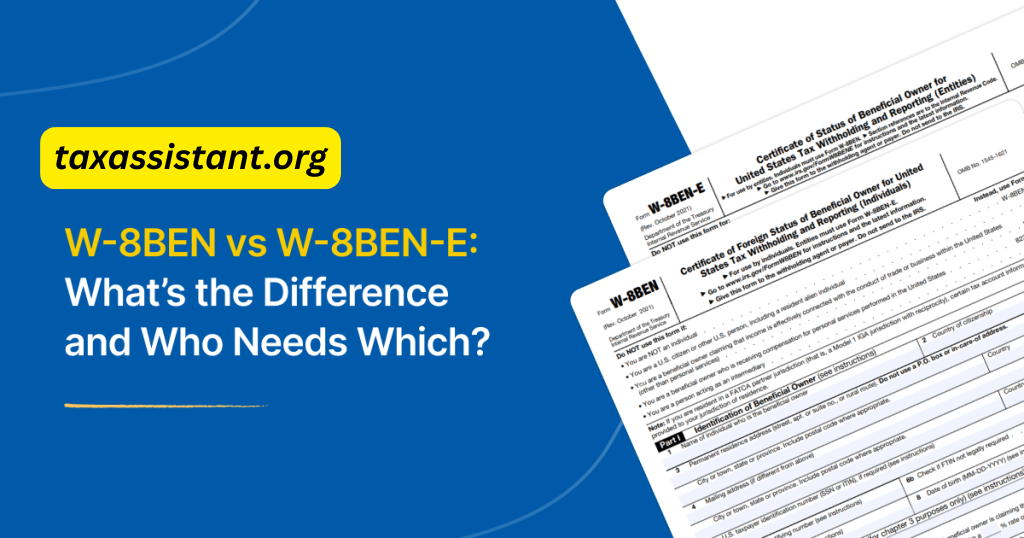
If you are a non-US resident or a foreign business earning income from US sources, navigating the Internal Revenue Service (IRS) tax compliance can be overwhelming. To avoid heavy tax withholdings, you will likely be asked by your US clients or platforms to fill out a W-8 series form.
Thank you for reading this post, don't forget to subscribe!The two most common forms are Form W-8BEN and Form W-8BEN-E.
While they sound almost identical, filing the wrong one can lead to delayed payments or an unnecessary 30% automatic tax withholding on your hard-earned money. In our previous guide, we explained how to avoid US backup withholding as an individual; today, we will deep dive into the core differences between W-8BEN and W-8BEN-E so you can choose the right one for your status.
Reed More….https://taxassistant.org/how-to-avoid-us-backup-withholding-w8ben/
What is Form W-8BEN? (A Quick Overview)
Form W-8BEN (Certificate of Foreign Status of Beneficial Owner for United States Tax Withholding and Reporting) is exclusively designed for foreign individuals.
If you are a freelancer, independent contractor, digital nomad, or a retail investor living outside the United States and earning “US-sourced income” (like dividends, royalties, or service fees), this is the form you need.
Why do you need it?
It establishes that you are not a US citizen or resident.
.It proves that you are the beneficial owner of the income being paid.
.It allows you to claim tax treaty benefits between your home country and the US, potentially reducing your withholding tax rate from 30% down to 0-15%.
What is Form W-8BEN-E? (An Overview)
The “E” in Form W-8BEN-E stands for Entity. This form is specifically used by foreign corporations, partnerships, trusts, or other organizations that receive payments from US sources.
Unlike the individual form, W-8BEN-E is highly complex and heavily tied to FATCA (Foreign Account Tax Compliance Act) regulations. US withholding agents use this form to ensure foreign companies are properly reporting their financial accounts and assets.
Why do you need it?
It confirms the foreign status of your business entity.
. It allows your corporation or partnership to claim tax treaty benefits.
. It documents your entity’s status under FATCA (e.g., whether it is an Active NFFE or Passive NFFE).
Key Differences: W-8BEN vs W-8BEN-E
To make things easy, here is a quick comparison table highlighting the operational differences between the two tax forms:
| Feature | Form W-8BEN | Form W-8BEN-E |
| Target Audience | Foreign Individuals / Freelancers | Foreign Entities / Corporations / Partnerships |
| Length of Form | 1 Page | 8 Pages |
| Complexity | Low (Simple personal tax details) | High (Requires FATCA classification) |
| Tax ID Needed | SSN, ITIN, or Foreign TIN | EIN (Employer Identification Number) or Foreign TIN |
| Validity | 3 Calendar Years | 3 Calendar Years |
How to Choose Which Form to File?
Choosing the correct form depends strictly on how your business is legally structured in your home country. Let’s look at two common real-world scenarios:
Scenario A: You are a Freelancer or Sole Proprietor
If you work as an individual service provider (e.g., a software developer in India or a graphic designer in Canada) and bill clients under your personal name, you must file Form W-8BEN.
Scenario B: You Operate a Registered Corporate Entity
If you own a registered private limited company, an LLC, or a partnership firm that signs contracts with US corporations, your business is considered a distinct entity. Therefore, you must fill out Form W-8BEN-E. Even if you are the 100% owner of that company, you cannot use the individual W-8BEN form.
Common Mistakes to Avoid When Filing Form W-8BEN-E
Because Form W-8BEN-E is 8 pages long, foreign business owners frequently make mistakes that lead to rejected forms. Keep these points in mind:
1. Incorrect FATCA Classification: Part I of the form requires you to state your Chapter 4 status. Most standard offshore software companies or service agencies fall under “Active NFFE” (Non-Financial Foreign Entity). Selecting a financial institution status by mistake will result in instant rejection.
2. Missing Global Intermediary Identification Number (GIIN): If your entity is classified under certain financial categories, a GIIN is mandatory. For standard active businesses, this section can usually be skipped.
3. Forgetting the Expiration Date: Both forms are valid from the date of signing until the end of the third succeeding calendar year. For example, a form signed in June 2026 will remain valid until December 31, 2029. Make sure to renew it on time to keep your payments running smoothly.
If you own a US single-member LLC that is treated as a “disregarded entity” for tax purposes by a non-US citizen, the rules can vary based on your tax structure. However, generally, if the income is flowing directly to an individual, W-8BEN applies. For a foreign corporation operating as an LLC, W-8BEN-E is required.
If you fail to provide a valid W-8BEN or W-8BEN-E, the US withholding agent or client is legally required by the IRS to withhold a flat 30% of your total gross invoice as tax.
Not always. In most cases, you can use your local country’s tax identification number (such as PAN in India or SIN in Canada) in the “Foreign TIN” section to claim your treaty benefits successfully.
Conclusion
Submitting the right paperwork is the single most critical step in safeguarding your global revenue from double taxation. Use Form W-8BEN if you are acting as an individual, and use Form W-8BEN-E if you are acting on behalf of a registered company.If you are still unsure about your entity’s FATCA classification or need professional help filing your tax documents smoothly, feel free to contact our team for customized tax support.
Editing by katie willimas