If you are an Indian freelancer, remote worker, or consultant earning from global clients, you might often face situations where foreign taxes are withheld or deducted from your payouts (such as US backup withholding tax).
Thank you for reading this post, don't forget to subscribe!Thankfully, under the Double Taxation Avoidance Agreement (DTAA), you don’t have to pay tax twice on the same income. You can legally claim a Foreign Tax Credit (FTC) in India to reduce your domestic tax liability.
However, to claim this credit, filing Form 67 on the Income Tax e-filing portal is a mandatory legal requirement under Rule 128 of the Income Tax Rules. In this guide, we will break down the exact step-by-step online filing process.
Reed More….https://taxassistant.org/firc-guide-freelancer-foreign-income-tax-refund/
Prerequisites: What Do You Need Before Filing Form 67?
Before you log into the income tax portal, ensure you have the following documents and details ready:
. Certificate or Statement of Foreign Tax Deducted: A document from the foreign tax authority, your client, or digital platform specifying the nature of income and the exact tax withheld (e.g., US Form 1042-S or system tax ledgers).
.Proof of Payment of Tax Outside India: Bank statements or transaction advices showing the net credit or tax deduction details.
A Tax Residency Certificate (TRC): If applicable under specific DTAA clauses.
Step-by-Step Process to File Form 67 Online
Filing Form 67 must be completed before you submit your final annual Income Tax Return (ITR-3 or ITR-4). Follow these steps to file it online:
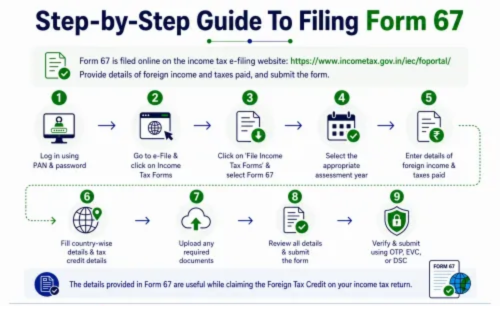
Step 1: Log in to the Income Tax E-Filing Portal
Go to the official e-filing portal (www.incometax.gov.in) and log in using your PAN/Aadhaar number and password.
Step 2: Navigate to e-File Forms
From the top menu bar, click on e-File > Income Tax Forms > File Income Tax Forms.
Step 3: Select Form 67
On the search bar or under the categories, look for Form 67 (Form for person claiming credit of foreign tax). Click on File Now.
Step 4: Choose the Assessment Year (AY)
Select the relevant Assessment Year from the drop-down menu.
(Note: If you are filing taxes for the Financial Year 2025-26, your Assessment Year will be 2026-27). Click on Continue and then Let’s Get Started.
Step 5: Fill Part A (Income and Foreign Tax Details)
Part A is the most critical section where you declare your foreign income earnings:
. Country Name: Select the country where your client is located (e.g., United States of America).
.Source of Income: Specify the nature of your income (e.g., Business or Profession).
.Income outside India: Enter the total gross revenue earned from that country in INR.
. Tax paid outside India: Enter the exact amount of tax withheld or paid in foreign countries (converted to INR).
. Tax Credit Claimed under DTAA Section: Mention the relevant section under which credit is claimed (usually Section 90 or 91).
Step 6: Fill Part B (Refund or Past Liabilities)
Part B requires you to declare if any foreign tax credit specifies past disputes or if any refund of foreign tax was received in earlier years. If none of these apply to you, simply select “No” or enter “0”
.Step 7: Upload Supporting Documents
Under the attachments section, you must upload the scanned PDF copies of:
. The certificate/statement of foreign tax deducted or paid.
. Your self-attested proof of tax payment/withholding (like your foreign remittance statements).
Step 8: Verification and Submission
. Review all the filled sections to ensure there are no math errors in currency conversion.
. Go to the verification tab, select your place, and choose the authorized signatory name.
. Click on Proceed to E-Verify and complete the submission using your Aadhaar OTP or Electronic Verification Code (EVC).
. Once successfully verified, the portal will generate an Acknowledgement Number for your filed Form 67. You can now proceed to safely file your ITR-3 or ITR-4 and claim your Foreign Tax Credit.
Conclusion
Filing Form 67 is an absolute must if you wish to prevent your global freelance income from being chipped away by double taxation. Missing the deadline or skipping this form can cause the Income Tax Department to deny your Foreign Tax Credit claims, leading to unexpected tax notices and penalties. Keep your documents handy, follow this step-by-step layout, and file early to ensure a smooth financial year.
Answer: According to Rule 115 of the Income Tax Rules, you must use the State Bank of India (SBI) Telegraphic Transfer Buying Rate (TT Buying Rate) applicable on the last day of the month preceding the month in which the tax was paid or deducted.
Answer: No. Legally, Form 67 must be submitted on or before the due date of filing your income tax return under Section 139(1). Filing it after submitting your ITR can lead to your tax credit claim being rejected during processing.
Answer: No. Form 67 is strictly required only when tax was actually deducted or paid in a foreign country and you want to claim a credit for that exact amount against your Indian income tax liabilities.
Editing by katie willimas