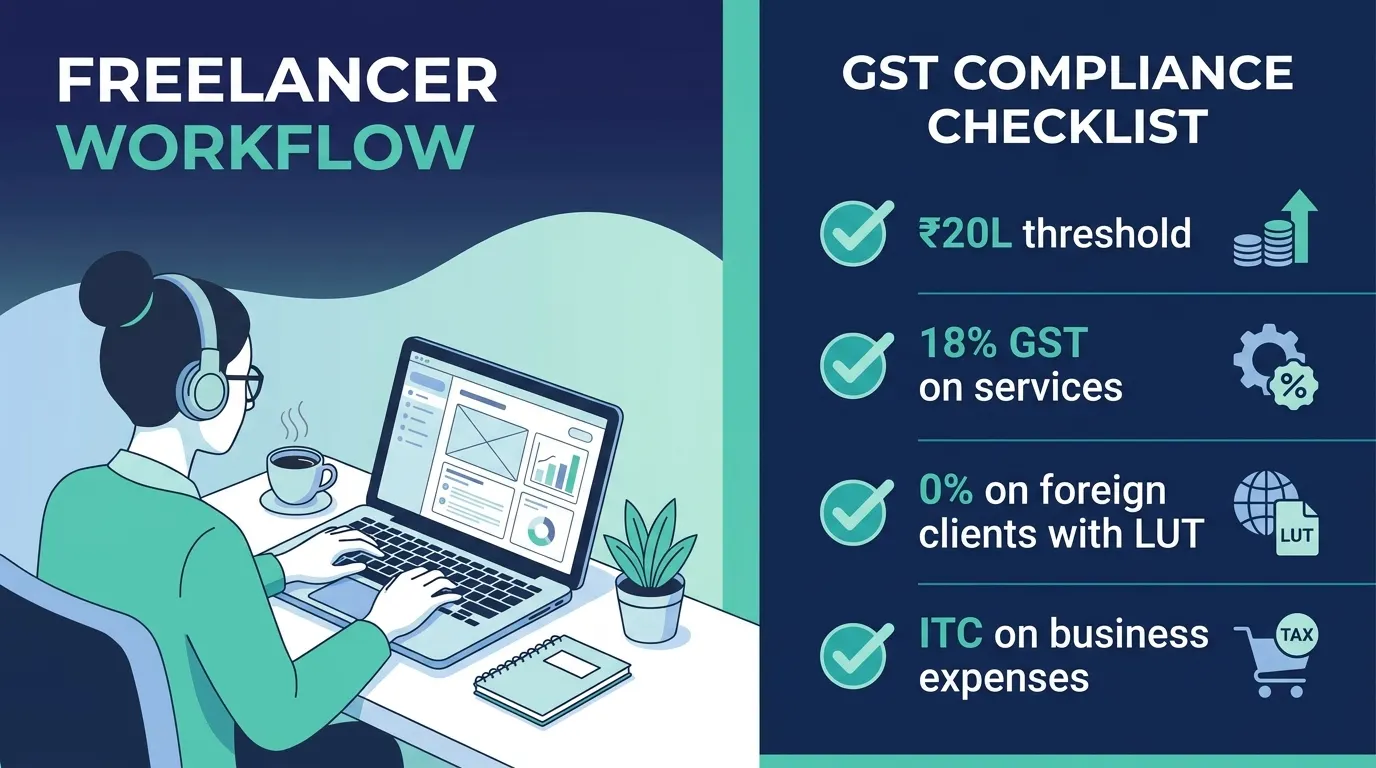
The landscape for Indian freelancers receiving foreign client payments is incredibly lucrative, but it is often surrounded by tax confusion. If you are an independent contractor, consultant, or agency owner exporting services—like software development, graphic design, content writing, or digital marketing—here is exactly how GST and Foreign Inward Remittance Certificates (FIRC) apply to you in 2026.
Thank you for reading this post, don't forget to subscribe!1. Do You Need to Register for GST?
The short answer is: It depends on your total global annual turnover.
Even though the export of services is technically considered an “inter-state supply” under GST laws (which normally requires immediate registration), the government provides a specific exemption for service exporters.
Read More…..How to File LUT on GST Portal for Export of Services (2026-27): A Step-by-Step Guide
- Turnover Below ₹20 Lakhs: If your total annual revenue (combining both domestic and international clients) is under ₹20 Lakhs (or ₹10 Lakhs if you operate from northeastern special category states like Manipur, Mizoram, Nagaland, or Tripura), GST registration is NOT mandatory.
- Turnover Above ₹20 Lakhs: The moment your aggregate cross-border and domestic revenue crosses the ₹20 Lakh threshold in a financial year, you must register for GST within 30 days.
CA Tip: Even if your turnover is below ₹20 Lakhs, you can opt for voluntary registration. This makes it seamless to open business bank accounts and allows you to claim an Input Tax Credit (ITC) refund on your business expenses (like laptops, software subscriptions, and internet bills).
Read More…..How Freelancers Can Create a Valid Tax Invoice for Foreign Clients (2026-27)
2. The Golden Rule: Export of Services is “Zero-Rated”
If you cross the threshold and register, does that mean you have to pay an 18% tax on your hard-earned foreign income? Absolutely not.
Under Section 16 of the IGST Act, the export of services is classified as a “Zero-Rated Supply.“ This means your tax rate on foreign invoices is 0%, provided you fulfill these five legal conditions:
- You (the service provider) are located in India.
- Your client is located outside India.
- The “place of supply” is outside India.
- Crucial: You receive the payment in convertible foreign currency (USD, GBP, EUR, etc.) in your Indian bank account.
- You and your client are not merely different branches of the same company.
3. How to Avoid Paying 18% Upfront: The LUT Route
If you cross the ₹20 Lakh threshold, you cannot just send a 0% tax invoice out of the blue. You have two pathways to handle your zero-rated exports.
A: File an LUT (Letter of Undertaking) – Highly Recommended
At the start of every financial year (by April 1st), you can file a simple, free document called a Letter of Undertaking (LUT) online via Form RFD-11 on the GST portal.
- The Benefit: It allows you to invoice your foreign clients with 0% GST completely upfront. No tax leaves your pocket, your working capital stays intact, and you can still claim ITC refunds for your local business expenses.
B: Pay IGST and Claim a Refund later
If you do not file an active LUT, you are legally required to pay 18% IGST upfront when filing your monthly returns, and then apply to the government for a refund later. This process severely hurts your monthly cash flow and can take months to clear.
4. Everything About FIRC & FIRA (Your Legal Proof)
Under GST law, the burden of proof is on you to show that your earnings came from a foreign country in foreign currency. This is where FIRC (Foreign Inward Remittance Certificate) or FIRA (Foreign Inward Remittance Advice) comes into play.
- What it is: A legal document issued by an Authorized Dealer (AD) Bank in India certifying that a specific amount of foreign currency was received from abroad and converted into Indian Rupees (INR).
- Why you absolutely need it: If you are registered for GST, tax authorities can audit you or reject your zero-rated export status if you cannot produce an FIRC/FIRA for your foreign payments. If they reject it, they will demand 18% GST plus steep interest and penalties.
- How to get it:
- If you receive a traditional international wire transfer directly into your local bank, your bank will automatically issue a FIRA or let you download it from your net banking dashboard.
- If you use cross-border payment platforms (like PayPal, Wise, Payoneer, or Xflow), they partner with Indian banks to auto-generate a digital FIRA for every transaction, which you can download directly from their apps.
GST Rules for Indian Freelancers at a Glance
| Scenario | GST Registration | Tax Rate on Foreign Clients | Key Document Needed |
| Turnover < ₹20 Lakhs | Optional | 0% | FIRC / FIRA (as proof of foreign funds) |
| Turnover > ₹20 Lakhs | Mandatory | 0% | GST Registration, Active LUT, and FIRC / FIRA |
A Quick Invoicing Note: When creating an invoice for a foreign client under an LUT, ensure you explicitly add this exact text line at the bottom of your invoice:
“Supply meant for export under Letter of Undertaking (LUT) without payment of Integrated Goods and Services Tax (IGST).”
Yes, as long as you get a digital FIRA. Many freelancers worry because the money lands in their Indian bank account as Indian Rupees (INR). Under GST law, the crucial factor is that the transaction originated in convertible foreign currency (like USD or EUR) and was converted into INR through an authorized channel.
Platforms like Wise, Payoneer, PayPal, and Xflow automatically handle this background conversion through partner banks and generate a digital Foreign Inward Remittance Advice (FIRA). As long as you can download this FIRA document from your payment platform’s dashboard, you satisfy the legal requirement for a 0% zero-rated export.
The law gives you 30 days from the exact date your total revenue crosses the ₹20 Lakh limit to register for GST. Once you get your GSTIN (GST Identification Number), you should immediately log into the GST portal and file your Letter of Undertaking (LUT) for the remainder of the financial year.
Any export invoices you raised before crossing the ₹20 Lakh threshold are completely fine without GST. However, once you cross the threshold, ensure you file the LUT before raising your next international invoice—otherwise, you will legally owe 18% IGST on that specific invoice until the LUT is active.
Absolutely, and this is one of the biggest financial perks of being a registered freelancer. Because the export of services is classified as “zero-rated” (and not “exempt”), the government allows you to claim back the GST you pay on your business-related expenses.
If you buy a laptop for work, pay for high-speed internet, subscribe to software (like Adobe Creative Cloud or AWS), or rent a co-working space, you can use those local GST invoices to accumulate Input Tax Credit. Since you owe 0% tax on your foreign clients, you can file a refund application (Form GST RFD-01) online to get that accumulated credit transferred directly into your bank account as cash.

"Suresh Kumar Saini is an experienced Tax Assistant and finance writer. He specializes in US & Canada Tax Guide, Indian Income Tax laws, GST compliance, and personal finance, helping freelancers and remote workers optimize their taxes."