If you are an Indian freelancer getting paid by international clients, seeing 1% shaved off your hard-earned money hurts. This deduction is driven by Section 194-O of the Income Tax Act, which forces digital marketplaces and payment gateways (like Upwork, Fiverr, or PayPal) to deduct 1% Tax Deducted at Source (TDS) on gross freelancer payouts.
Thank you for reading this post, don't forget to subscribe!While you cannot bypass tax laws, you can legally restructure your payment setups or use specific tax provisions to eliminate, minimize, or quickly reclaim this 1% deduction.
3 Legal Strategies to Stop the Upfront 1% TDS
1: Move to Direct Bank Wires (Bypass the Middleman)
The 1% TDS under Section 194-O only applies when a digital platform or marketplace facilitates the transaction. If you invoice your client directly, the 1% TDS disappears.
Read More….Why Senior Citizens May Need to File an ITR for a TDS Refund
- How it works: Where contractually permitted, transition your clients off marketplaces. Have them pay you via direct SWIFT international wire transfers or local virtual accounts provided by business-tier international money transfer services.
- Why it works: Foreign clients do not have an Indian Tax Deduction Account Number (TAN) or legal presence in India. Because they cannot legally deduct Indian TDS, your payment arrives completely gross.
2: Maintain Your PAN to Protect the ₹5 Lakh Threshold
The law protects smaller or part-time freelancers via an explicit safety net built directly into Section 194-O.
- The Rule: If your gross annual payouts on a specific marketplace or platform stay under ₹5,00000 (₹5 Lakh), the platform is legally barred from deducting the 1% TDS.
- The Trap: This exception only kicks in if your PAN or Aadhaar is verified on the platform. If your tax profile is incomplete, the platform is forced to skip the threshold and immediately slam you with a penalty 5% TDS rate.
3: Apply for a Nil/Lower Deduction Certificate
If you expect a high volume of freelancing income but know your actual end-of-year tax liability will be zero (often the case if you use the Section 44ADA presumptive tax scheme to write off 50% of your earnings as expenses), you can request an official waiver.
Read More….How Freelancers Can Claim Tax Refund on Foreign Income (FIRC Guide)
- How it works: File Form 13 online through the income tax TRACES portal.
- The Outcome: The tax department will assess your estimated income and issue a Lower or Nil TDS Certificate. You upload this certificate directly to your platform’s tax settings to legally lower or pause their deductions.
What if the 1% is Already Deducted?
If a platform has already withheld the 1% TDS, do not panic—the money is not gone.
Every rupee deducted is tied to your PAN and will show up in your Form 26AS and Annual Information Statement (AIS). When you file your Income Tax Return (ITR) at the end of the fiscal year, this TDS functions as a pre-paid tax credit:
- If your final tax bill is higher than the TDS, it reduces what you owe.
- If your final tax bill is lower than the TDS (or zero), the Income Tax Department refunds the entire deducted balance straight to your bank account with interest.
The Ultimate Freelancer Safeguard: Get Your FIRA No matter which payment route you choose, always request a Foreign Inward Remittance Advice (FIRA) from your bank or payment processor for every single transfer. This document is your ultimate legal proof that the funds entered India as service exports, ensuring you remain fully compliant and protected under GST zero-rated supply rules.
Yes. The 1% TDS deducted by e-commerce platforms is strictly an Income Tax compliance requirement and does not impact your GST status.
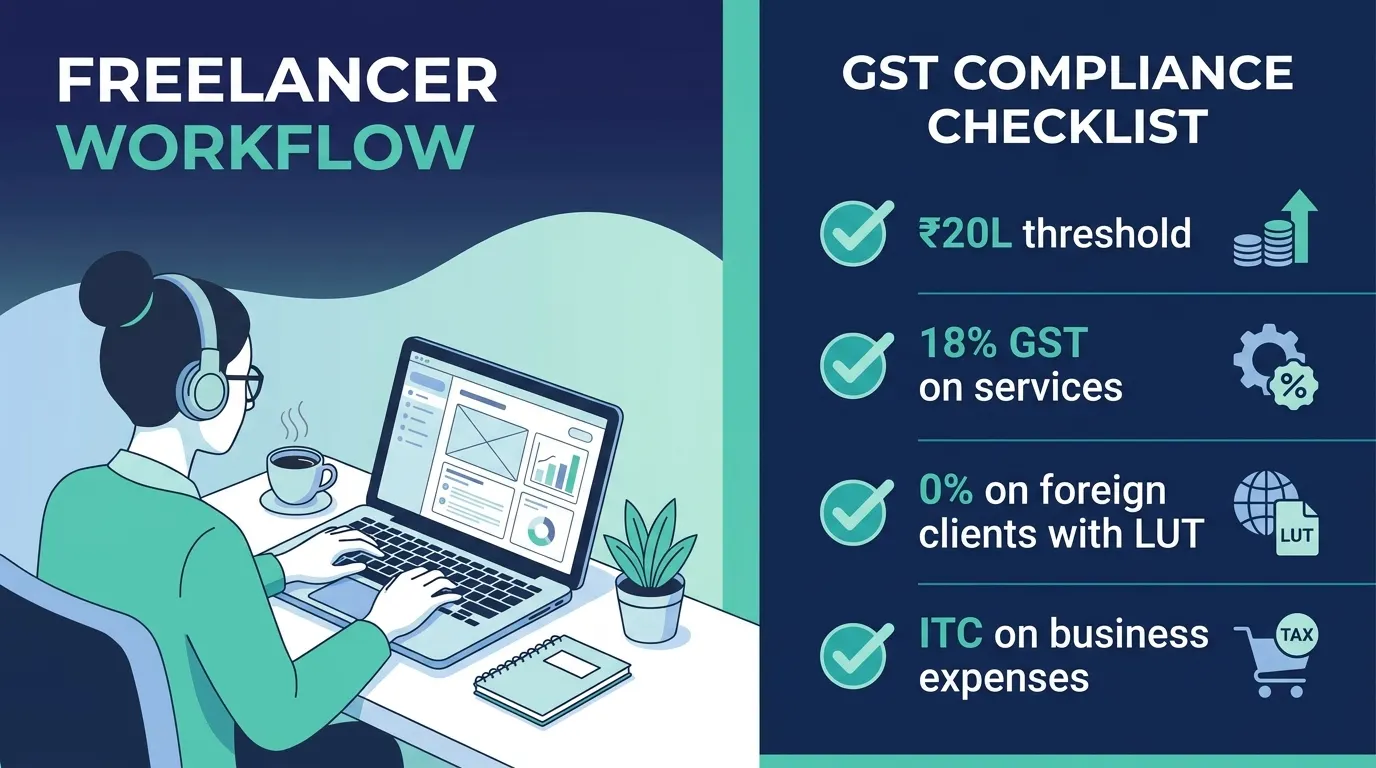
As long as your client is based outside India, you are delivering services remotely from India, and your payment is received in convertible foreign currency (via the platform’s banking channels), your work qualifies as an Export of Services. Under GST laws, exports are treated as a “zero-rated supply.”
Important Step: To claim 0% GST legally, you must file a Letter of Undertaking (LUT) on the GST portal at the beginning of each financial year. If you file your LUT, you won’t have to pay 18% GST on your international invoices, regardless of the 1% income tax deduction.
It depends on the exact tool you use.
International Marketplaces (Upwork, Fiverr): They strictly act as e-commerce platforms facilitating a multi-party marketplace. They will deduct the 1% TDS.
Pure Payment Gateways / Local Virtual Accounts (Wise, Payoneer): If a client pays you via a direct local bank transfer feature (like a Wise USD local account details or Payoneer receiving account) and the provider simply routes that money to India as a direct wire transfer, they generally operate as standard cross-border payment facilitators rather than e-commerce marketplaces. In these direct B2B invoicing setups, the 1% TDS typically does not trigger.
Absolutely. Section 44ADA allows eligible Indian professionals to declare only 50% of their gross receipts as taxable profit and pay tax on that half, skipping the need to maintain complex expense registers.
When you file your ITR (typically Form ITR-4) under this scheme:
The portal will calculate your absolute tax liability based on that 50% profit.
You then go to the “TDS Credits” section, where the 1% deducted by platforms like Upwork or PayPal will be visible (fetched directly from your Form 26AS).
The system will automatically offset the 1% TDS against your final tax bill. If the TDS deducted exceeds what you actually owe, the Income Tax Department will refund the remainder directly to your bank account.

"Suresh Kumar Saini is an experienced Tax Assistant and finance writer. He specializes in US & Canada Tax Guide, Indian Income Tax laws, GST compliance, and personal finance, helping freelancers and remote workers optimize their taxes."