
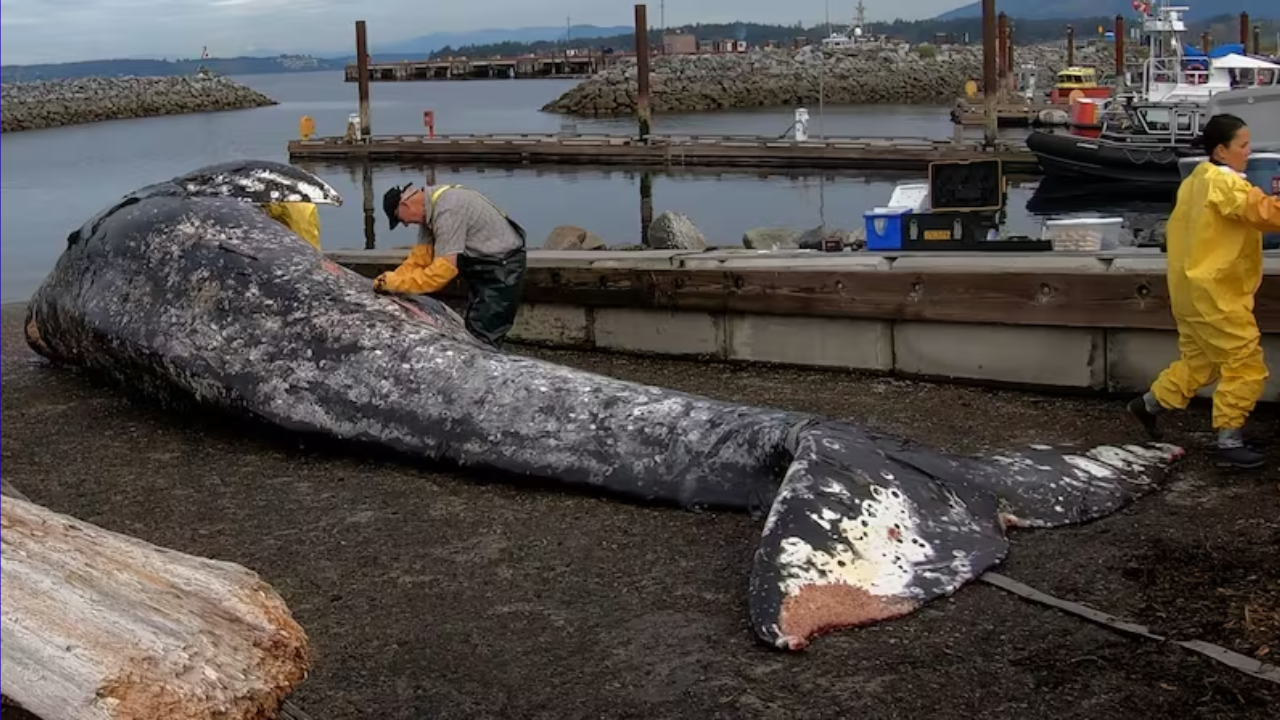
The discovery of four dead grey whales along the British Columbia coast in less than two weeks has sparked deep concern among marine biologists and local communities. The Department of Fisheries and Oceans (DFO) confirmed the strandings occurred during the whales’ annual migration north to their feeding grounds.
Thank you for reading this post, don't forget to subscribe!The Current Toll
As of late April 2026, the DFO has responded to four separate incidents across the region:
- Locations: Two whales were found in Barkley Sound, one near Kyuquot, and one near Sidney.
- Physical State: Initial necropsies reveal the whales were severely emaciated. Marine mammal coordinator Paul Cottrell noted they were essentially “bags of bones,” indicating they lacked the blubber necessary to survive the journey.
- Regional Impact: These four cases bring the B.C. total to five deaths this year, part of a wider spike that includes 15 recorded deaths in Washington State over the same period.
Root Causes and Environmental Factors
Experts believe these deaths are symptomatic of an ecosystem in distress rather than isolated accidents:
- Starvation in the Arctic: The leading theory is a lack of prey—primarily amphipods—in the Arctic. Melting sea ice has disrupted the food chain, leaving whales unable to “bulk up” before their 12,000-mile migration.
- The “Unusual Mortality Event” (UME): Biologists fear a resurgence of the UME that decimated the population between 2019 and 2023, causing the population to plummet from 28,000 to roughly 13,000.
- Compounding Dangers: In their weakened state, whales are more likely to stay near busy shorelines in search of food, increasing the risk of vessel strikes and entanglement in fishing gear.
Collaborative Response
The DFO is working alongside the Huu-ay-aht, Kyuquot/Cheklesaht, and W̱SÁNEĆ First Nations to conduct necropsies and monitor the coastline. As the migration continues through May, authorities are urging the public to report any sightings of distressed or dead marine mammals to help track the severity of the crisis.
Related Stories

"Suresh Kumar Saini is an experienced Tax Assistant and finance writer. He specializes in US & Canada Tax Guide, Indian Income Tax laws, GST compliance, and personal finance, helping freelancers and remote workers optimize their taxes."