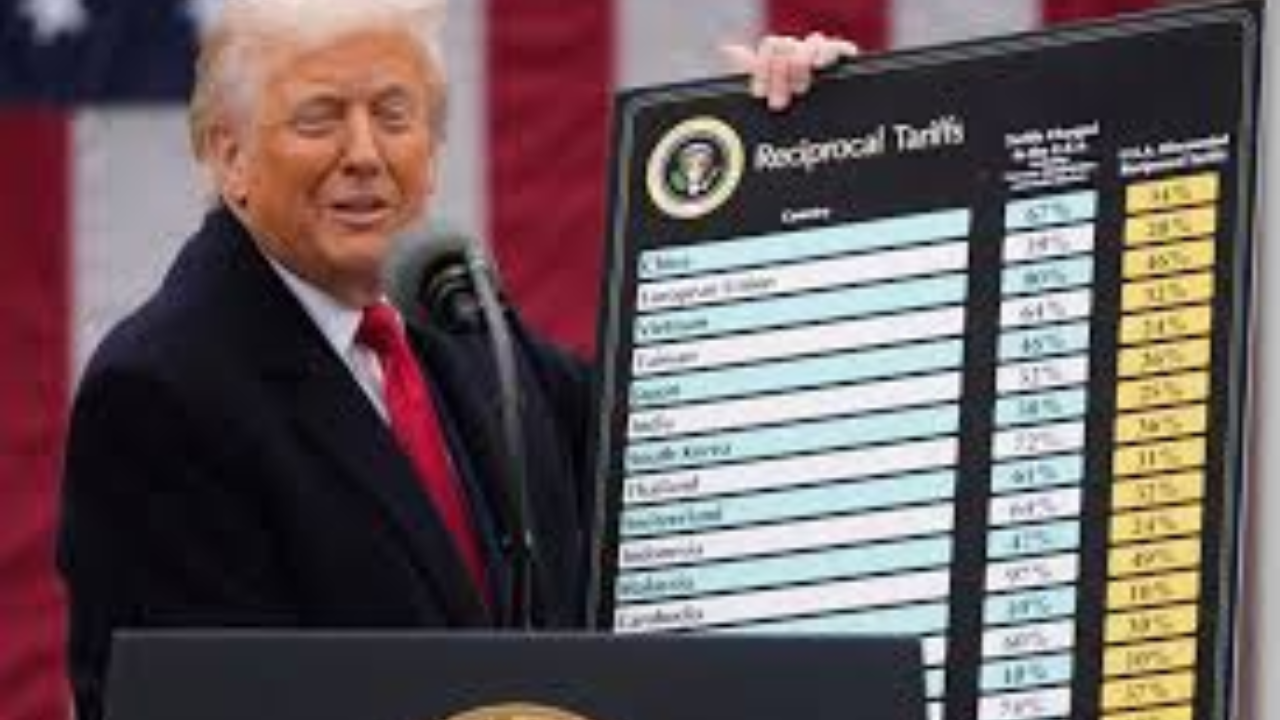
President Donald Trump has recently renewed his pledge to use revenue from his controversial tariff policy to provide a direct financial benefit to most Americans. The proposal, however, remains light on specific details and is overshadowed by a critical legal challenge before the U.S. Supreme Court.
Thank you for reading this post, don't forget to subscribe!The $2,000 Dividend Proposal
- The Claim: President Trump has asserted that most U.S. citizens will receive a “dividend of at least $2000 a person” generated from tariff revenue.
- Source of Funds: The money is claimed to come from the “Trillions of Dollars” in revenue generated by the administration’s tariffs, with the aim of also paying down the “ENORMOUS DEBT.”
- Eligibility: Trump specified that the payment would go to “everyone,” but explicitly “not including high income people!” The official income threshold for this exclusion has not yet been defined.
- Mechanism (Uncertain): While the president speaks of a “dividend,” Treasury Secretary Scott Bessent has suggested the $2,000 benefit may not be a single direct check. Instead, it could be delivered through various forms of tax relief, such as:
- Eliminating federal taxes on tips and overtime.
- Removing taxes on Social Security benefits.
- Expanding tax deductibility for car loans and mortgages.
- Any such sweeping benefit program would require Congressional approval to be enacted.
The Critical Legal Challenge
The proposed “dividend” is entirely dependent on the tariffs themselves, which are currently the subject of a contentious legal battle that has reached the U.S. Supreme Court (SCOTUS).
- The Issue: The core dispute is whether the President exceeded his authority in imposing widespread tariffs by citing the International Emergency Economic Powers Act (IEEPA), a 1977 law intended for national emergencies. Opponents argue that the power to levy tariffs (which act as a tax) rests solely with Congress.
- SCOTUS Scrutiny: During recent oral arguments, Justices across the ideological spectrum appeared skeptical of the administration’s claims of broad, unilateral tariff authority under IEEPA. Chief Justice John Roberts and other conservatives questioned whether the president’s action oversteps the separation of powers doctrine.
- Outlook: A ruling against the administration could declare the current tariff structure illegal, potentially forcing the government to stop collection and even issue billions of dollars in refunds to businesses. While trade experts suggest the administration has other legal statutes (like Section 232 or 301) to reimpose tariffs, a loss would significantly complicate the legal foundation of the entire revenue-generating policy.
Economic Context & Administration’s View
Trump continues to defend the tariffs vigorously, branding opponents as “FOOLS” and claiming the policy has made the U.S. the “Richest, Most Respected Country In the World,” citing low inflation and a “Record Stock Market Price.”