Over the past 20 years, the share of U.S. debt held by foreigners has fallen substantially. Demand for U.S. debt has partly shifted towards private investors, including from novel sources, particularly stablecoin issuers. The increase in stablecoins’ holdings of Treasury securities has helped partly offset the demand decline from some foreign governments. While their share of holdings is relatively small, if the trend continues, stablecoin issuers’ demand for short-term Treasury securities could nearly double to a more noteworthy $400 billion by the end of 2030.
Rising federal government debt is raising concerns about the sustainability of the U.S. government’s fiscal position and its ability to finance its debt at relatively low interest rates. This so-called exorbitant privilege may face even more challenges from the changing composition of investors holding that debt.
Over the past 20 years, the share of Treasury securities held by foreigners has fallen substantially, largely driven by a decline in holdings by some foreign governments. The Chinese government in particular has been diversifying its asset holdings away from U.S debt since the late 2000s. Demand for U.S. debt has partly shifted towards private investors, both foreign and domestic, who are more sensitive to changes in global interest rates. Hence, if U.S. debt were perceived as riskier, the larger share of private investors could start requiring greater compensation to hold Treasury securities.
Coinciding with these developments, demand for U.S. debt has climbed among novel sources, such as stablecoin issuers that offer a one-to-one conversion rate to the U.S. dollar. To protect convertibility, these issuers hold U.S. liquid assets—particularly short-term Treasury securities. The increasing appetite from stablecoin issuers may partially offset the declining demand from a major foreign government holder, depending in part on the mix of new investors into Treasury securities via the stablecoin market. In fact, some research shows that stablecoin issuers’ demand for Treasury securities is already large enough to have a measurable impact on short-term government bond yields (see Bank for International Settlements 2026 and references therein.)
In this Economic Letter, we document the rise in stablecoin issuers’ holdings of Treasury securities over the past five years, particularly relative to the decline in China’s holdings. We also highlight that stablecoin issuers have increased their holdings of short-term Treasury securities since 2023 more than Japan, the largest non-U.S. holder of Treasury securities. Finally, we point out that, if the recent trend in stablecoin issuers’ growth in holdings were to continue, the associated demand for short-term Treasury securities would nearly double to about $400 billion by the end of 2030. This would make stablecoin issuers an increasingly noteworthy source of demand for Treasury securities, though one that remains substantially smaller that the U.S. government’s financing needs.
Foreign demand for Treasury securities
The debt of the federal government held by the public has risen steadily over the past 20 years from about 35% of GDP in 2006 to roughly 100% today. At the same time, the composition of lenders to the U.S. Treasury has changed meaningfully (see Department of the Treasury, Federal Reserve Bank of New York, and Board of Governors of the Federal Reserve System 2025). While both the domestic and the foreign demand for U.S. debt has risen over the past 20 years, Figure 1 shows that the share of U.S. debt held by foreigners has declined steadily from its peak of more than 50% around 2008 to roughly 30% in early 2026.
The fall in the share of U.S. debt held by foreigners has been partly driven by a decline in holdings from some foreign governments. At its peak in the 1970s, foreign governments reached a nearly 100% share of all foreign demand for Treasury securities, shown in Figure 2. By early 2026, this share had fallen to just above 40%.
An important factor underlying the decline in foreign governments’ share of foreign holdings of U.S. debt is demand from China. After the Japanese government, the Chinese government is one of the largest holders of U.S. debt. After peaking in late 2013, China’s overall Treasury securities holdings have steadily declined, falling by more than half by mid-2026. One often-cited factor for this decline is the Chinese government’s desire to diversify its portfolio holdings across a broader range of global assets (Chari and Milesi-Ferretti 2026).
Figure 1
Share of Treasury securities held by foreigners
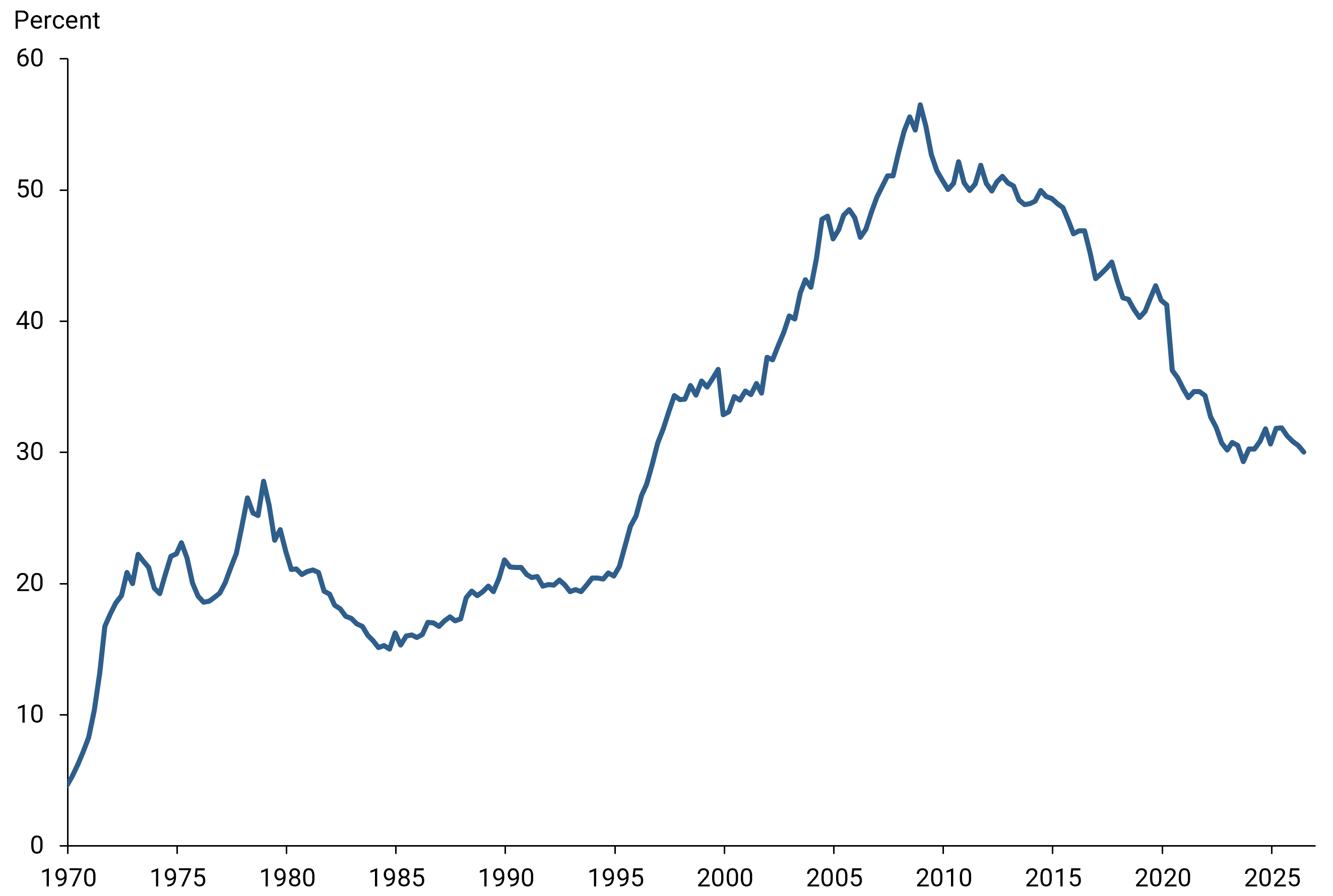
Note: Treasury securities held by the “rest of the world” divided by Treasury securities held by “all sectors,” as defined by the Board of Governors of the Federal Reserve System.
Source: Board of Governors of the Federal Reserve System.
Figure 2
Foreign govt. share of foreign demand for Treasuries
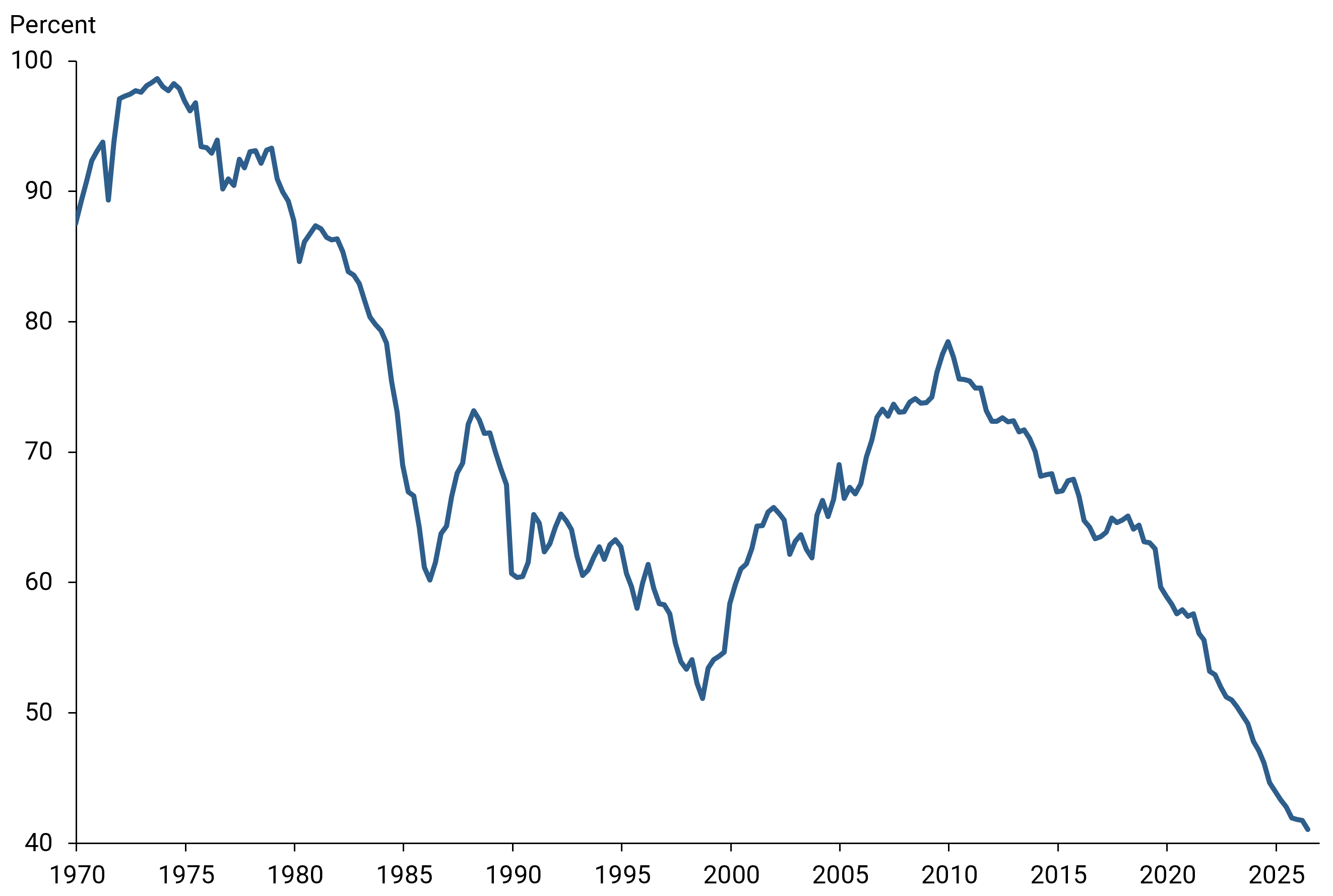
Source: Board of Governors of the Federal Reserve System.
Stablecoin issuers’ demand for Treasury securities
Investors’ interest in digital assets has risen dramatically since the first Bitcoin transaction in 2009. Some types of digital currencies allow holders to receive instantaneous and final payments on distributed ledgers, for example, blockchains, when using these assets for digital platform transactions. However, the values of these cryptocurrencies are subject to large fluctuations, which makes them less viable as a stable store of value for users.
In contrast, stablecoin issuers aim to maintain a fixed parity, typically one-to-one, with a specific national currency or a basket of national currencies, with the goal of providing a more stable store of value. As a result, investors in stablecoins should be able to redeem their holdings at par value against the specific currency, in most cases the U.S. dollar. Stablecoin issuers thus may also inherit standard problems associated with fixed exchange rate regimes. For example, if stablecoin investors start doubting whether they can redeem their holdings at the par value, stablecoin issuers could be subject to runs. To protect against this possibility, stablecoin issuers typically hold historically safe and liquid financial assets to fulfill investors’ demand to convert stablecoins back into dollars.
A similar issue arises for banks. They accept deposits that they partly lend to firms and households or invest in other products. Since depositors can demand their deposits back at any time, banks need to have sufficient funds on hand to meet these demands. If depositors doubt a bank’s ability to do so, a run on the bank may occur. As a result, through banking regulations and deposit insurance, banks are required to hold sufficient liquidity to minimize the probability of bank runs.
The GENIUS Act adopted in 2025 provides a regulatory framework for stablecoins. It will require that domestic issuers approved under the Act back stablecoin issuance one-to-one with high-quality liquid assets, such as Treasury bills.
As of mid-August 2026, the largest stablecoins are Tether and USD Coin, estimated to make up more than 80% of the market capitalization. Both stablecoins offer a one-to-one convertibility to the U.S. dollar. To support this convertibility, the issuers of these two stablecoins hold a large fraction of their assets in short-term Treasury securities. However, they also hold cash, bank deposits, and other types of assets such as repurchase agreements.
Given the growth of these two stablecoins, their holdings of Treasury securities have grown more than tenfold over the past five years, largely surpassing the growth in U.S. Treasury bills holdings of foreign governments.
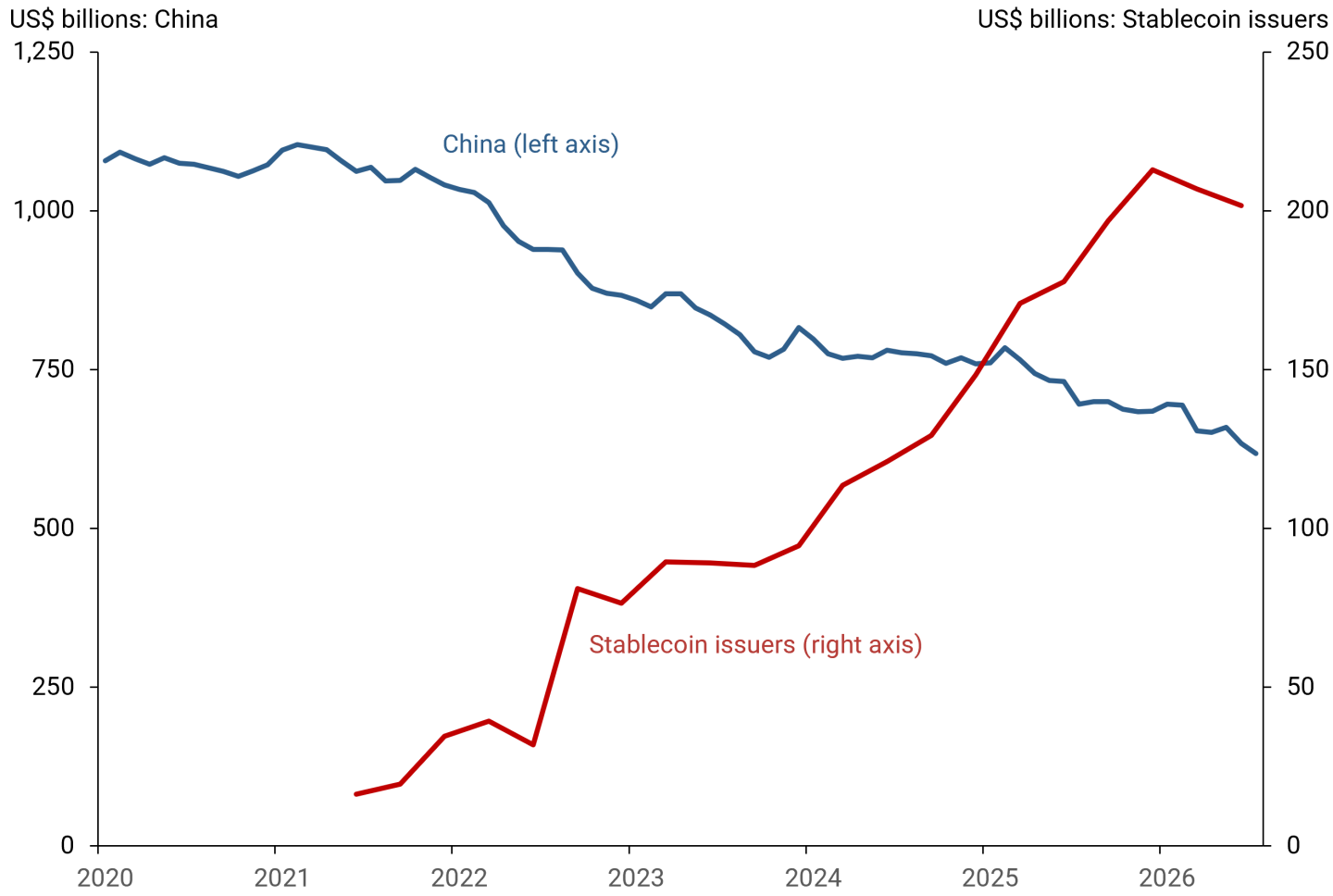
Importantly, the increase in stablecoin issuers’ demand for U.S. debt could help counterweigh the declining demand from China, as shown in Figure 3. Over the past five years, stablecoin issuers have increased their Treasury security holdings by about $200 billion, that is, more than 40% of the decline in China’s holdings over the same period.
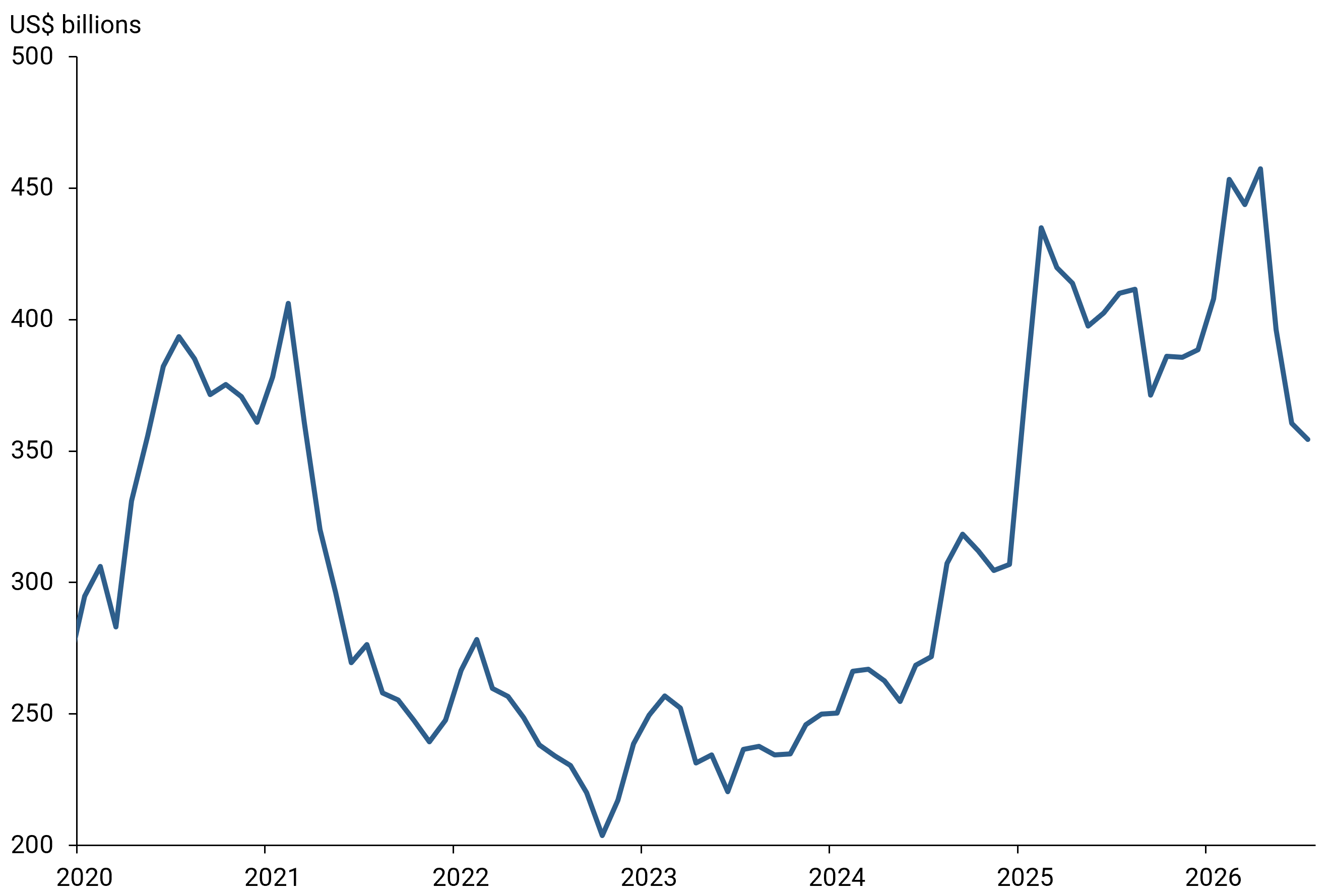
However, the decline in China’s holdings of U.S. debt is mostly in the form of longer-term debt, while stablecoin issuers are increasing their holdings of short-term Treasury securities. As such, the demand for short-term Treasury securities coming from stablecoin issuers has added to a pickup in demand for Treasury bills by foreign governments since 2023 (Figure 4). This change has been largely driven by Japan, the largest non-U.S. holder of Treasury securities. Notably, since 2023, stablecoin issuers have increased their holdings of short-term Treasury securities more than Japan.
Figure 3
Treasury holdings: Stablecoin issuers vs. China
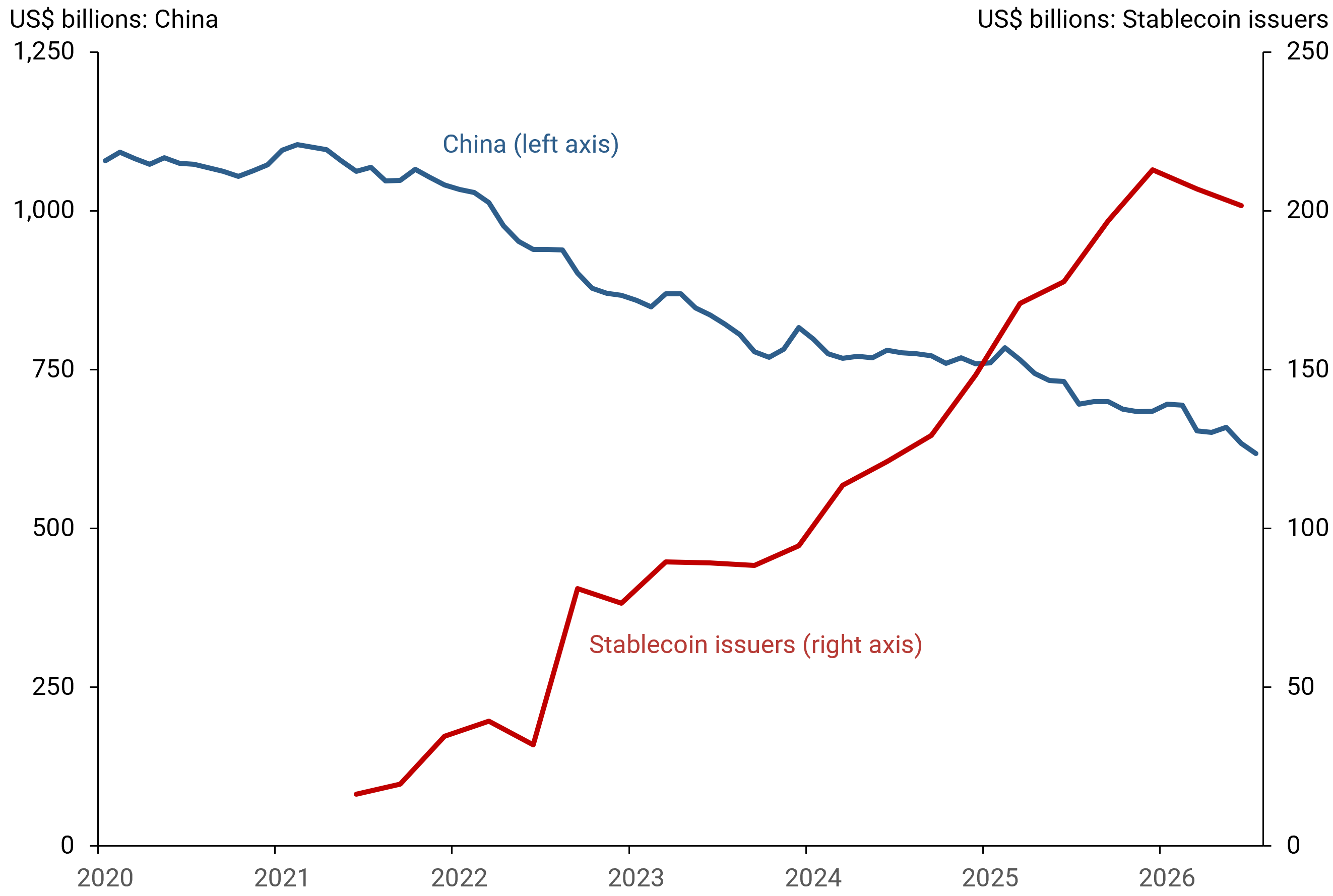
Source: U.S. Treasury, Tether, and Circle Internet Financial.
Figure 4
Treasury bills held by foreign official institutions
A simple projection
The demand for Treasury securities coming from stablecoin issuers will depend on the growth of stablecoin adoption worldwide and on the mix of investors. That is, stablecoins could attract new investors who do not currently hold Treasury securities, or they could offer current holders an alternate vehicle to continue holding Treasury securities indirectly. Stablecoins are partly used to facilitate transactions in digital assets, and their use for cross-border payments is growing according to research conducted at the International Monetary Fund (Adrian et al. 2022). Relative to GDP, stablecoin usage is higher in Africa, the Middle East, and Latin America, and most transactions are international. As such, it is likely that stablecoins reduce the cost of cross-border transactions, including remittances. In addition, stablecoins may provide a safer store of value for residents of countries where the value of the local currency is volatile (Waller 2025).
Extrapolating the recent trend in the growth of stablecoin issuers’ holdings of Treasury securities over the next five years suggests the demand for U.S. debt from this source could double to roughly $400 billion. Other studies project even stronger growth in stablecoin issuers’ demand for Treasury securities by 2030. This would make stablecoins a more noteworthy source of demand for U.S. debt instruments, though one that remains a lot smaller than the U.S. government’s financing needs.
This simple projection embeds a lot of uncertainty. Stablecoin market growth will importantly depend on regulations adopted around the world and on the introduction of competing products (Bank for International Settlements 2026). Additionally, banks may introduce new technologies that ease cross-border digital currency payments, which would compete against the use of stablecoins for such transactions.
Conclusion
This Letter examines how the demand for Treasury securities from stablecoin issuers has grown over the past five years and has partially offset declining demand from one of the largest foreign government holders, China. At shorter debt maturities, the growth in stablecoin issuers’ holdings since 2023 has been larger than that of Japan, the largest non-U.S. holder of Treasury securities. Our findings highlight that, if the recent trend in stablecoin issuers’ demand for Treasury securities were to continue, the associated demand for Treasury securities could double to about $400 billion by the end of 2030. While this increase in demand would be more noteworthy, the amount of these holdings would remain a small part of the U.S. government’s financing needs.
References
Adrian, Tobias, Federico Grinberg, Tommaso Mancini-Griffoli, Robert M. Townsend, and Nicolas Zhang. 2022. “A Multi-Currency Exchange and Contracting Platform.” International Monetary Fund Working Paper 2022/217 (November 3).
Bank for International Settlements. 2026. Annual Report 2025/26. (June 28, 2026).
Chari, Anusha, Gian Maria Milesi-Ferretti. 2026. “The United States and Its Creditors: Assessing Foreign Demand for U.S. Assets.” Hutchins Center Working Paper 111 (August 12), Brookings Institution.
Department of the Treasury, Federal Reserve Bank of New York, and Board of Governors of the Federal Reserve System. 2025. “Foreign Portfolio Holdings of U.S. Securities as of June 28, 2024.” Department of the Treasury, April.
Waller, Christopher J. 2025. “Reflections on a Maturing Stablecoin Market.” Member, Board of Governors of the Federal Reserve System, Speech at A Very Stable Conference, San Francisco, CA (February 12).
Foreign official holdings have dropped from nearly 100% of total foreign demand in the 1970s to just above 40% today. A major driver is portfolio diversification by foreign governments. For example, the Chinese government has cut its U.S. Treasury holdings by more than half since late 2013 to spread its official reserves across a broader variety of global assets.
To maintain a 1:1 conversion rate with the U.S. dollar and guard against token runs, stablecoin issuers (like Tether and Circle) must back their supply with safe, highly liquid assets. They heavily favor short-term U.S. Treasury bills (T-bills) because they offer immediate liquidity, minimal duration risk, and positive yield, satisfying statutory requirements like the GENIUS Act of 2025.
Not entirely, but it provides a meaningful offset in specific debt maturities. Over the past five years, stablecoin issuers accumulated ~$200 billion in Treasuries—offsetting over 40% of the decline in China’s holdings over the same period. However, while foreign central banks traditionally purchased long-term bonds, stablecoin issuers almost exclusively buy short-term T-bills.
If recent adoption trends continue, stablecoin issuers’ demand for short-term Treasury bills is projected to nearly double to roughly $400 billion by the end of 2030. While this will make them a noteworthy class of private institutional buyers, $400 billion remains a fraction of total U.S. government financing needs.
Unlike central banks that hold Treasuries for foreign exchange reserves, stablecoin issuers are private actors subject to market runs, crypto market volatility, and regulatory changes. If a stablecoin faces mass redemptions, the issuer would be forced to rapidly liquidate T-bills, potentially triggering short-term liquidity shocks and volatility in money markets.

Suresh holds a Master of Commerce (M.Com) degree and is a dedicated personal finance researcher and writer. Combining his advanced academic background in commerce with deep industry research, he covers complex topics like taxation, banking systems, credit analysis, and personal finance strategies. As the founder of Tax Assistant (taxassistant.org), Suresh is committed to translating complicated financial guidelines and economic data into simple, accurate, and actionable educational resources for everyday readers.