Knowing how to calculate interest on savings accounts can help you predict how much you can earn every month on your balance. You can manually calculate savings account interest using the simple interest formula (A = P * R * T) or compound interest formula (A = P(1 + R/N)ᴺᵀ). But don’t worry if you’re not a math whiz: You can also simply input a few key details into an online savings calculator to see your results.
Let’s take a closer look at the calculation and some ways to earn a higher interest rate on your savings.
How to calculate interest on savings accounts
There are some important terms to know related to calculating interest on a savings account. A few key terms include:
- Interest rate: This is the percentage of your savings that the bank pays you in interest over a specific period (usually one year).
- Annual percentage yield (APY): The annual percentage yield is the amount of interest customers earn over one year when compounding frequency is factored in.
- Compound frequency: This refers to how often the financial institution compounds interest on an account. It may be compounded yearly, semi-annually, quarterly, monthly, weekly, or daily. The more often interest is compounded, the faster the balance will increase. Many savings accounts offer daily compounding interest.
- Principal: This is the starting balance you contribute to a savings account before interest accrues. For instance, if you open your account by depositing $1,000, this amount is the principal.
How to calculate simple interest on a savings account
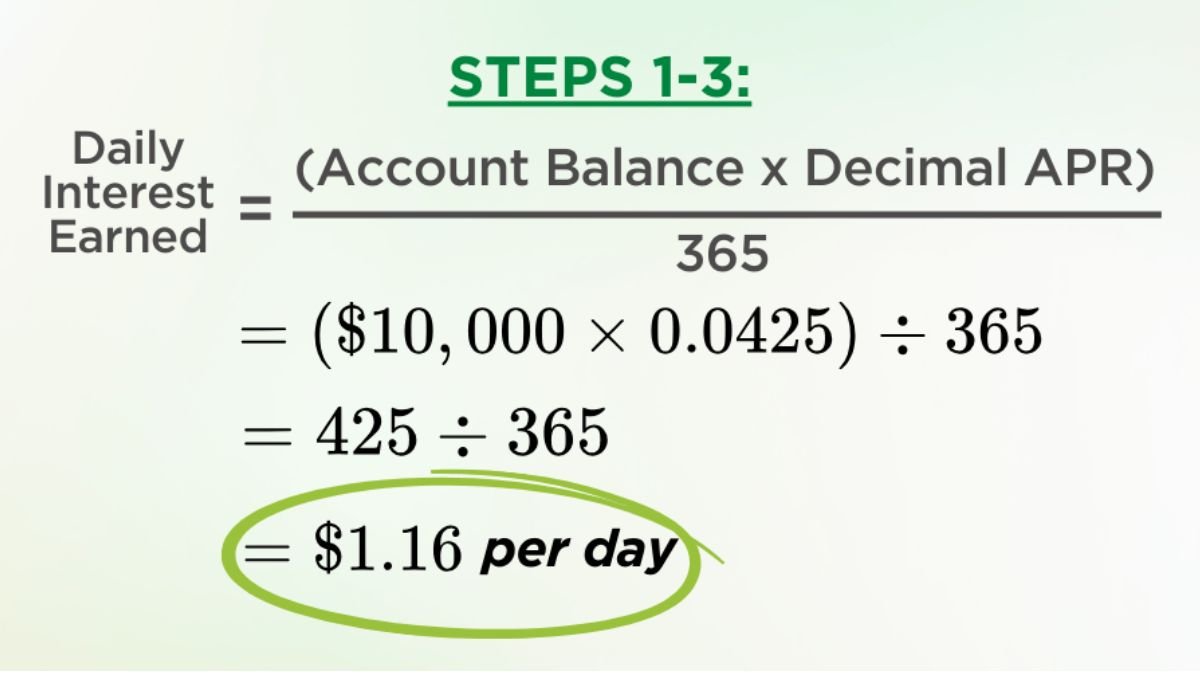
Calculating interest on a savings account involves a simple formula that includes the account balance, the interest rate, and how long the money is deposited. The formula for calculating simple interest is:
A = P * R * T
- A = Ending account balance
- P = Principal or starting balance
- R = Interest rate (usually expressed as an annual rate)
- T = The number of years the money is in the account
For instance, suppose you have $5,000 in a savings account with a 3.5% annual interest rate. To find out how much your principal balance would earn in one year, you’d use the following formula:
A = 5,000 * 0.035 * 1
This results in an annual interest amount of $175. To break down interest earnings by month, you can divide the ending amount by 12, which results in a monthly interest payment of $14.58.
Again, this formula is a simple interest calculation. However, most savings accounts have compound interest. That means the interest you earn is regularly added to the account balance so that interest also begins earning interest, creating a snowball effect.
How to calculate compound interest on a savings account
The formula for compound interest on a savings account is more complex than the simple interest formula, but it’s still relatively straightforward:
A = P(1 + R/N)ᴺᵀ
- A = Ending account balance
- P = Principal or starting balance
- R = Interest rate (APY)
- N = The number of times the account compounds per year
- T = Number of years
To see compound interest in action, let’s take a quick look at an example calculation.
Using the same numbers from earlier, suppose you deposit $5,000 in a savings account that earns 3.5% APY. You leave the money in the account for one year, and interest compounds daily.
In this example, the compound interest calculation is:
A = 5,000(1 + 0.035/365)¹ * ³⁶⁵
This gives you an ending balance of $5,178.09, including $178.09 in interest. This is slightly more interest than you would receive with a simple interest rate.
Tips for getting a higher savings account rate
There are several ways you can get a higher savings account rate. Here are a few tips that can help you earn more interest:
- Switch to a high-yield savings account: These accounts generally pay much higher rates than traditional savings accounts, allowing you to earn more interest on your deposits. You can see our picks for the best high-yield savings accounts here.
- Compare rates: Many high-yield savings accounts are available, and some pay higher rates than others. While earning a fraction of a percentage won’t make a huge difference in most cases, it can sometimes be worth considering. And some high-yield savings accounts currently offer 4% APY or more.
- Maintain a high account balance: Some savings accounts have tiered rate structures, where higher account balances earn a higher rate. If your account has tiered rates, keep more money in your account to increase your interest rate.
- Look for interest cutoffs: Some savings accounts only earn interest up to a certain balance. Try to avoid keeping money in these accounts past the upper threshold for interest earnings.
- Monitor interest rates: Interest rates tend to change frequently. While most financial institutions adjust their rates at roughly the same time and in the same direction, your interest rate could become less competitive over time. Keep an eye on rates at different institutions to ensure you are still earning a good APY.
- Consider a CD: Certificates of deposit (CDs) allow you to lock in yields for long periods — typically, one to five years. This is useful in periods when interest rates are falling. However, you usually must keep your money in the account for the entire period to avoid penalties.
The interest rate is the base annual rate your bank pays on your balance, excluding compounding. APY (Annual Percentage Yield) reflects the total interest you actually earn in a year because it factor in the compounding frequency (daily, monthly, or quarterly). APY provides a more accurate picture of your annual earnings.
The more frequently interest compounds (e.g., daily versus annually), the faster your account balance grows. When interest compounds daily, the interest earned each day is added to your principal, meaning you earn interest on top of interest sooner.
A High-Yield Savings Account (HYSA) functions like a regular savings account but offers a significantly higher APY—often 4% or more compared to the national average for traditional brick-and-mortar accounts, which is often around 0.40% to 0.50%.
Most savings account interest rates are variable, meaning financial institutions can raise or lower them at any time based on market conditions and central bank rate adjustments. To lock in a fixed interest rate for a specific timeframe, consider a Certificate of Deposit (CD).
Yes, most CDs charge an early withdrawal penalty—typically calculated as a few months’ worth of interest—if you transfer or cash out your funds before the agreed maturity term ends.

Manoj Sharma is a Senior Writer on the banking team at Tax Assistant. He provides information on budgeting, bank accounts, the banking industry, and other related topics. Using original data and methodologies, he helps you identify the best financial institutions, accounts, and products tailored to your needs. Manoj holds a degree in Journalism and Political Science from Syracuse University. All articles are strictly reviewed and fact-checked by our panel of expert Chartered Accountants, including CA Devendra Saini, CA Nikhil Khunteta, and CA Ankit Goyal