Following the passage of the One Big Beautiful Bill Act (OBBBA), the federal Child Tax Credit (CTC) has structural changes that permanently alter how families claim this break. If you are planning your finances for the upcoming tax season, the temporary expansions from past pandemic-era relief remain gone, replaced by a permanent baseline.
The fundamental breakdown covers the 2026 credit amounts, strict identification rules, and how phase-outs affect your potential refund.
1. Credit Amounts & The “Refundability” Split
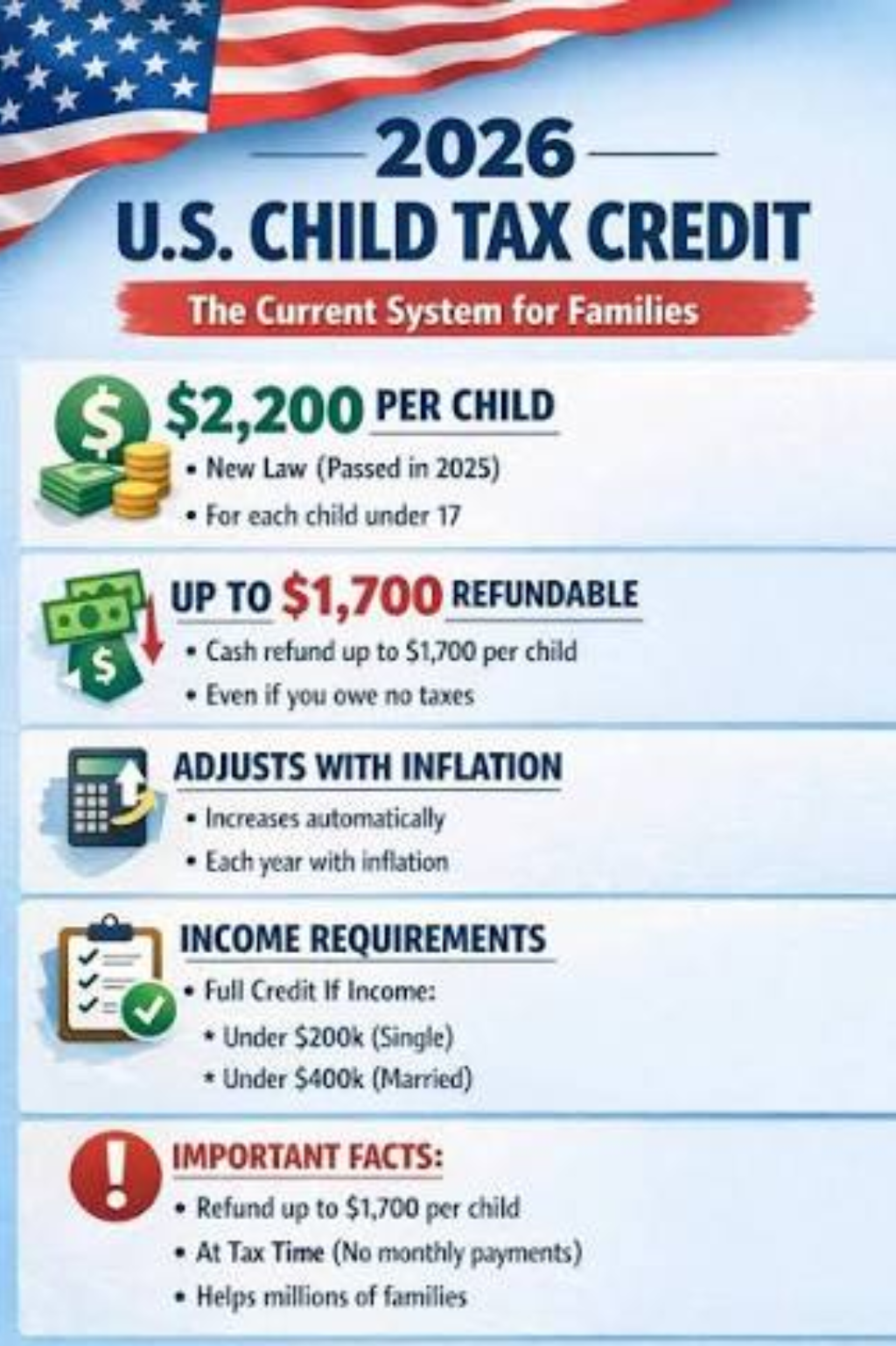
The absolute maximum child tax credit amount 2026 is $2,200 per qualifying child under the age of 17.
However, because the credit is split into two distinct financial categories, you may not receive the full amount back in cash if you have a low federal income tax liability.
Read More…How to Track Your Tax Refund in 3 Easy Steps
- The Nonrefundable Portion ($500): This chunk can lower your federal income tax bill dollar-for-dollar. If your tax bill drops to $0, any leftover amount from this $500 cannot be given to you as a cash refund.
- The Refundable Portion (Up to $1,700): Formally known as the Additional Child Tax Credit (ACTC), this is the maximum amount you can get back as a refund check even if you owe $0 in federal income taxes.
Note: Starting in 2026, the maximum $2,200 baseline and the $1,700 refundable cap are officially indexed to inflation, meaning these amounts will adjust slightly upward in future tax years.
2. Stricter New Eligibility Rules
To claim the credit, dependents must clear standard IRS checks. Crucially, the OBBBA implemented rigid documentation rules that heavily impact mixed-status households.
The Age & Living Requirements
- The Age Limit: The child must be 16 or younger on December 31st of the tax year. The moment a child turns 17, they age out of the $2,200 credit.
- Residency: The dependent must live with you for more than six months out of the year (exceptions apply for temporary absences like school, military deployment, or hospital stays).
- Financial Support: The child cannot provide more than half of their own financial support.
Strict Social Security Number (SSN) Mandate
The IRS has eliminated standard work-arounds for tax identification:
- For the Child: The dependent must have an SSN valid for employment issued before the tax filing deadline. An ITIN (Individual Taxpayer Identification Number) no longer qualifies a child for the CTC.
- For the Filer: The taxpayer claiming the child must also possess an employment-authorized SSN. If you file a joint return, at least one spouse must have a valid SSN. Taxpayers who file exclusively using an ITIN can no longer claim the CTC.
3. High-Income Phase-Outs & Low-Income Floors
Your Modified Adjusted Gross Income (MAGI) dictates how much of the credit you actually keep.
High-Income Reductions
The credit phases out for higher earners. The benefit drops by $50 for every $1,000 your MAGI exceeds these permanent limits:
- Married Filing Jointly: Phase-out starts at $400,000
- Single / Head of Household: Phase-out starts at $200,000
The Lower-Income Phase-In (The Floor)
To get any cash back from the refundable $1,700 portion (ACTC), a family must earn at least $2,500 in a year. The refund phases in at a rate of 15% on any earned income above that $2,500 floor.
Calculation Examples:
- Scenario A (Full Refund): A single parent earns $25,000. Their earnings above the floor are $22,500 ($25,000 minus $2,500). Calculating 15% of $22,500 equals $3,375. Because $3,375 is higher than the $1,700 refundable cap, they receive the full $1,700 refund.
- Scenario B (Partial Refund): A parent earns $8,000. Their earnings above the floor are $5,500 ($8,000 minus $2,500). Calculating 15% of $5,500 equals $825. Their refund is capped at $825, missing out on the rest of the $1,700 match.
4. Payment Schedule: No Advance Monthly Checks
The monthly advance payment program utilized in previous years has not been brought back.
The 2026 Child Tax Credit is distributed entirely as a single lump sum when you file your annual federal tax return. Keep in mind that federal law requires the IRS to hold all tax refunds containing the refundable ACTC until mid-February to screen for fraud. Most early filers can expect their funds to land in bank accounts by early March.
Have Older Kids? Dependents who are 17 to 18 years old, or full-time college students aged 19 to 23, do not qualify for the $2,200 credit. However, you can claim them under the Credit for Other Dependents (ODC), which grants a flat, nonrefundable $500 credit per dependent.
A: Unfortunately, no. The IRS evaluates eligibility based on your child’s age on December 31st. If your child celebrates their 17th birthday at any point during the year—even if it is on December 31st—they no longer qualify for the main $2,200 Child Tax Credit. However, you do not lose out completely; you can still claim them for the flat, nonrefundable $500 Credit for Other Dependents (ODC).
A: Under the strict rules introduced by the One Big Beautiful Bill Act (OBBBA), you no longer qualify. Previously, only the child was required to have an SSN. Now, the IRS explicitly requires both the qualifying child and the primary taxpayer claiming the credit to possess a valid, employment-authorized Social Security Number. If you only have an ITIN, you cannot claim the CTC or its refundable portion.
A: No, you will not receive the full $2,200. Because the credit is split into nonrefundable and refundable portions, a tax liability of zero means the first $500 nonrefundable chunk disappears. You are left with the refundable portion (the Additional Child Tax Credit), which maxes out at $1,700 per child. Furthermore, remember that to get that $1,700 refund, you must have earned at least $2,500 in income, and the refund phases in gradually based on your total earnings.

Suresh holds a Master of Commerce (M.Com) degree and is a dedicated personal finance researcher and writer. Combining his advanced academic background in commerce with deep industry research, he covers complex topics like taxation, banking systems, credit analysis, and personal finance strategies. As the founder of Tax Assistant (taxassistant.org), Suresh is committed to translating complicated financial guidelines and economic data into simple, accurate, and actionable educational resources for everyday readers.