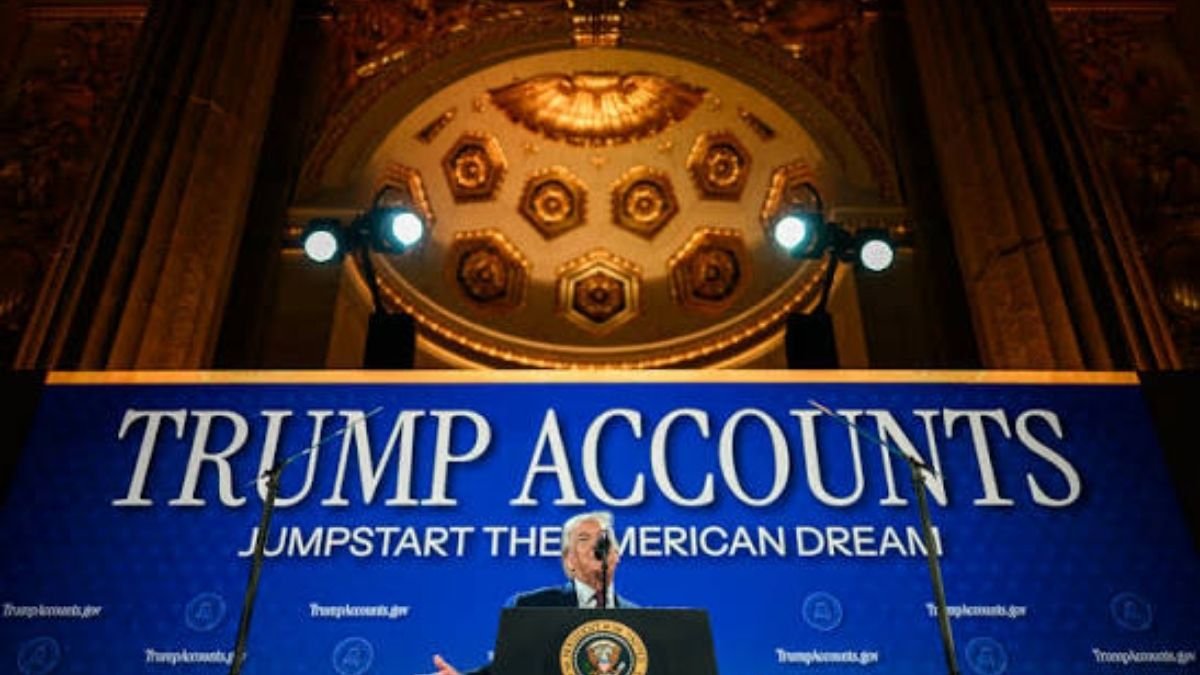
Millions of Trump Accounts, the new savings accounts for children, will be funded with an initial $1,000 deposit from the U.S. Treasury. So far, nearly three dozen companies and philanthropists have pledged to match that seed money with their own donations.
Experts say savings accounts, along with employer contributions, could help reframe the conversation about saving early for children’s futures.
How Trump Accounts work
While any child under 18 with a Social Security number can establish the IRA-like savings account, only those born between Jan. 1, 2025, and Dec. 31, 2028, get a $1,000 deposit directly from the government as one-time seed money.
Parents and their employers, family members, friends — really anyone — can contribute up to $2,500 per year, beginning on July 5, with a $5,000 annual cap on contributions.
Charitable organizations and state governments can also make contributions, which do not count against the annual limit. So far, Treasury Secretary Scott Bessent says 20 U.S. states are working to meet the administration’s “50 State Challenge” to help fund the accounts.
Nearly three dozen companies and philanthropists have pledged to match donations. Below is an updated list. Each company’s matching contribution may vary.
Companies pledging matching funds to Trump Accounts
Financial
- Acorns
- Bank of America
- Bank of New York Mellon Corporation
- BlackRock
- Charles Schwab
- Chime
- Citi
- Empower
- Franklin Templeton
- Investment Company Institute
- JPMorgan Chase
- Mastercard
- Robinhood
- Russell Investments
- SoFi Technologies
- State Street
- Visa
- Wells Fargo
Tech
- Block, Inc.
- Broadcom
- Coinbase
- Dell Technologies
- IBM
- Intel
- Micron ($250 million investment)
- Nvidia
Consumer/Corporate
- American Airlines (per CNBC)
- Charter Communications
- Chipotle Mexican Grill
- Comcast
- Continental Resources
- Rupert Murdoch’s News Corp. and Fox Corp.
- Steak ‘n Shake
- Turning Point USA
- Uber
Nonprofits and philanthropists
- Michael and Susan Dell are providing eligible children aged 10 and under who live in ZIP codes with a median income of $150,000 or less a contribution of $250. The commitment is estimated at $6.25 billion.
- Hedge fund founder Ray Dalio and his wife, Barbara, pledged $250 each to about 300,000 children living in Connecticut ZIP codes in households with median incomes below $150,000.
- Altimeter Capital CEO Brad Gerstner said he would donate $250 to each Indiana child under 5 who has a Trump account.
- Rap artist and songwriter Nicki Minaj has pledged $150,000 to $300,000 to the Trump accounts of her fans’ children.
Will matching money initiatives for Trump Accounts truly spark American savings?
Lindsey Stanberry, family financial advisor for Babylist.com, an online resource for growing families, says that Trump Accounts may serve as an opportunity to “shift the conversation” in helping families save for their children’s futures as early as possible.
She notes that the employer-matching feature works much like a 401(k) plan.
“Adding the cash incentive could encourage more families to prioritize investing in these accounts,” Stanberry said. “While the goal of these accounts is to help build wealth for all American children, ultimately, it will be easier for families who have access to employer matching programs.”
She hopes to see “a growing wave of corporate participation,” and that employers will support both full-time and hourly employees.
Other child savings accounts to consider
IRAs, 529 plans, and education savings accounts are already options for families to consider, in addition to the new Trump Accounts.
“Trump Accounts and 529 accounts are similar in that the money in them can be used to pay for college, but with a Trump Account, your child could also use the money to buy a home, or they could hold on to it to use in retirement,” Stanberry noted.
529 accounts have much higher contribution limits, and investment earnings aren’t taxed when used to pay for qualified education expenses. Meanwhile, taxes are paid on the investment earnings in Trump Accounts when you withdraw the money, just as with traditional IRAs.
“I think of these like tools in a toolbox, and you don’t have to choose just one,” Stanberry added. “Families can open a Trump Account to take advantage of the $1,000 seed money and any employer match while also contributing to a 529 to maximize their child’s educational funding.”
Babylist.com has a page comparing Trump Accounts and 529s that can help you navigate the differences.
Any U.S. citizen child born between January 1, 2025, and December 31, 2028, is eligible for the one-time $1,000 Treasury contribution. Older children under 18 with a valid Social Security number can still open a Trump Account to receive employer, family, state, or donor contributions, but they do not receive the initial federal deposit.
The overall annual contribution limit is $5,000 per child. Parents, family members, and friends can contribute to this total. Employers can contribute up to $2,500 per year tax-free as part of an employee benefit, which counts toward the $5,000 maximum. Contributions from qualifying nonprofits, state governments, and corporate pledge matches do not count against this annual cap.
Funds are locked in broad index tracking funds until the child turns 18 years old. After reaching age 18, the account transitions into a Traditional IRA structure. The beneficiary can use the money for qualified higher education expenses, buying a first home, or starting a business, or keep the funds invested for retirement.
Unlike 529 plans, where investment growth and withdrawals are completely tax-free when used for qualified education expenses, Trump Accounts are taxed upon withdrawal. Investment earnings inside a Trump Account grow tax-deferred, and taxes are paid at the beneficiary’s ordinary income rate when withdrawals occur in adulthood.
Nearly three dozen major companies and philanthropists (such as Michael & Susan Dell, Ray Dalio, and Brad Gerstner) have pledged matching funds. Corporate employer matches are typically processed via payroll contributions, while targeted philanthropic pledges are automatically applied to accounts based on qualifying criteria like location (ZIP codes) or median household income.

Manoj Sharma is a Senior Writer on the banking team at Tax Assistant. He provides information on budgeting, bank accounts, the banking industry, and other related topics. Using original data and methodologies, he helps you identify the best financial institutions, accounts, and products tailored to your needs. Manoj holds a degree in Journalism and Political Science from Syracuse University. All articles are strictly reviewed and fact-checked by our panel of expert Chartered Accountants, including CA Devendra Saini, CA Nikhil Khunteta, and CA Ankit Goyal
