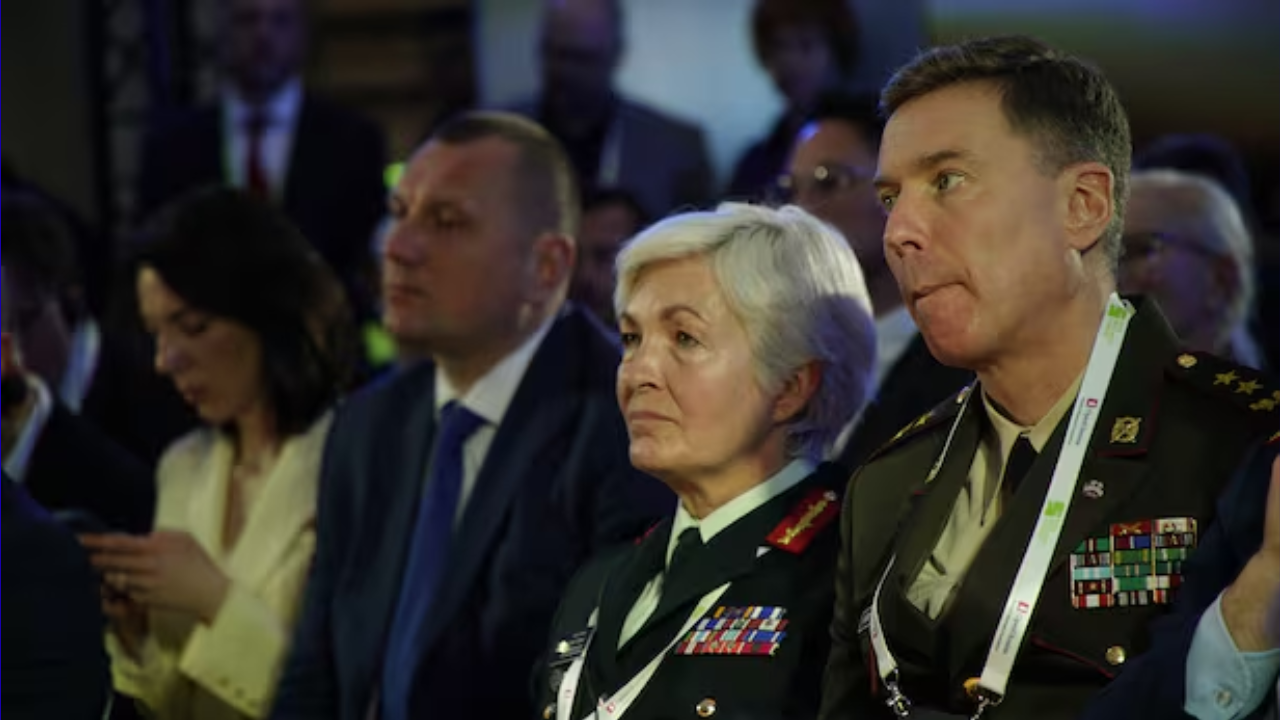
Amidst a backdrop of heightening tensions within the NATO alliance, General Jennie Carignan, Canada’s Chief of the Defence Staff, made a high-profile visit to Kyiv on April 23, 2026. Her mission was clear: to stabilize Ukraine’s confidence in Western support as political shifts in North America and Europe create new uncertainties.
Thank you for reading this post, don't forget to subscribe!“Operational Stability” Amidst Political Noise
Addressing the Kyiv Security Forum, Carignan acknowledged the current “bumpy” geopolitical landscape but urged Ukrainian officials to focus on military continuity rather than political headlines.
- Downplaying U.S. Exit Fears: In discussions with CBC News, Carignan expressed skepticism regarding a full U.S. withdrawal from NATO. From her vantage point, the alliance is “realigning” rather than retreating, despite the more critical stance currently taken by the Trump administration.
- The Military Anchor: She reinforced that while political leadership may fluctuate, the military-to-military bonds and planning within NATO remain the bedrock of the defense strategy.
Operation Unifier: Adapting to a New Reality
The visit highlighted a significant shift in Canada’s Operation Unifier (now extended through 2029). As the conflict matures, the nature of Canadian assistance is evolving to match the high level of Ukrainian expertise:
- From Students to Leaders: Canada is moving away from basic training to a “train the trainer” model. Canadian personnel are now teaching Ukrainian veterans how to design curriculum and lead instruction themselves.
- Decentralized Training: Instruction is increasingly occurring within Western Ukraine and directly inside combat brigades to ensure the training remains relevant to the evolving front-line conditions.
The 2026 Geopolitical Crossroads
Carignan’s reassurance comes as NATO grapples with several internal and external pressures:
- The Membership Question: NATO Secretary General Mark Rutte recently signaled that the 32 member nations still lack the necessary consensus to offer Ukraine a formal invitation, even as they affirm the country’s long-term membership is “irreversible.”
- U.S. Policy Shifts: Uncertainty surrounding U.S. funding and the future of international nuclear treaties has forced allies to weigh the possibility of a “European-led” NATO framework.
- A Bridge of Solidarity: By visiting Kyiv during this friction point, Carignan positioned Canada as a steadying force, signaling that Ottawa’s commitment is not contingent on the consensus of larger powers.
Ultimately, Carignan’s message was one of resilience: political turbulence is expected, but the operational defense of Ukraine remains a fixed priority for the Canadian Armed Forces.

"Suresh Kumar Saini is an experienced Tax Assistant and finance writer. He specializes in US & Canada Tax Guide, Indian Income Tax laws, GST compliance, and personal finance, helping freelancers and remote workers optimize their taxes."