ABA routing numbers — also known as bank routing numbers — are nine-digit numbers that identify a specific U.S. bank or credit union when money is transferred between financial institutions. They ensure your checks and electronic transactions are processed in a speedy and cost-effective manner.
You don’t need to memorize your bank’s ABA routing number, but you do need to have it handy for certain occasions. Here’s when you may need your routing number, and how to find it.
What is a bank ABA routing number?
ABA routing numbers are nine-digit codes that identify financial institutions. These numbers are part of a standardized system designed by the American Bankers Association (ABA) in 1910 to make sure that check transactions went through to the right banks.
Today, only 3% of payments are made with checks, but ABA routing numbers are still widely used to facilitate both check and electronic transactions.
Every ABA routing number is formatted as follows:
- Digits 1-4: The routing number for the Federal Reserve district. The first two digits always start with between 00 and 12.
- Digits 5-8: The identity of the financial institution.
- Digit 9: The check digit, which verifies the authenticity of the routing number.
Do I need to memorize my bank’s ABA routing number?
You don’t need to memorize your bank’s ABA routing number, but you will need to look it up once in a while. Without both your account number and your bank’s ABA routing number, you can’t set up these essential transactions:
- Wire transfers
- IRS tax refunds
- Loan applications
- Online bill payments
- Automatic withdrawals
- Transferring funds
- Re-ordering checks
- Direct deposits from your employer or Social Security
How to find your bank’s ABA routing number
To find your bank’s ABA routing number, you can log in to your bank account through your browser or banking app, then select the account and look for the information.
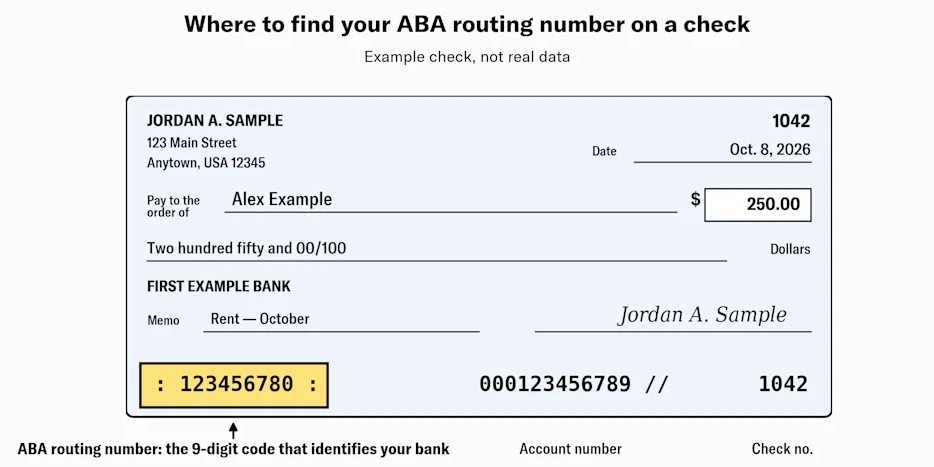
ABA routing numbers, which are sometimes called check routing numbers, are also printed on the checks issued to you by your bank, deposit slips, and bank statements.
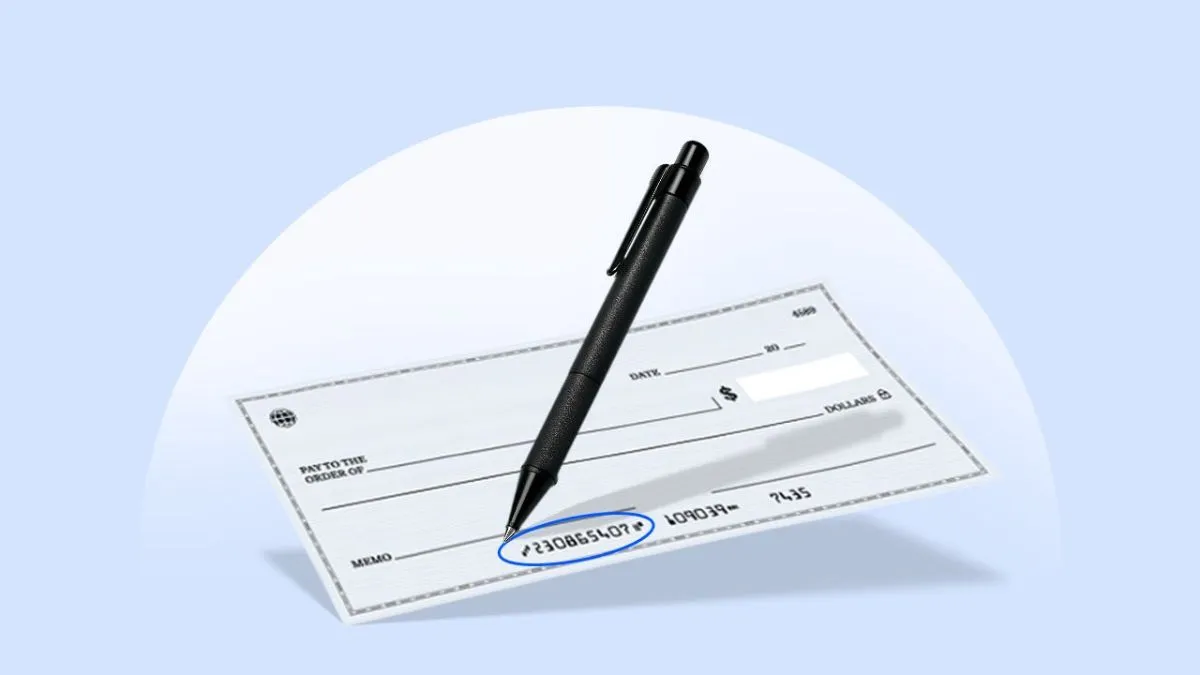
On a check, the routing number is the first series of numbers you see on the bottom, left-hand corner of the front side. The numbers that follow it are your account number and check number, respectively.
Additionally, you can look up the number by using the ABA’s Routing Number Lookup tool — but you might end up finding the wrong number. That’s because large banks have multiple routing numbers. For example, Bank of America uses a unique ABA routing number for each state, and the correct number depends on the state where the account was issued. So it’s best to call your bank and confirm, or look at your account-specific information.
What happens if I use the wrong ABA routing number?
If you use the wrong ABA routing number, you’ll have problems with your transaction. The transaction could be delayed, rejected, or worse: It could go through to the wrong account.
For state and federal tax refunds, your bank will likely reject the deposit, and you’ll receive the refund by check. If so, the check will be sent to the address on your tax return and addressed to the people whose names are on the return. In other scenarios, you’ll need to be more proactive.
Before the transaction goes through
If the transaction is still pending, contact the issuing institution right away. Here’s what you can do:
- Banks: For scheduled transfers, you may need to notify your bank at least three days before the scheduled date. Your bank may require a written notice.
- Merchants: If you’ve authorized a merchant to credit or debit your account, contact them to correct the information. You may need to revoke authorization for a transaction in writing and ask if you can be issued a cancellation number.
- The IRS: You can’t change your routing number after you file your tax return, but you can call the IRS at 800-829-1040 to request a check.
After the transaction goes through
If the money goes to the wrong account, you’ll have to work with the agency that received the funds to find a solution. They may be able to move the funds to the correct account or return them to the issuer, but they might require you to submit a payment reversal request.
Unfortunately, the company that received the money could also refuse to return it, in which case you might have to take legal action to recover the funds.
You can find your routing number in several places:
On a check: Look at the bottom left corner of your check—it is the first nine-digit number printed there.
Online or Mobile Banking: Log in to your bank’s app or website, select your specific account, and check the account details page.
Bank Statements & Deposit Slips: Check the summary section of your monthly statement or the bottom of a deposit slip.
Contacting Your Bank: Call customer service directly to confirm the exact routing number for your state or branch.
Yes. Large financial institutions often have multiple routing numbers assigned by state, region, or transaction type (such as wire transfers versus direct deposits). Always verify the correct number for the location where your account was opened before setting up a transaction.
ABA Routing Number: A public nine-digit code that identifies the financial institution where your account is held.
Account Number: A unique identifier that points to your specific personal or business account at that bank.
You need both numbers to set up transactions like direct deposits, wire transfers, or automatic bill payments.
If the number is incorrect, your transaction could be delayed, rejected, or sent to the wrong bank:
For Tax Refunds: The bank will usually reject the transfer, and the IRS will issue you a check by mail instead.
For Pending Transfers: Contact your bank, merchant, or the issuing party immediately to cancel or correct the details before processing completes.
For Completed Transfers: You will need to submit a payment reversal request with the receiving institution, or potentially take legal action if the recipient refuses to return the funds.
An ABA routing number follows a specific 9-digit format:
Digits 1–4: Identify the Federal Reserve district servicing the institution (the first two digits always range from 00 to 12).
Digits 5–8: Identify the specific bank or credit union.
Digit 9: A “check digit” calculated using a mathematical algorithm to verify that the routing number is legitimate.

Manoj Sharma is a Senior Writer on the banking team at Tax Assistant. He provides information on budgeting, bank accounts, the banking industry, and other related topics. Using original data and methodologies, he helps you identify the best financial institutions, accounts, and products tailored to your needs. Manoj holds a degree in Journalism and Political Science from Syracuse University. All articles are strictly reviewed and fact-checked by our panel of expert Chartered Accountants, including CA Devendra Saini, CA Nikhil Khunteta, and CA Ankit Goyal