What is the Kiddie Tax?
Officially known as the Tax Computation for Certain Children with Unearned Income, the California Kiddie Tax is an additional tax that may apply to certain children who have unearned income over $2,700. The child’s unearned income above the applicable threshold is taxed at the parent’s rate if that rate is higher than the child’s.
The additional tax is calculated on California Form FTB 3800.
You must complete Form FTB 3800 if all the following conditions apply:
- The child is:
- under age 18 at the end of the tax year, or
- age 18 at the end of the tax year and didn’t have earned income that was more than half of their support, or
- a full-time student under age 24 at the end of the tax year and didn’t have earned income that was more than half of their support.
- The child had unearned income taxable by California of more than $2,700.
- At least one of the child’s parents was alive at the end of the tax year.
- The child doesn’t file a joint return for the tax year.
The kiddie tax can catch young taxpayers off guard when filing their own returns. If they have unearned income over the limit, they may be surprised to learn they need to provide their parent’s tax information to calculate their own tax.
Common types of unearned income:
- dividends
- taxable interest
- capital gains
- taxable scholarship and fellowship grants not reported on federal Form W-2
- unemployment compensation
Other types of unearned income include rents, royalties, taxable social security benefits, pension and annuity income, alimony, and income received as a beneficiary.
If your parent isn’t required to file a CA Form 540, the additional tax calculation doesn’t apply.
Example: Parents don’t live in California and don’t file a California return
Hector is a 20-year-old full-time college student from Arizona. He established residency in California, where he attends college and works to help support himself. His parents also provide significant financial support, including help with insurance, tuition, and most of his living expenses. Hector has $3,860 of unearned income, some of which is from taxable grants he used to pay for room and board. When he gets to the California State section, he’ll make the following entries.
Step 1: Continue to the Child Unearned Income Tax screen.

Step 2: Answer the questions on the CA Tax for Children with Unearned Income screen. In our example, the parents won’t file a California tax return.
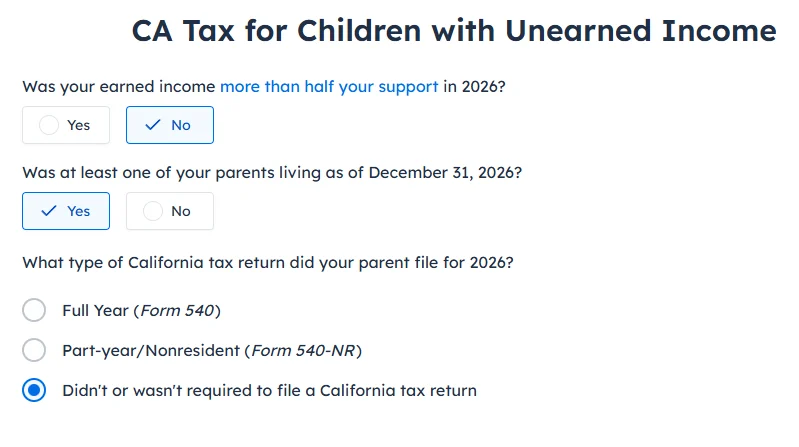
The next screen is a Summary explaining that no additional tax is calculated, and no Form FTB 3800 is required.

Example: Parents live in California
Let’s look at the same scenario, but this time Hector’s parents live in California and file a California tax return. Step 1 is the same as in the first example.
Step 2: Answer the questions on the CA Tax for Children with Unearned Income screen. In this example, the parents file a Full Year California tax return.

Step 3: On the next screen, Tell us about your CA earned income, enter earned income. This information is then used to calculate the tax on Form FTB 3800. Hector has earnings of $16,000 from his job.

Step 4: Fill in the information on the Tell us about your parent screen. In this example, the parents had other children with unearned income.

Note: If your parent doesn’t have a Social Security Number, check the “My parent doesn’t have a Social Security Number” box. An alert will appear explaining you’ll need to print and mail your California tax return.

Step 5: Fill in the information on the Tell us about your parent’s CA tax return screen. In this example, Hector’s parents are filing a joint return with $156,000 of income and $6,500 of California tax.

The last screen shows a summary of the special tax calculated, which will be reported on Form FTB 3800. Hector owes $223.

Unearned income generally includes investment-type income rather than money earned from a job. Common examples include:
Dividends and taxable interest
Capital gains (from stock sales or cryptocurrency)
Taxable scholarship or fellowship grants not reported on a W-2 (such as amounts used for room and board)
Unemployment compensation, rental income, royalties, and trust distributions
No. The Kiddie Tax only applies to unearned income. Wages, salaries, tips, and self-employment income from personal services are considered earned income and are taxed at the child’s regular tax rate, regardless of the amount.
If the parents are not required to file a California tax return (Form 540 or Form 540NR), the additional California Kiddie Tax calculation does not apply. As demonstrated in the Hector example, the child completes the California section indicating their parents do not file a California return, and no additional California tax is calculated on Form FTB 3800.
A child can have up to $2,700 in taxable unearned income before the California Kiddie Tax applies. Unearned income at or below $2,700 is taxed using standard dependent rates or standard deductions, so Form FTB 3800 is not required.
Yes, under certain conditions. Parents can elect to report their child’s unearned income on their own return using Form FTB 3803, provided the child’s income consists solely of interest, dividends, and capital gain distributions, and meets state threshold requirements. Doing so eliminates the need for the child to file Form FTB 3800, though it may alter the parent’s overall tax picture.

Suresh Saini is the Founder and Lead Financial Researcher at Tax Assistant. He holds a Master of Commerce (M.Com) degree with a specialized focus on Advanced Accountancy, providing him with a robust academic and analytical foundation in complex accounting principles, credit systems, and personal finance structures.
Driven by a passion to democratize financial literacy, Suresh has spent years analyzing and decoding shifting fiscal guidelines. At Tax Assistant, he manages the platform’s core editorial direction, transforming dense government updates and complex banking parameters into structured, clear, and actionable guides for both individual taxpayers and small businesses across North America.
Before launching taxassistant.org, Suresh conducted deep financial and market dynamics research, focusing on asset management, personal wealth optimization, and strategic tax planning. His dedication to data integrity ensures that every piece of news, breakdown, or analysis published under his leadership is rigorously fact-checked by certified tax professionals and aligned perfectly with contemporary regulatory frameworks.