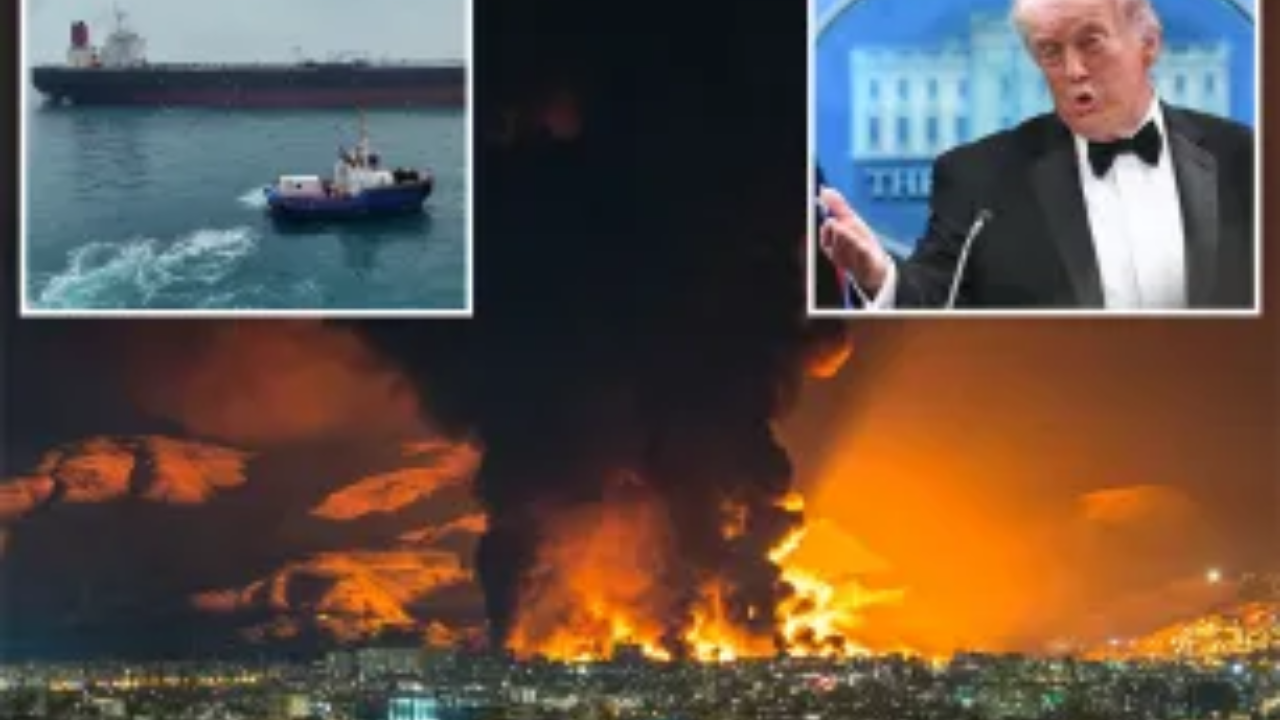
President Trump has intensified his rhetoric regarding the U.S. naval blockade of Iran, claiming that the country’s oil infrastructure could “explode” within three days. This warning centers on the technical and economic pressures mounting as Iran’s storage capacity reaches a breaking point.
Key Components of the Claim
In a statement from the Oval Office on April 24, 2026, the President outlined a scenario of catastrophic infrastructure failure driven by the following factors:
- Saturation at Kharg Island: With the blockade preventing tankers from departing, Iran’s primary storage hubs are reportedly at or near 100% capacity.
- The “Underground Failure” Theory: Trump argued that a forced, total shutdown of production—necessitated by the lack of storage—would cause irreparable geological and mechanical damage to the oil wells.
- Financial Impact: The administration estimates the blockade is currently depriving the Iranian government of roughly $500 million in daily revenue.
The State of the Blockade
The blockade, initiated by CENTCOM on April 13, 2026, has fundamentally altered the regional energy landscape:
- Logistics: U.S. forces are currently intercepting or deterring all commercial traffic attempting to access Iranian ports.
- Market Volatility: Global oil prices remain high, hovering near $120 per barrel, largely due to the “dual blockade” dynamic where Iran has also restricted passage through the Strait of Hormuz.
- Secondary Sanctions: To tighten the noose, the U.S. Treasury recently sanctioned several international shipping firms and a major Chinese refinery for violating the embargo.
Diplomatic Paradox
The situation remains volatile despite a standing ceasefire. While President Trump announced an extension of the ceasefire on April 21, he emphasized that it is contingent on Iran providing a “unified proposal” to end the conflict. Conversely, Iranian leadership has labeled the blockade an act of war, maintaining that their own regional threats remain “on the table” if the economic pressure is not lifted.

Suresh holds a Master of Commerce (M.Com) degree and is a dedicated personal finance researcher and writer. Combining his advanced academic background in commerce with deep industry research, he covers complex topics like taxation, banking systems, credit analysis, and personal finance strategies. As the founder of Tax Assistant (taxassistant.org), Suresh is committed to translating complicated financial guidelines and economic data into simple, accurate, and actionable educational resources for everyday readers.