The United States military is currently trapped in the world’s most expensive math problem. For decades, the American defense strategy relied on technological overmatch—having the biggest, smartest, and most expensive tools on the battlefield.
1. The $4 Million Dollar Mismatch
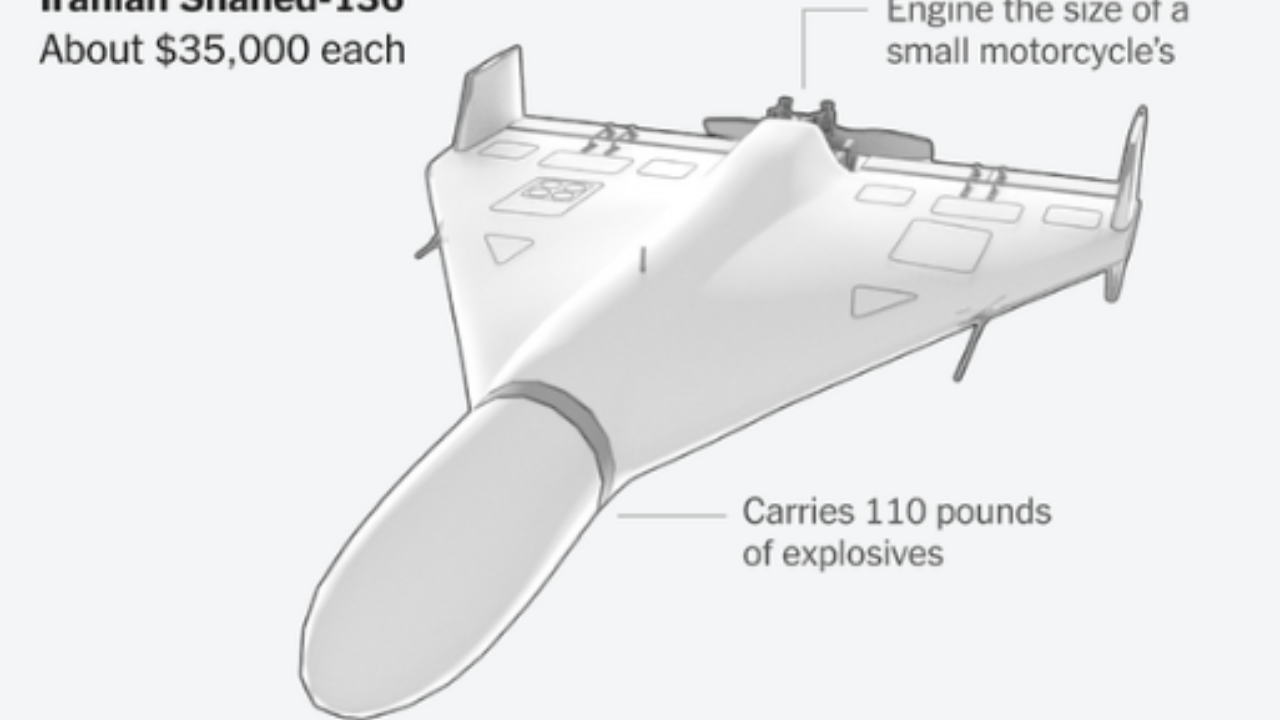
The primary weapon in Iran’s arsenal isn’t a stealth jet; it’s the Shahed-136. It is essentially a fiberglass triangle powered by a noisy moped engine.
- The Cost to Build: Roughly $20,000.
- The Cost to Kill: To ensure a 100% intercept rate, the U.S. often fires a Patriot missile (approx. $4 million) or an SM-2 (approx. $2.1 million).
The Math: The U.S. is spending 200 times more to defend a target than Iran is spending to attack it. Even if the U.S. shoots down every single drone, it is losing the “Economic War.”
2. Death by a Thousand Cuts (and Swarms)
The danger isn’t just the price tag; it’s the volume.
- Saturating the Sky: Iran doesn’t send one drone; they send fifty. If the U.S. uses its finite supply of high-end interceptors on “junk” drones, it leaves the fleet vulnerable to high-speed ballistic missiles that those interceptors were actually designed for.
- Off-the-Shelf Parts: These drones use civilian-grade GPS and engines found in lawn equipment. You cannot “sanction” a lawnmower engine out of existence, making the supply chain nearly impossible to break.
3. The 2026 Counter-Strategy: Fighting Cheap with Cheap
Realizing that firing $4 million missiles at $20,000 drones is a fast track to bankruptcy, the Pentagon has pivoted toward Asymmetric Defense:
- Directed Energy (Lasers): Systems like HELIOS are being fast-tracked. A laser shot costs about $1.00 in electricity, finally winning the cost-per-kill battle.
- Electronic Warfare: Instead of blowing drones up, the U.S. is using high-powered “jammers” to fry their cheap circuits for free.
- Coyote Interceptors: Small, reusable “kamikaze” drones that cost a fraction of a traditional missile.
The Verdict
The era of the “unbeatable” expensive weapon is over. Iran has proven that in modern conflict, quantity has a quality of its own. The U.S. is no longer just fighting for airspace; it is fighting to stop its defense budget from being bled dry by “toy” airplanes.

Suresh holds a Master of Commerce (M.Com) degree and is a dedicated personal finance researcher and writer. Combining his advanced academic background in commerce with deep industry research, he covers complex topics like taxation, banking systems, credit analysis, and personal finance strategies. As the founder of Tax Assistant (taxassistant.org), Suresh is committed to translating complicated financial guidelines and economic data into simple, accurate, and actionable educational resources for everyday readers.