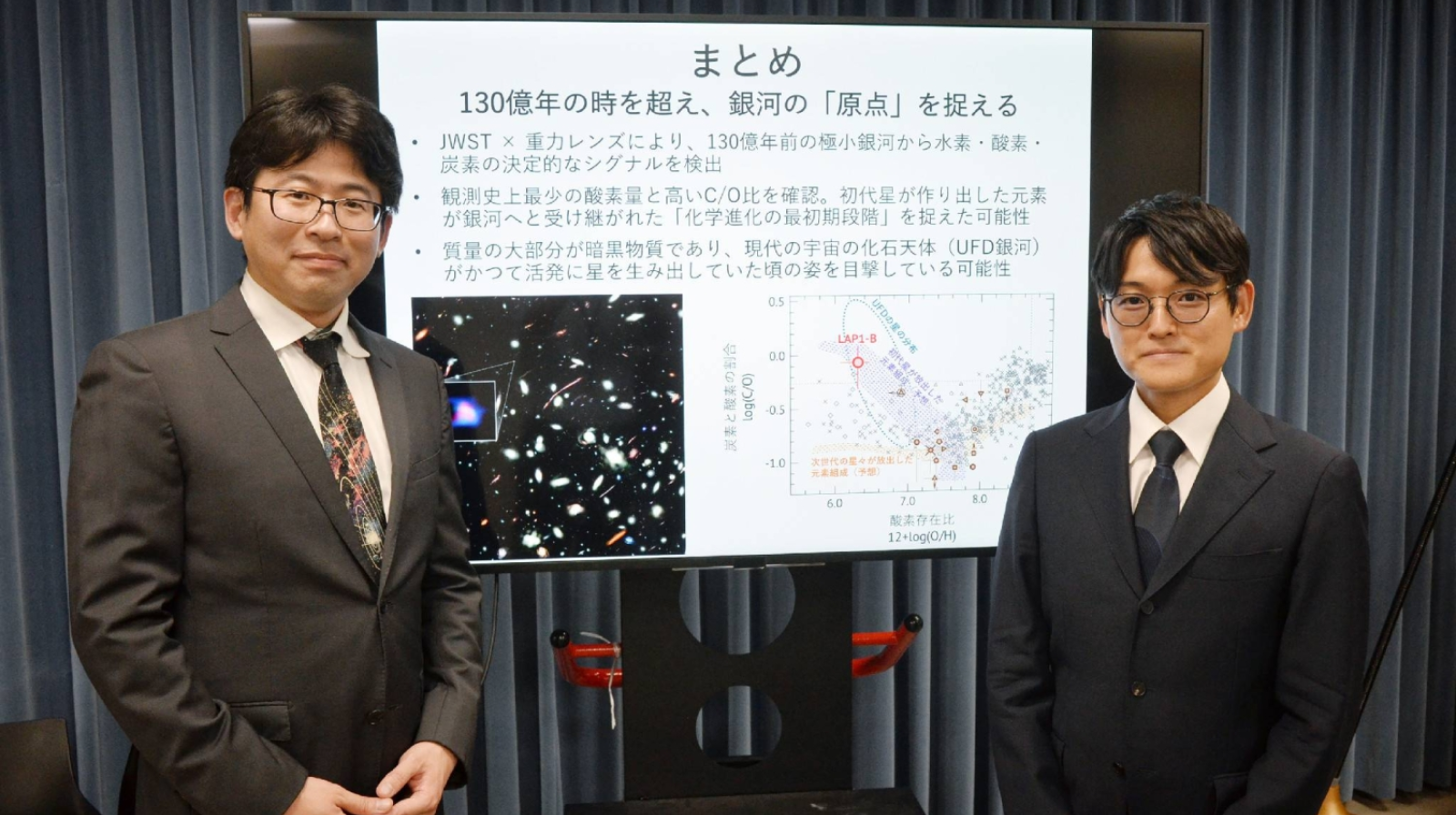
Researchers from Japan have just pulled back the curtain on the cosmic “Dark Ages,” identifying a galaxy that offers a nearly pristine look at the universe’s infancy. Using the James Webb Space Telescope (JWST), the team discovered LAP1-B, a galaxy so chemically pure it serves as a virtual time capsule from 13 billion years ago.
Thank you for reading this post, don't forget to subscribe!The Discovery: LAP1-B
The findings, led by Kimihiko Nakajima and Masami Ouchi, highlight a galaxy that is fundamentally different from anything in our modern neighborhood:
- Chemical Purity: Its oxygen levels are approximately 1/240th of our Sun’s. This suggests it is composed almost entirely of the raw hydrogen and helium left over from the Big Bang.
- The “Missing Link”: Astronomers believe LAP1-B is a direct ancestor of the ancient “fossil galaxies” currently orbiting the Milky Way.
- Scale: Despite its significance, it is tiny—weighing less than 3,300 solar masses—and is held together largely by dark matter.
How They Saw It: Cosmic Magnification
Since LAP1-B is too dim for even the JWST to spot on its own, the team utilized gravitational lensing. By using a massive foreground galaxy cluster as a natural magnifying glass, the gravity warped and brightened the light from LAP1-B, making its chemical signature visible to our sensors.
Why It’s a Milestone
This discovery brings us to the doorstep of seeing Population III stars—the very first stars to ever ignite. These massive, short-lived giants created the first heavy elements (carbon, oxygen, iron) that eventually formed planets and, ultimately, us. By finding a galaxy this “clean,” we are seeing the universe just as it began the transition from a dark void into a star-filled expanse.

"Suresh Kumar Saini is an experienced Tax Assistant and finance writer. He specializes in US & Canada Tax Guide, Indian Income Tax laws, GST compliance, and personal finance, helping freelancers and remote workers optimize their taxes."