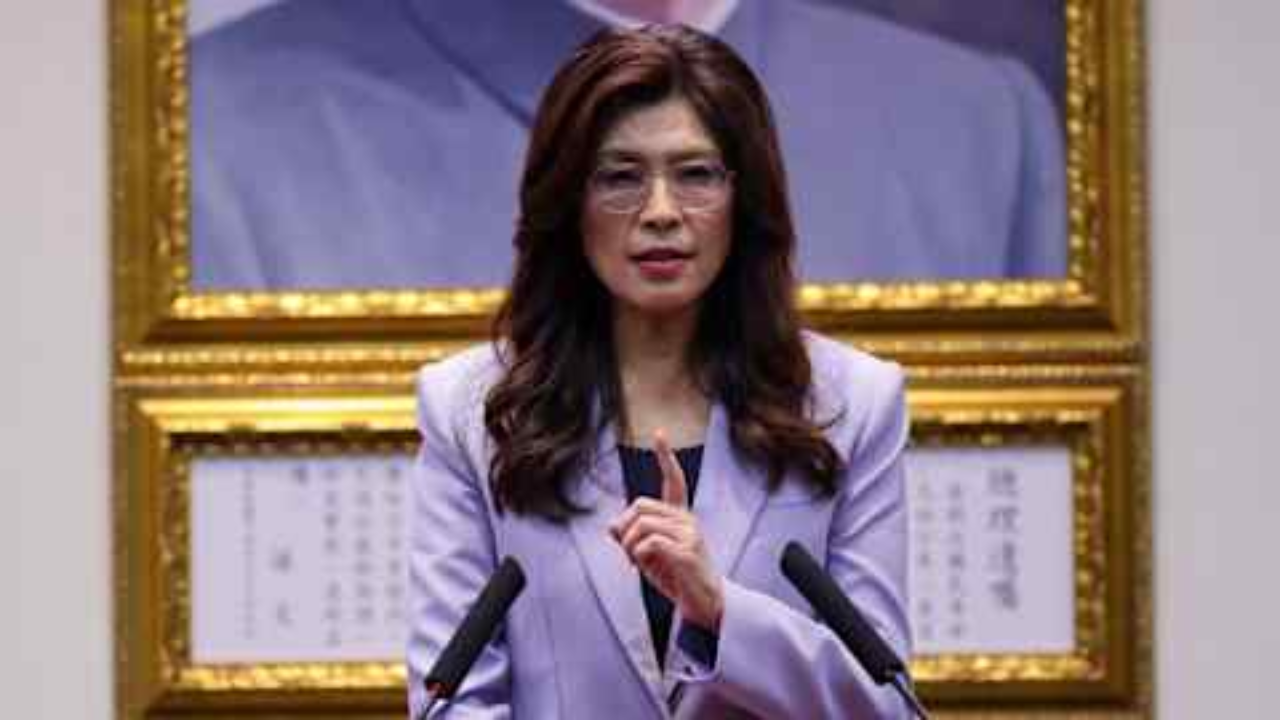
Cheng Li-wun, leader of Taiwan’s main opposition party, the Kuomintang (KMT), is delivering a blunt message to Washington and Beijing during her 15-day U.S. tour: Taiwan will not be used as leverage or a bargaining chip in great power politics.
Her high-profile visit follows a high-stakes summit between Donald Trump and Xi Jinping, sparking intense debate over Taiwan’s geopolitical future.
Core Messages from the U.S. Tour
- Rejecting “Bargaining Chip” Rhetoric: Responding to suggestions that U.S. arms sales to Taipei could be leveraged in trade negotiations with Beijing, Cheng told the Financial Times that Taiwan’s security cannot be traded away.
- Avoiding a “Next Ukraine” Scenario: Cheng warned that the ruling Democratic Progressive Party’s (DPP) total lack of official communication with Beijing has pushed the region to a breaking point, heightening local fears of a catastrophic conflict.
- Dialogue as Pragmatic Defense: She insists that reopening civic and political channels with China does not mean weakening Taiwan’s defenses; rather, it is a pragmatic necessity to prevent military miscalculations.
The Geopolitical Tension
Cheng’s U.S. trip follows her landmark April visit to Beijing, where she became the first sitting KMT chair to meet with Chinese President Xi Jinping in a decade. However, her strategy faces fierce pushback on multiple fronts:
| Stakeholder | Core Concern & Stance |
| Cheng Li-wun (KMT) | Argues that engagement tests Beijing’s “goodwill” for a peaceful resolution, provided Taiwan steers clear of an explicit independence platform. |
| U.S. Lawmakers | Highly skeptical of Beijing’s motives. Some express frustration over the KMT’s role in cutting Taiwan’s special defense budget from $\$40\text{ billion}$ to $\$25\text{ billion}$. |
| Taiwan’s Ruling Party (DPP) | Accuses the KMT of playing into Beijing’s hands, arguing that prioritizing dialogue over strong deterrence actively undermines Taiwan’s sovereignty. |
The Bottom Line: Cheng maintains that building a stable relationship with China is not an “anti-U.S.” stance, arguing that preventing a superpower conflict is ultimately in America’s best interest.
Reed More……https://www.ft.com/us-economy

Suresh holds a Master of Commerce (M.Com) degree and is a dedicated personal finance researcher and writer. Combining his advanced academic background in commerce with deep industry research, he covers complex topics like taxation, banking systems, credit analysis, and personal finance strategies. As the founder of Tax Assistant (taxassistant.org), Suresh is committed to translating complicated financial guidelines and economic data into simple, accurate, and actionable educational resources for everyday readers.