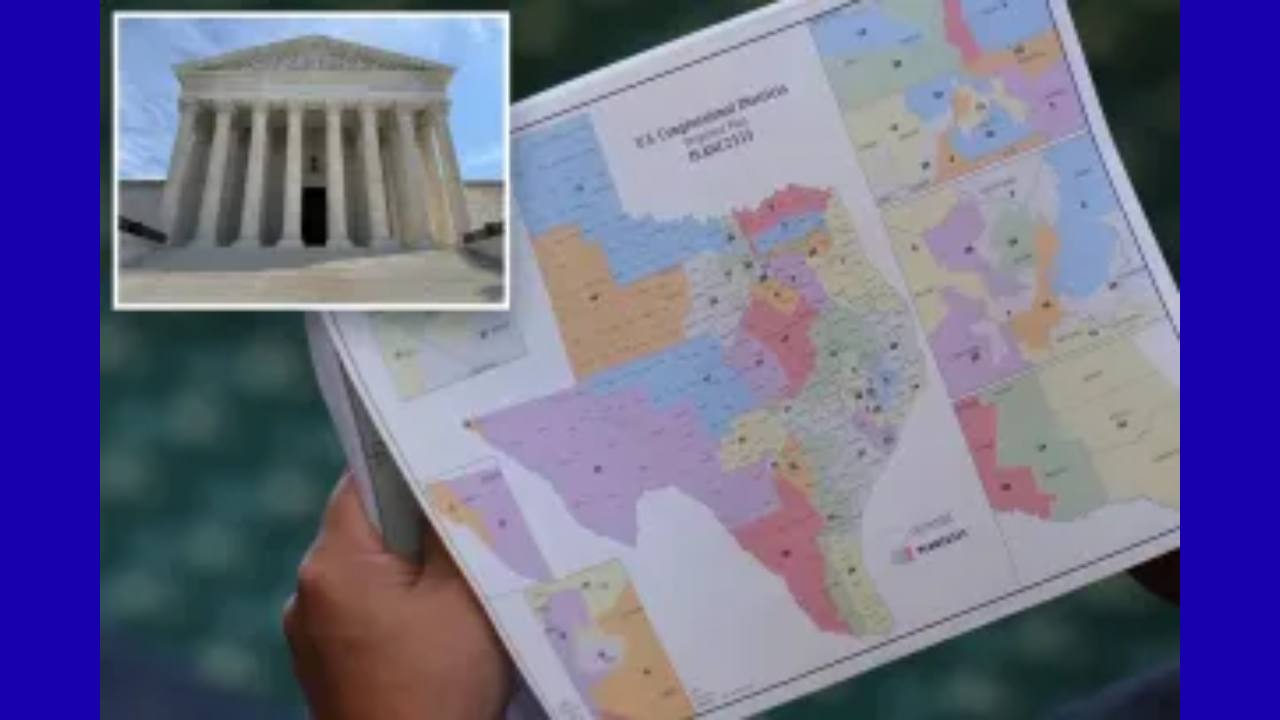
the U.S. Supreme Court issued a final ruling allowing Texas to proceed with its GOP-backed congressional map. The 6-3 decision effectively ends the legal freeze on the map, ensuring it will be the standard for the 2026 midterm elections.
Key Takeaways from the Ruling
- Political Question: The Court reiterated that partisan gerrymandering—drawing lines to favor one party—falls outside the jurisdiction of federal courts.
- Legislative Good Faith: The majority argued that the lower courts did not give the Texas Legislature the proper “presumption of good faith” regarding their intent when drawing the new boundaries.
Context: The 2025 Mid-Decade Redraw
This map was not part of the standard decennial census update but was a specific mid-decade redistricting passed in late 2025.
- Political Stakes: Analysts suggest the map could shift up to five seats toward the Republican column in the U.S. House.
- Controversy: The redistricting process was so heated it led to a legislative walkout by Democrats in August 2025 in an attempt to block the vote.
- Legal Challenges: Civil rights groups argued the lines intentionally diluted the voting power of Black and Latino communities. While a lower panel of judges initially agreed, the Supreme Court’s ruling overrides that finding for the current cycle.
Future Outlook
| Impact Area | Outcome |
| 2026 Elections | Candidates will run on the GOP-designed map this November. |
| National Strategy | Similar redistricting efforts in states like California and Virginia may now be accelerated by Democrats to counter Texas’s shift. |
| Long-term Litigation | While the map is cleared for 2026, lawsuits regarding the 2028 and 2030 cycles remain active in the lower courts. |

Suresh holds a Master of Commerce (M.Com) degree and is a dedicated personal finance researcher and writer. Combining his advanced academic background in commerce with deep industry research, he covers complex topics like taxation, banking systems, credit analysis, and personal finance strategies. As the founder of Tax Assistant (taxassistant.org), Suresh is committed to translating complicated financial guidelines and economic data into simple, accurate, and actionable educational resources for everyday readers.