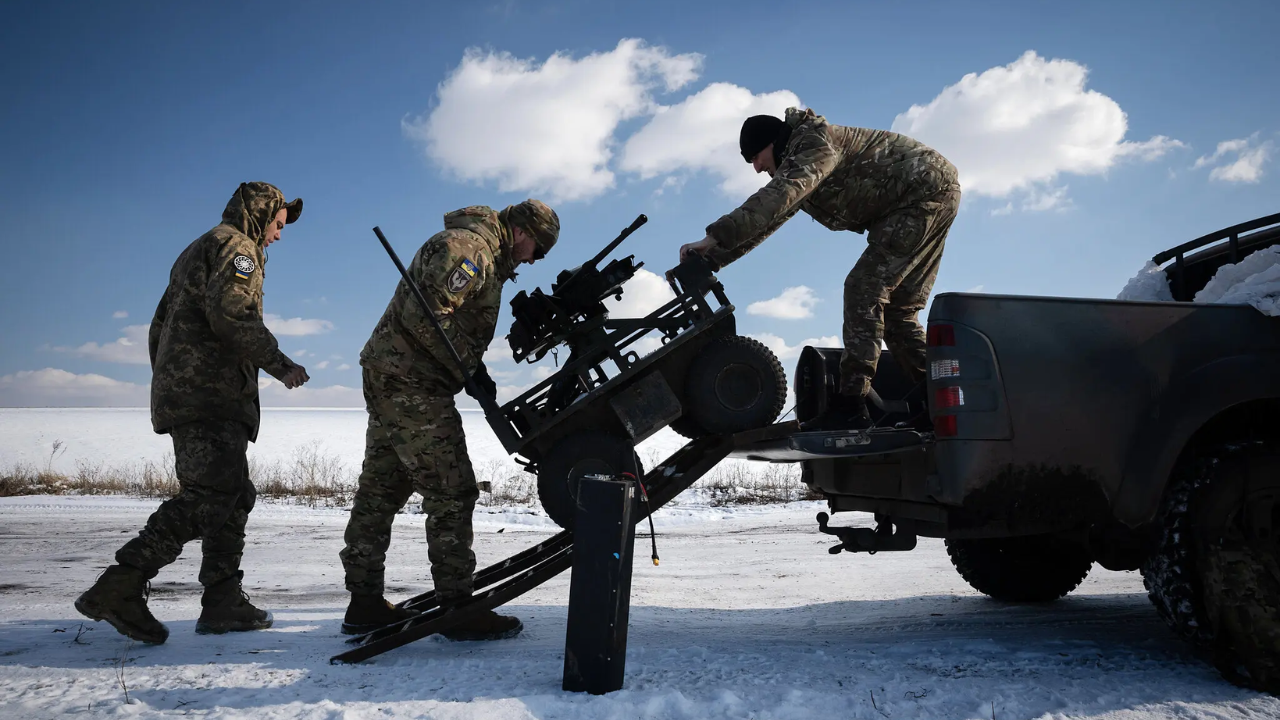
The era of the “lone soldier” is being eclipsed by the era of the “autonomous unit.” The transition toward AI-driven combat isn’t just a technical upgrade; it is a fundamental shift in the geometry of the battlefield.
Thank you for reading this post, don't forget to subscribe!From Human Decisions to Machine Logic
The most significant change is the compression of the “OODA Loop” (Observe, Orient, Decide, Act).
- Latency is Lethal: In modern combat, the seconds it takes for a human to process information are becoming a tactical vulnerability.
- Autonomous Lethality: We are moving away from remote-controlled tools toward systems that can identify, track, and engage targets independently. This removes the “human bottleneck,” allowing for speeds that human biology simply cannot match.
The Power of the Swarm
The future of the battlefield isn’t a single, expensive “Terminator”—it is a disposable swarm.
- Quantity as Quality: Mass-produced, low-cost drones can overwhelm even the most sophisticated traditional defenses. A $2 million air-defense missile is a losing investment when used against a $500 drone.
- Resilience: Unlike a tank or a jet, a swarm has no single point of failure. It is a decentralized network that continues to function even as individual units are destroyed.
The Shift in Global Power
The “robotics revolution” is effectively democratizing high-tech warfare.
- Lowering the Entry Barrier: Precision strike capabilities, once the exclusive domain of superpowers, are now available to anyone with a 3D printer and open-source AI software.
- Industrial Attrition: Victory is increasingly determined by supply chains rather than traditional bravery. The nation that can maintain the steadiest flow of semiconductors and lithium becomes the dominant force.
The Ethical Vacuum
As the technology outpaces international law, we face a “responsibility gap.”
- Algorithmic Bias: If an AI misidentifies a civilian as a combatant based on a flaw in its training data, the legal framework for accountability is currently non-existent.
- The Devaluation of Conflict: There is a growing concern that by removing the “blood cost” for the side utilizing robots, the psychological barrier to starting a war will be significantly lowered.
The Bottom Line
The “Killer Robot” headline isn’t a prediction—it’s a description of a process already in motion. The battlefield of the future won’t be defined by who has the strongest soldiers, but by who has the most sophisticated algorithms and the largest manufacturing base to support them.

"Suresh Kumar Saini is an experienced Tax Assistant and finance writer. He specializes in US & Canada Tax Guide, Indian Income Tax laws, GST compliance, and personal finance, helping freelancers and remote workers optimize their taxes."