
The staggering 70% plunge in private equity (PE) tech deal value marks a historic shift. The software and tech-services sectors—once the crown jewels of private equity due to their predictable, recurring revenue—are facing an existential valuation reset.
Thank you for reading this post, don't forget to subscribe!The culprit? The 3-to-5-year underwriting blindspot. Because generative AI is evolving at a breakneck pace, buyout groups can no longer guarantee that a traditional software company won’t be rendered obsolete by AI-native tools before the fund is ready to exit the investment.
The Three Risks Freezing the M&A Pipeline
The traditional PE “buy-and-build” software playbook has stalled due to three structural threats:
- Code Obsolescence: Investors fear that expensive, proprietary SaaS workflows will be replaced by custom, enterprise-level AI agents or cheaper, AI-native startups.
- Margin Erosion: For IT outsourcing and tech-enabled services, AI-driven automation means corporate clients are aggressively demanding lower contract pricing, squeezing margins.
- The Valuation Chasm: Sellers are still anchoring their asking prices to historic highs, while PE buyers are discounting valuations heavily to price in AI disruption risk.
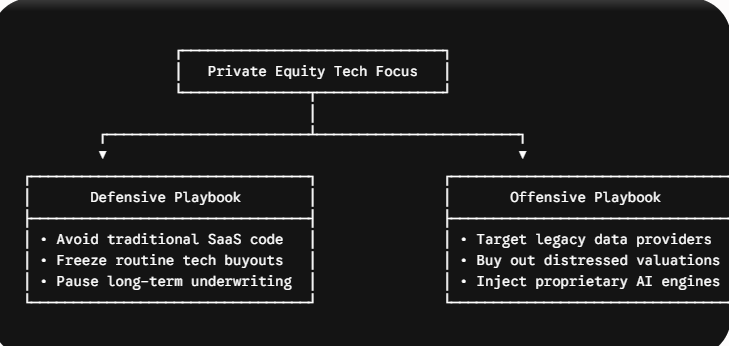
The Strategic Pivot: Defend vs. Offend
Private equity isn’t abandoning technology; it is radically changing its playbook to separate the vulnerable from the valuable.
| Defensive Strategy (Avoiding the Hype) | Offensive Strategy (Capitalizing on the Dip) |
| Pausing Traditional SaaS: Halting buyouts of routine workflow software vulnerable to AI replacement. | Targeting Legacy Data: Buying premium data and research networks (e.g., FactSet, Gartner) whose stock prices dipped due to AI panic, but whose core proprietary data remains highly defensive. |
| Stricter Exit Underwriting: Avoiding any business model that can be easily replicated or automated by an open-source LLM. | Portfolio-Wide AI Injections: Acquiring mature, undervalued companies and aggressively deploying proprietary AI engines to force-multiply their margins. |
The Bottom Line: While the headline deal volume has plummeted, the smart money is pivoting. The next wave of PE tech value won’t come from buying expensive AI startups, but from acquiring heavily discounted legacy companies and engineering their AI transformations from the inside out.