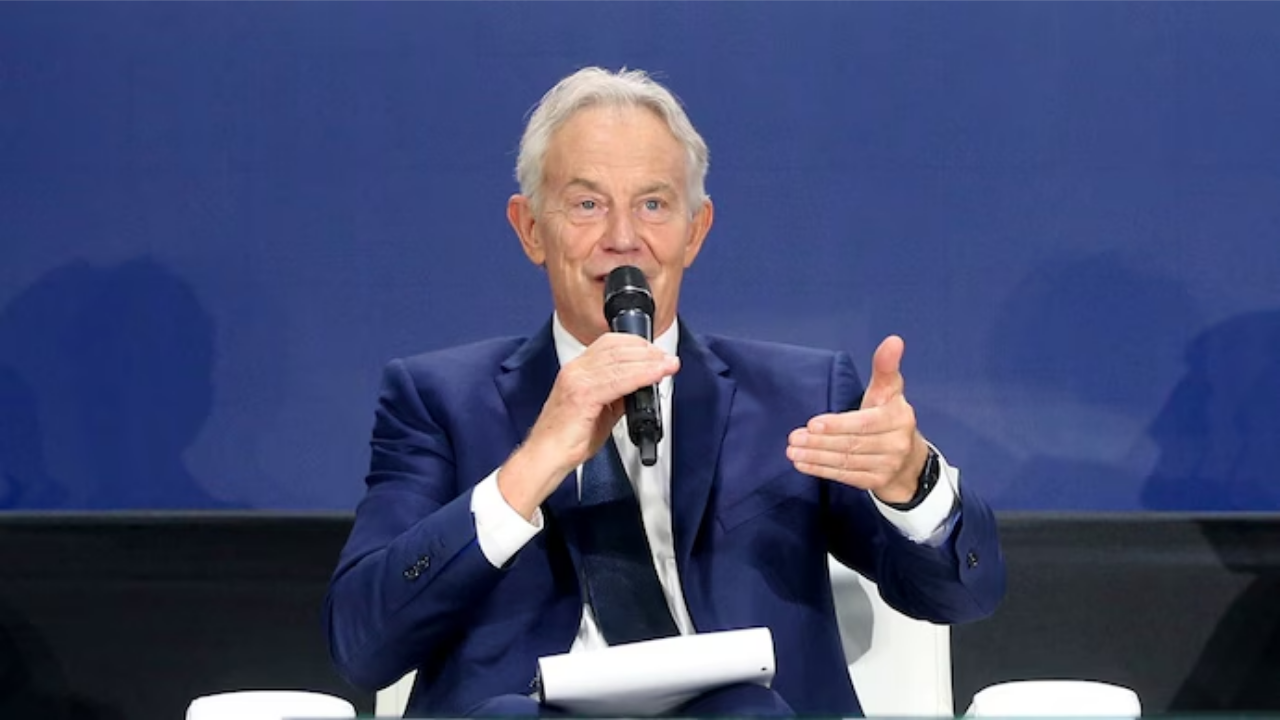
Trump Taps Tony Blair for Key Gaza Role, Sparking International Fury
Thank you for reading this post, don't forget to subscribe!Former UK Prime Minister Tony Blair is set for a dramatic return to the international stage, proposed by U.S. President Donald Trump for a leading role in a controversial 20-point Gaza peace plan.
Blair would serve as a key member of a new international transitional authority, the “Board of Peace,” which would be chaired by Trump and tasked with overseeing Gaza’s post-war administration and reconstruction. Blair’s think tank, the Tony Blair Institute for Global Change, helped develop the proposal.
The plan and Blair’s involvement have been immediately met with outrage. Critics, including Hamas political bureau member Husam Badran, who reportedly called Blair “the devil’s brother,” condemn the plan for being imposed without Palestinian consultation. Opponents argue Blair’s history—particularly his role in the Iraq War—undermines his legitimacy and risks repeating past foreign-imposed failures.
Supporters, however, point to his experience in conflict resolution, citing his work on the Good Friday Agreement in Northern Ireland. Blair has endorsed the plan as “bold and intelligent,” despite the heavy shadows of his past decisions. His potential new role places him at the center of one of the decade’s most sensitive geopolitical crises.
The Ghosts of Iraq: Tony Blair’s Controversial Return to Power in Trump’s Gaza Plan
Former British Prime Minister Tony Blair is once again a central figure in the Middle East, this time as a proposed leader in a U.S.-backed plan for the post-conflict governance of Gaza. President Donald Trump has named Blair as a key member of the proposed “Board of Peace,” an international body that would supervise a technocratic Palestinian committee and manage the reconstruction and funding of the devastated territory.
The move instantly reignited the debate over Blair’s legacy. While he is widely celebrated as the architect of the 1998 Northern Ireland peace deal, his name remains inextricably linked to the 2003 Iraq War, a decision that has fundamentally damaged his standing in the Arab world.
The outrage has been sharp and immediate. Palestinian figures, including Hamas’s Husam Badran, have openly condemned the lack of consultation and questioned Blair’s credibility, seeing his involvement as a precursor to a new Western-imposed governance experiment. The risk, analysts warn, is that a foreign-led, technocratic authority—even one advised by Blair’s Institute for Global Change—will fail to secure the local legitimacy needed for lasting stability.
Blair’s supporters maintain his decades of experience in diplomacy and conflict resolution make him uniquely qualified to navigate this complex crisis. Yet, the question remains: Can a politician whose reputation is so divided succeed in guiding Gaza towards peace, or is his controversial past destined to repeat itself?