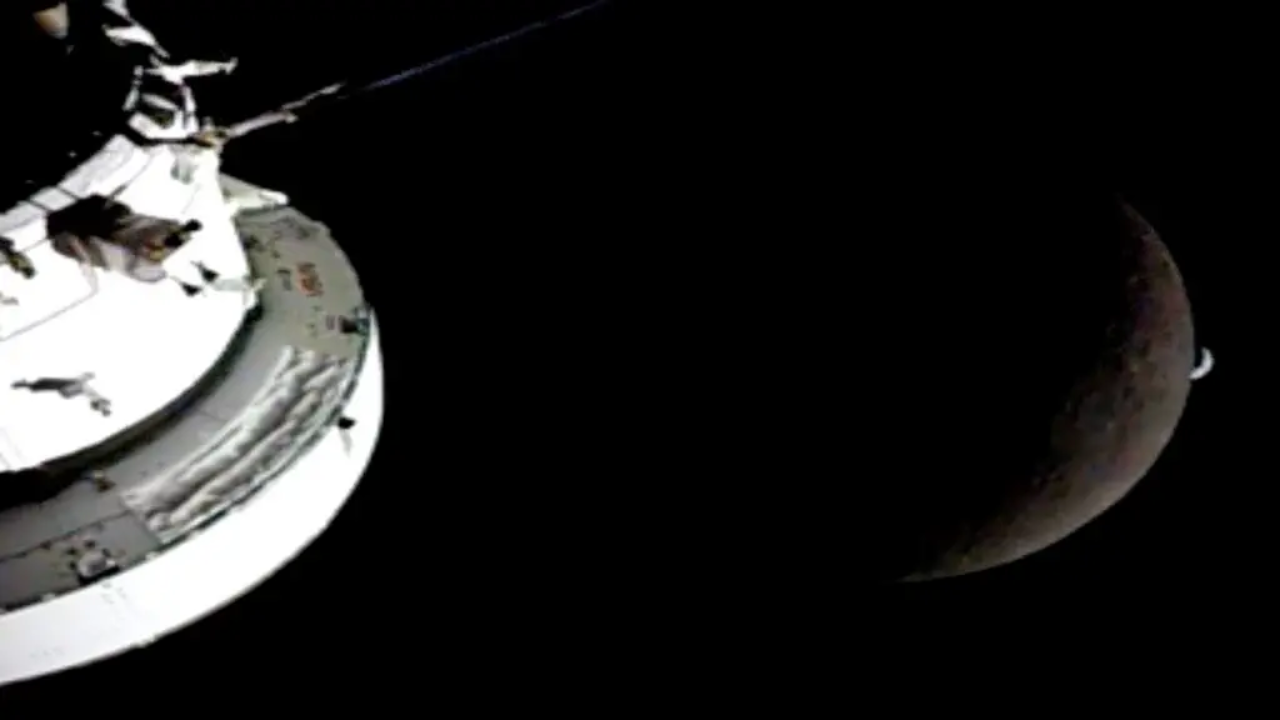
The four-person crew of Artemis II is currently on a high-speed return trip to Earth after successfully completing a historic lunar flyby. This mission marks the first time humans have ventured beyond low Earth orbit in over fifty years, providing the astronauts with views of the cosmos that have quite literally never been seen by human eyes.
Thank you for reading this post, don't forget to subscribe!A New Human Record
On April 6, 2026, Commander Reid Wiseman, Victor Glover, Christina Koch, and Jeremy Hansen became the farthest-traveling humans in history. At their peak distance, they reached 252,756 miles (406,771 km) from Earth, surpassing the legendary record set by the Apollo 13 crew in 1970.
The Eclipse from Above
- The View: From their vantage point, the Moon appeared as a colossal, dark disc against the Sun’s corona.
- The “Sight”: The crew reported seeing the Sun’s atmosphere—the corona—flaring in a perfect, shimmering ring around the Moon, a perspective that is physically impossible to achieve from within Earth’s atmosphere.
First-Hand Look at the Far Side
While satellite imagery has mapped the Moon’s “Far Side,” it remains largely a mystery to human perception. The crew performed a close approach over the Orientale Basin, a massive, multi-ringed impact crater. Watching the sun rise over the lunar horizon from the lunar “backside” provided the crew with geological details and lighting conditions never before documented in person.
The Final Leg
Key Milestone:
- Splashdown: Expected Friday, April 10, 2026.
- Location: The Pacific Ocean, off the coast of Baja California.
- The Re-entry: The capsule will hit the atmosphere at nearly 25,000 mph, testing the heat shield against temperatures reaching $2,760^{\circ}\text{C}$ ($5,000^{\circ}\text{F}$).
This mission serves as the final proving ground before Artemis III attempts to land the first woman and the first person of color on the lunar surface.