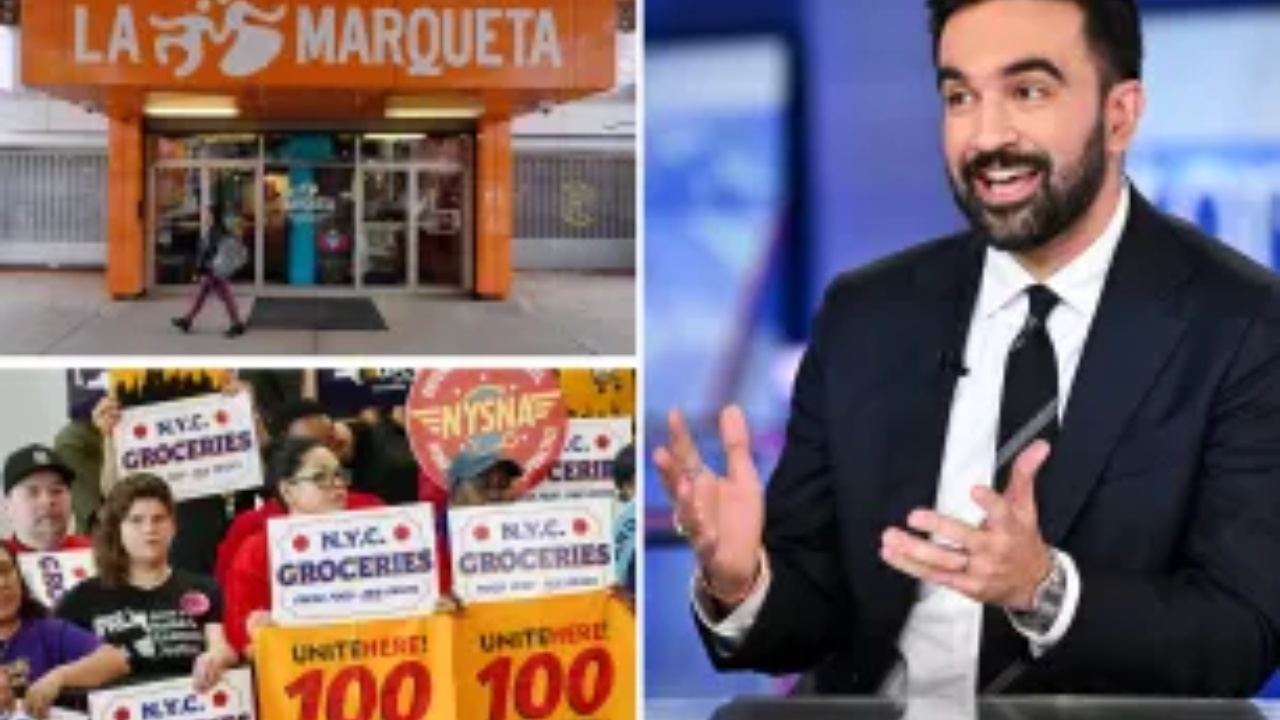
The political battle over Mayor Zohran Mamdani’s public grocery store initiative has exploded, with critics labeling the East Harlem site a multi-million-dollar taxpayer “boondoggle” and the administration defending it as a vital strike against corporate price-gouging.
Here is a breakdown of the clash over the East Harlem location at La Marqueta and the math behind the controversy.
The Blueprint vs. The Backlash
The city plans to spend $30 million in capital funds to build a 9,000-square-foot store from the ground up beneath the elevated Metro-North tracks at Park Avenue and East 116th Street. While privately operated, the store will pay zero rent and zero property taxes, allowing the city to contractually mandate lower prices on baseline staples like bread and eggs.
| The “Boondoggle” Argument (Critics) | The Administration’s Defense (Mamdani) |
| Market Distortion: Industry experts point out that $30 million is nearly triple what it normally costs to build a supermarket from scratch. Because the store pays no rent or taxes, critics argue the city is using taxpayer money to unfairly undercut neighborhood “mom-and-pop” grocers who do pay taxes. | Wiping Out Overhead: The administration argues that eliminating real estate taxes and rent removes the massive overhead that private grocers face. By taking profit out of the real estate equation, 100% of those structural savings can legally be passed directly to consumers. |
| Not a Food Desert: Within a short walk of the site, there are already multiple local markets, plus a low-cost, national chain option (Aldi) at East River Plaza. Critics question why the city is spending millions to inject government competition into an already saturated market. | Targeting High-Need Pockets: The administration counters that 40% of East Harlem households received SNAP or public assistance over the past year. With 65,000 residents living within a 10-minute walk—including 5,000 NYCHA residents—the location targets people hit hardest by the cost-of-living crisis. |
| The “66% Price Jump” Error: Opponents flagged a glaring data misinterpretation in the Mayor’s press release, which claimed NYC grocery prices jumped 66% over the last decade. The State Comptroller report cited actually measured a 66% increase in total consumer spending on groceries, not basic price inflation. | Direct Market Intervention: Despite the data mix-up, Mayor Mamdani maintains that corporate consolidation has turned basic food into a luxury, making a “public option” grocery network the only permanent way to protect working-class families from inflation. |
A History of Neighborhood Friction
This isn’t East Harlem’s first massive political war over subsidized grocery real estate.
In 1999, the city heavily subsidized a massive Pathmark supermarket on 125th Street and Third Avenue. Local independent grocers fought it aggressively, warning it would decimate their businesses. While the Pathmark was highly popular for a time, its parent company (A&P) went bankrupt in 2015. Today, that Pathmark site sits as a vacant lot, and the neighborhood remains reliant on the exact same independent local operators who are now bracing for a second wave of city-subsidized competition.
What’s Next?
The $70 million total budget to open five municipal stores across the five boroughs faces its first major legislative hurdle on May 29, 2026. The City Council will hold a critical hearing where lawmakers plan to grill administration officials on the fiscal viability of the project and its long-term impact on NYC’s small business economy.

Suresh holds a Master of Commerce (M.Com) degree and is a dedicated personal finance researcher and writer. Combining his advanced academic background in commerce with deep industry research, he covers complex topics like taxation, banking systems, credit analysis, and personal finance strategies. As the founder of Tax Assistant (taxassistant.org), Suresh is committed to translating complicated financial guidelines and economic data into simple, accurate, and actionable educational resources for everyday readers.