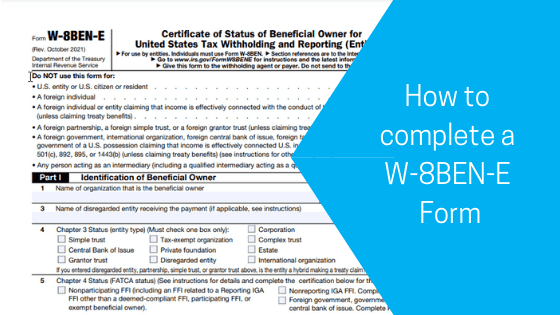
If you are a non-U.S. business entity doing business with U.S. companies, you have likely been asked to fill out Form W-8BEN-E. For many foreign business owners, looking at this 8-page document containing 30 complex parts can be incredibly overwhelming.
However, ignoring or incorrectly filling out this form can cost your business a massive 30% withholding tax on your U.S.-sourced income.
In this comprehensive guide, we will break down what Form W-8BEN-E is, who needs it, and how to fill it out correctly to protect your business revenue.
What is Form W-8BEN-E?
Form W-8BEN-E (Certificate of Status of Beneficial Owner for United States Tax Withholding and Reporting) is an official document issued by the U.S. Internal Revenue Service (IRS).
It is used by foreign entities (corporations, partnerships, LLCs, and trusts outside the United States) to confirm their non-U.S. status. The form serves two main purposes:
- It establishes that your business is not a U.S. person/entity for tax purposes.
- It allows you to claim a reduced rate of, or exemption from, the standard U.S. withholding tax under an applicable tax treaty between your country and the United States.
W-8BEN vs. W-8BEN-E: What is the Difference?
- Form W-8BEN: Used strictly by foreign individuals (like freelancers, independent contractors, or solo bloggers).
- Form W-8BEN-E: Used strictly by foreign entities (like registered corporations, private limited companies, partnerships, or organizations). The “E” stands for Entity.
Who Needs to Fill Out Form W-8BEN-E?
You need to complete Form W-8BEN-E if your foreign business receives payments from a U.S. source, known as FDAP income (Fixed, Determinable, Annual, or Periodical income). Common examples include:
- Fees paid for services rendered to U.S. clients.
- Royalties (from software, books, music, or intellectual property).
- Dividends or interest earned from U.S. investments.
- Rental income from U.S. real estate.
The U.S. company paying you acts as a withholding agent. Before they can release your payment legally without withholding 30%, they must have your valid W-8BEN-E on file.
Step-by-Step: How to Fill Out Form W-8BEN-E
While the form has 30 parts, most active operational businesses (like digital marketing agencies, software development firms, or e-commerce companies) only need to complete Part I, Part III, and Part XXX.
Here is how to navigate the most critical sections:
Part I: Identification of Beneficial Owner
This section establishes the basic identity of your business.
- Line 1: Enter the legal name of your organization.
- Line 2: Country of incorporation.
- Line 4: Chapter 3 Status. Most standard foreign businesses will check “Corporation” or “Partnership”.
- Line 5: FATCA Status. This is highly important. If you run a standard, active operating business (e.g., selling goods or services), you should generally check “Active NFFE” (Non-Financial Foreign Entity). If your income comes primarily from passive investments (interest, dividends), you would check “Passive NFFE”.
- Line 6: Permanent residence address (do not use a P.O. Box).
- Line 9b: Foreign TIN. Enter your local country’s business tax registration number (e.g., PAN/GSTIN in India, Company Registration Number in the UK/Canada). This is mandatory if you want to claim tax treaty benefits.
Part III: Claim of Tax Treaty Benefits
This is where your business actually saves money. You only fill this out if your country has a tax treaty with the U.S.
- Line 14a: Check the box and enter the name of your country to state that your entity is a resident of a country that has a tax treaty with the U.S.
- Line 14b: Check the box and choose the basis for meeting the Limitation on Benefits (LOB) provisions. Most active commercial companies check “Company that meets the active trade or business test”.
- Line 15: Specify the exact treaty article number and the reduced rate of withholding you are claiming based on your country’s specific tax treaty.
Part XXV: Active NFFE Status
If you checked “Active NFFE” in Part I (Line 5), you must come down to Part XXV and check Line 39 to certify that less than 50% of your business income is passive and less than 50% of your assets produce passive income.
Part XXX: Certification
The form must be signed and dated by an authorized individual (such as a director, CEO, or authorized corporate officer) who has the legal power to sign on behalf of the company.
Frequently Asked Questions (FAQs)
No. You do not send this form to the IRS. You must send the completed and signed form directly to the U.S. company or withholding agent who requested it from you. They will keep it in their internal compliance files.
Generally, a Form W-8BEN-E remains valid starting from the date it is signed until the last day of the third succeeding calendar year. For example, a form signed on October 26, 2026, will remain valid until December 31, 2029. However, if your company’s name, address, or tax status changes, you must submit a new form immediately.
If you provide incorrect information, the form becomes invalid, and the U.S. withholding agent is legally required to withhold 30% of your total payment. Always double-check your Foreign TIN and FATCA classification.
Disclaimer
Tax laws are complex and change frequently. This guide provides general information based on current IRS guidelines for educational purposes only. Make sure to consult a certified public accountant (CPA) or a qualified tax professional to evaluate your specific corporate structure before submitting official tax documents.

Suresh holds a Master of Commerce (M.Com) degree and is a dedicated personal finance researcher and writer. Combining his advanced academic background in commerce with deep industry research, he covers complex topics like taxation, banking systems, credit analysis, and personal finance strategies. As the founder of Tax Assistant (taxassistant.org), Suresh is committed to translating complicated financial guidelines and economic data into simple, accurate, and actionable educational resources for everyday readers.
