
The Australian government has launched its largest legal claim in history, suing US manufacturing giant 3M for AU$2 billion (US$1.4bn). The lawsuit seeks to hold the company accountable for widespread toxic contamination caused by “forever chemicals” found in firefighting foams used across dozens of military bases.
Thank you for reading this post, don't forget to subscribe!According to Attorney-General Michelle Rowland, the government is moving to recover the skyrocketing costs borne by taxpayers to clean up environmental damage across 28 distinct defense locations.
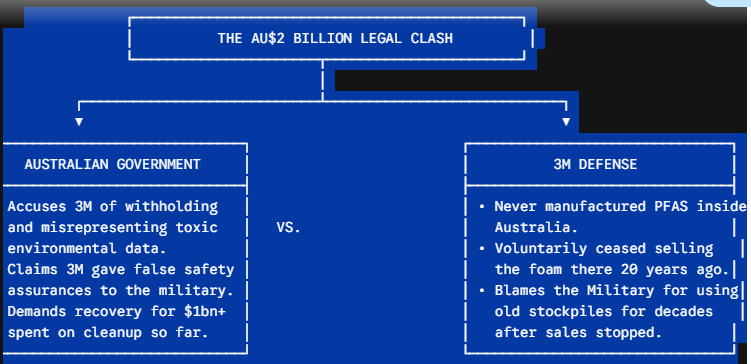
The Core Dispute: Corporate Deception vs. Customer Stockpiling
The lawsuit focuses on Aqueous Film-Forming Foam (AFFF)—a highly effective fire suppressant used on military bases to choke out intense fuel fires. The legal battle centers on two fundamentally opposing arguments:
The Science: Why “Forever Chemicals” Trigger Multi-Billion-Dollar Lawsuits
The chemicals at the center of the lawsuit belong to a family known as PFAS (per- and poly-fluoroalkyl substances). Widely prized for their unparalleled ability to repel heat, water, and oil, they are found in everything from non-stick pans and clothing to electronics.
However, their unique chemical structure presents severe environmental and biological risks:
- Indestructible Bonds: The carbon-fluorine bonds in PFAS are among the strongest in organic chemistry. They do not break down under normal environmental conditions, allowing them to persist indefinitely in nature.
- The Contamination Chain: When sprayed onto the ground during decades of military drills, the chemicals leached deep into the earth. They contaminated local soil, migrated into groundwater tables, entered the agricultural food chain, and accumulated inside human bodies.
- Health Hazards: Broad scientific research has linked elevated PFAS exposure to severe medical conditions, including hormone disruption, reproductive issues, and increased risks of kidney and testicular cancers.
A History of Settlements: In 2022, 3M announced it would completely phase out PFAS manufacturing by the end of 2025. This followed a massive US$10.3 billion settlement in the United States to resolve claims regarding PFAS contamination in public drinking water systems.
What Happens Next?
As Australia’s Department of Defence continues to manage chemical plumes creeping past base borders, this landmark case will be closely watched worldwide. It sets a massive global precedent for whether chemical manufacturers can be held financially liable for the legacy of their products, even decades after exiting a market.

"Suresh Kumar Saini is an experienced Tax Assistant and finance writer. He specializes in US & Canada Tax Guide, Indian Income Tax laws, GST compliance, and personal finance, helping freelancers and remote workers optimize their taxes."