
This article addresses session gambling for the casual player, not the individual that is considered a professional gambler who regularly and in good faith pursues the activity for their livelihood.
We’ll cover the definition of session gambling, clarify what Form W-2G is and is not discuss the new limit on deducting gambling losses and outline steps for determining your winnings from session gambling. We’ll also touch briefly on Form 8275, which is not supported by Tax Assistant.
When the One Big Beautiful Bill Act (OBBBA) became law July 4, 2025, the tax treatment of gambling losses changed. For gambling activity beginning January 1, 2026, you may deduct 90% of your gambling losses up to the amount of your winnings as an itemized deduction. Under the old rules, you could generally deduct 100% of your losses up to the amount of your winnings.
Session gambling is not a new concept, and it applies to gambling such as slot machine play, but not to sports wagering for instance, or tournament play. And the new limit on deductible gambling losses has made accurately calculating session gambling activity more important.
This means you may need to spend additional time keeping detailed records—such as the date, location and type of gambling activity for each session—and reconciling those records with the winnings reported in Box 1 of your Form W-2G.
What is session gambling?
As a simple definition, session gambling is considered the player’s time spent in a single session of gambling supported by appropriate documentation. The gain or loss is measured by comparing what you brought in (considered your buy-in) and what you walk out with (considered your cash-out).
For example, Randy walked into a casino with a $500 buy-in and won $2,000 in a jackpot. He kept playing for another four hours and walked out with $1,600. His session gain is $1,100 ($1,600 – $500 = $1,100) with supporting documentation on his player card.
Randy’s $1,100 session gain will not match the $2,000 of winnings reported in Box 1 of Form W-2G, even though the casino correctly reported the $2,000 jackpot. In addition, that amount doesn’t reflect Randy’s overall result for the session.
If Randy claims a session gambling adjustment on his tax return, he may also need to file Form 8275, Disclosure Statement, to explain the adjustment. Although FreeTaxUSA doesn’t support this form, it may be manually completed and included with a paper-filed tax return.
What is the session gambling method?
This method is a way to determine your actual gain or loss in a session of gambling. Under this method, you calculate the gain or loss on a session-by-session basis. You can then add up the results across all your sessions for the year.
- If your cash-out is more than your buy-in, that session produced a gain.
- If your cash-out is less than your buy-in, that session produced a loss.
Total the gains from all your winning sessions—this becomes your total session winnings.
Total the losses from all your losing sessions—this becomes your total session loss.
The total of your losing sessions is the amount you may be able to claim as an itemized deduction on Schedule A, subject to the new OBBBA limitation.
Beginning January 1, 2026, you may only deduct the lesser of:
- 90% of your annual gambling losses, or
- 100% of your annual gambling winnings
Casual gamblers report allowable losses on Schedule A, Itemized Deductions.
Going back to Randy’s example, suppose his records show the following sessions for the year:
- Session A: $500 buy-in, $1,600 cash-out → $1,100 gain
- Session B: $2,000 buy-in, $4,700 cash-out → $2,700 gain
- Session C: $1,000 buy-in, $200 cash-out → $800 loss
- Session D: $3,000 buy-in, $1,200 cash-out → $1,800 loss
Total session winnings: $1,100 + $2,700 = $3,800
Total session losses: $800 + $1,800 = $2,600
Can I deduct all my losses?
Keeping a diary or Excel spreadsheet to regularly track your gambling activity can help substantiate your losses. Supporting documentation may include Form(s) W-2G, player-card activity, bank statements, sportsbook account ledgers, etc. The IRS considers a win/loss statement from a casino supportive evidence, but it’s not sufficient by itself
Remember beginning January 1, 2026, you may only deduct the lesser of:
- 90% of your annual gambling losses, or
- 100% of your annual gambling winnings
Casual gamblers report allowable losses on Schedule A, Itemized Deductions.
For example, you win a total of $125,000 during the year but lose $135,000. There was no session gambling involved. You report the full $125,000 in gambling winnings. Your deductible gambling losses are limited to $121,500, or 90% of your losses.
How do I report my session gambling income?
This method requires several steps.
Step 1. Add up all your reported winnings. This would include amounts reported in Box 1 of each Form W-2G, plus any other winnings not reported on a Form W-2G.
Step 2. Using your supporting documentation, determine your total winnings using the session method. This amount may be less than what’s reported in Box 1 of the W-2G(s). This calculation determines your gambling income. At this step, you aren’t yet applying the limitation or deducting any losses yet.
The difference between the amounts in Step 1 and Step 2 is the adjustment you’ll enter on your tax return to report the correct amount of winnings. Make sure you have detailed documentation to support this adjustment.
Here’s an example:
Rosy had $10,600 in slot machine winnings reported in Box 1 of her 2026 Form W-2G. She writes down that number on a piece of paper.
Next, because she has supporting records of her gambling sessions for the year, she can use the session method and refer to the details on her player card to determine her actual winnings. Rosy calculates session winnings of $4,200 and writes this number down as well.
- On her piece of paper, Rosy subtracts $4,200 from $10,600. The difference between these two amounts—$6,400—is the adjustment she’ll need to make on her tax return. This adjustment is called a contra income adjustment and is entered as a negative number in Tax Assistant She has not yet calculated her deductible losses.
Step 3. Rosy can now start reporting her gambling information in Tax Assistant. She’ll start with her W-2G.


Step 4. Rosy must now create the contra income adjustment.
The contra income adjustment (negative amount) is entered to lower the reported winnings as shown on Form W-2G because Rosy uses the session gambling method.
In Tax Assistant follow this menu path: Income > Uncommon Income > Other Income.

Scroll to the bottom of the screen and answer YES to the Miscellaneous Income question.
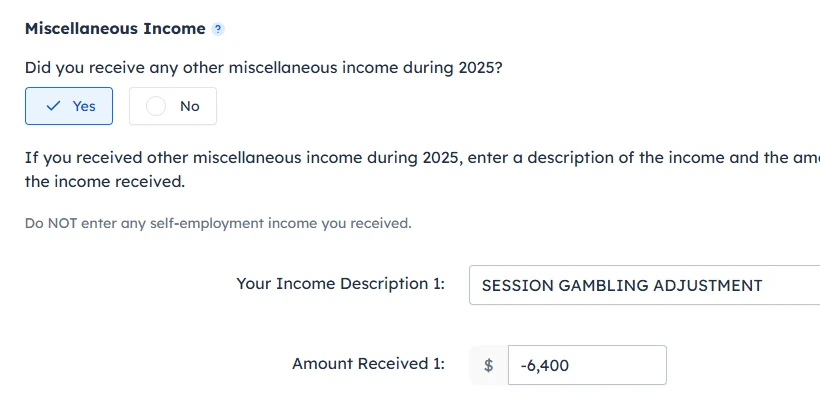
Rosy’s tax return now properly reports:
- the $10,600 from Form W-2G (which matches what the IRS receives);
- the contra income adjustment of -$6,400;
- and the total amount of winnings of $4,200.
This matches the calculations on Rosy’s records.


Step 5. Rosy is now ready to calculate her allowable gambling losses using the new rules.
Beginning January 1, 2026, you may only claim an itemized deduction equal to the lesser of:
- 90% of annual gambling losses, or
- 100% of annual gambling winnings
Using her session records, Rosy determines that her total gambling losses for the year were $2,600. She compares her two limits:
- 90% of her losses: $2,600 x 90% = $2,340
- 100% of her winnings: $4,200 x 100% = $4,200
Since $2,340 is less than $4,200, Rosy’s deductible gambling loss is limited to $2,340. This is a manual calculation Rosy must make and enter in Tax Assistant.
Step 6. Rosy uses this menu path: Deductions/Credits >Itemized Deductions > Other Itemized Deductions.


It looks like this on her Schedule A:

Remember, if you use the session gambling method, Form 8275 should be included with the tax return to explain the adjustment. Since Tax Assistant doesn’t support the form, you’ll need to print, sign and date, and mail the form with your tax return. Always keep a copy of information you send to the IRS and using a tracking service such as USPS for proof of delivery is a good idea.
Under the One Big Beautiful Bill Act (OBBBA), for gambling activity beginning January 1, 2026, casual gamblers can only deduct the lesser of 90% of their annual gambling losses or 100% of their annual gambling winnings as an itemized deduction on Schedule A. Previously, taxpayers could deduct 100% of their losses up to the amount of their winnings.
The session gambling method calculates your net gain or loss for a single continuous period of play—such as slot machine play—by comparing the money you started with (buy-in) against the money you walked away with (cash-out), supported by documentation like a player card. At the end of the year, you add up all winning sessions to determine your total session winnings and add up all losing sessions separately to determine your total session losses.
Session gambling applies to continuous, house-banked play such as slot machines. It does not apply to sports wagering or tournament play, where individual wagers or events are tracked separately rather than as a single continuous session.
Because a casino reports individual jackpots in Box 1 of Form W-2G rather than your overall session result, you report the full Form W-2G amount so your return matches IRS records. You then enter a contra-income adjustment (a negative number under Other/Miscellaneous Income) equal to the difference between your Form W-2G winnings and your actual net session winnings.
Yes, if you enter a session gambling contra-income adjustment to reduce the winnings reported on your Form W-2G, you may need to include Form 8275 (Disclosure Statement) to explain the adjustment to the IRS. If your tax software does not support e-filing Form 8275, you must print, sign, date, and mail the form with a paper-filed tax return.

Suresh Saini is the Founder and Lead Financial Researcher at Tax Assistant. He holds a Master of Commerce (M.Com) degree with a specialized focus on Advanced Accountancy, providing him with a robust academic and analytical foundation in complex accounting principles, credit systems, and personal finance structures.
Driven by a passion to democratize financial literacy, Suresh has spent years analyzing and decoding shifting fiscal guidelines. At Tax Assistant, he manages the platform’s core editorial direction, transforming dense government updates and complex banking parameters into structured, clear, and actionable guides for both individual taxpayers and small businesses across North America.
Before launching taxassistant.org, Suresh conducted deep financial and market dynamics research, focusing on asset management, personal wealth optimization, and strategic tax planning. His dedication to data integrity ensures that every piece of news, breakdown, or analysis published under his leadership is rigorously fact-checked by certified tax professionals and aligned perfectly with contemporary regulatory frameworks.