The Strait of Hormuz remains the world’s most critical energy chokepoint, facilitating the passage of roughly 20% of global oil and liquefied natural gas (LNG). Because of its narrow geography, any instability in the region has an immediate and profound impact on global energy markets.
Global Distribution of Oil Flows
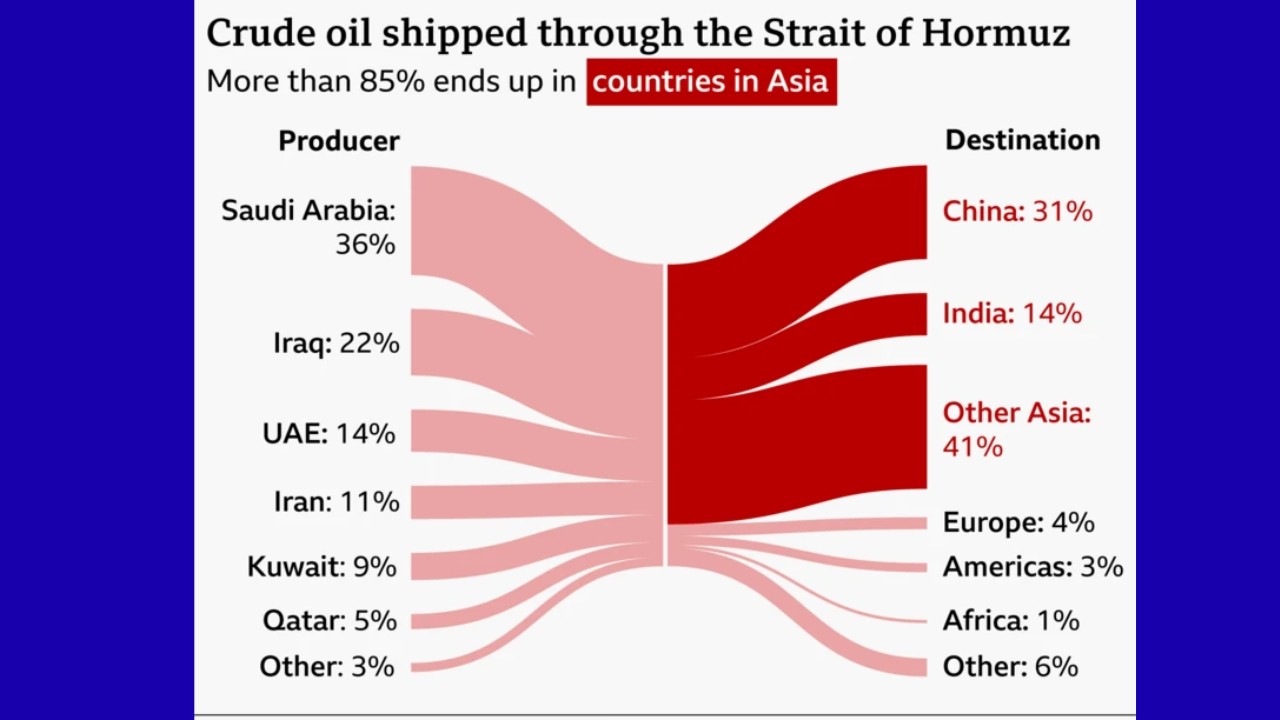
While the Strait is a global concern, the vast majority of its traffic is destined for the East. Currently, 86% to 90% of all oil passing through the waterway is delivered to Asian markets.
- China: The primary stakeholder, receiving approximately 31% to 37% of the total crude flow.
- India: The second-largest recipient, accounting for 14% of the volume.
- Other Key Importers: Japan and South Korea also rely heavily on this route to sustain their industrial economies.
Economic Vulnerability
Despite the heavy concentration of exports to Asia, the Strait’s influence is not localized. The global nature of the oil market means that even minor disruptions can trigger:
- Price Volatility: Global benchmarks (like Brent Crude) react instantly to perceived threats in the Strait, raising costs for consumers worldwide.
- Supply Chain Strain: A blockage forces tankers to take longer, more expensive routes, increasing shipping insurance and freight costs.
- Alternative Limitations: While some nations use pipelines to bypass the Strait, these lack the capacity to handle the massive volumes that maritime shipping provides.
Summary: The Strait of Hormuz is the “jugular vein” of the global energy industry. While Asian nations are the primary physical recipients of its oil, the entire world remains tethered to its stability.

Suresh holds a Master of Commerce (M.Com) degree and is a dedicated personal finance researcher and writer. Combining his advanced academic background in commerce with deep industry research, he covers complex topics like taxation, banking systems, credit analysis, and personal finance strategies. As the founder of Tax Assistant (taxassistant.org), Suresh is committed to translating complicated financial guidelines and economic data into simple, accurate, and actionable educational resources for everyday readers.