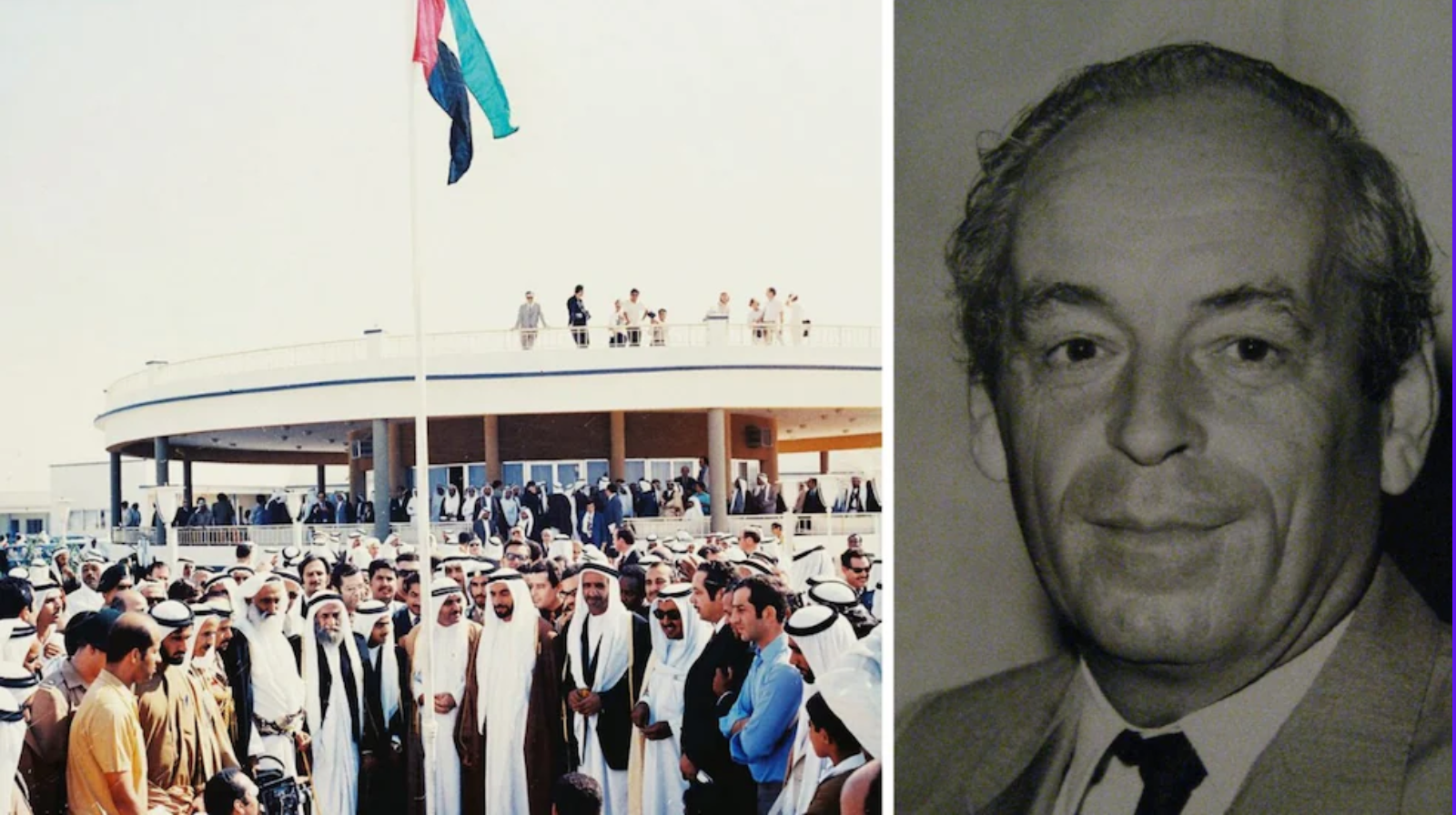
While history often focuses on the high-level politics of national formation, the physical shape of the United Arab Emirates was largely determined by one man, a Land Rover Series I, and thousands of cups of tea. Sir Julian Walker, known as the “Boundary Walker,” spent years navigating the desert to turn tribal loyalties into the borders we see today.
Thank you for reading this post, don't forget to subscribe!The Mission: Mapping the “Blank” Space
In the 1950s, the Trucial States (the precursor to the UAE) had no formal internal borders. Sovereignty was fluid, based on which Sheikh a tribe pledged allegiance to rather than a line on a map. However, the discovery of oil changed everything.
- The Problem: Oil companies needed to know exactly which Ruler held the rights to specific patches of desert.
- The Solution: The British Foreign Office tasked Julian Walker with a “Trigonometrical and Tribal Survey” to settle border disputes between the seven sheikhdoms.
The Methodology: Tea and Topography
Walker’s approach was unique because it prioritized human geography over physical geography. From 1953 to 1960, he lived a nomadic life out of his Land Rover.
- Interrogating the Landscape: Walker would drive to remote wells and mountain villages. He wouldn’t just measure the land; he would interview the Bedouin.
- The Litmus Test: He famously asked residents: “Where do you take your disputes?” or “To whom do you pay your Zakat (charity)?” * The “Jigsaw” Result: Because he followed people rather than straight lines, the resulting map was a complex puzzle. If a mountain village felt they belonged to Sharjah despite being surrounded by Fujairah territory, Walker drew them as an enclave.
Challenges in the Dunes
The task was far from a simple road trip. Walker faced significant hurdles:
- The Buraimi Crisis: His work was often interrupted by regional tensions and the threat of armed conflict over the Buraimi Oasis.
- Survival: He navigated without GPS, relying on hand-sketched landmarks and mountain peaks.
- Diplomacy: He had to mediate between powerful Rulers, including Sheikh Zayed bin Sultan Al Nahyan and Sheikh Rashid bin Saeed Al Maktoum, ensuring that every line drawn was a compromise they could live with.
A Lasting Legacy
Today, the UAE is the only country in the world with such a complex internal “jigsaw” of borders. This unique geography—including the Omani enclave of Madha and the UAE enclave of Nahwa—stands as a living monument to Walker’s meticulous work and his respect for the ancestral loyalties of the desert.