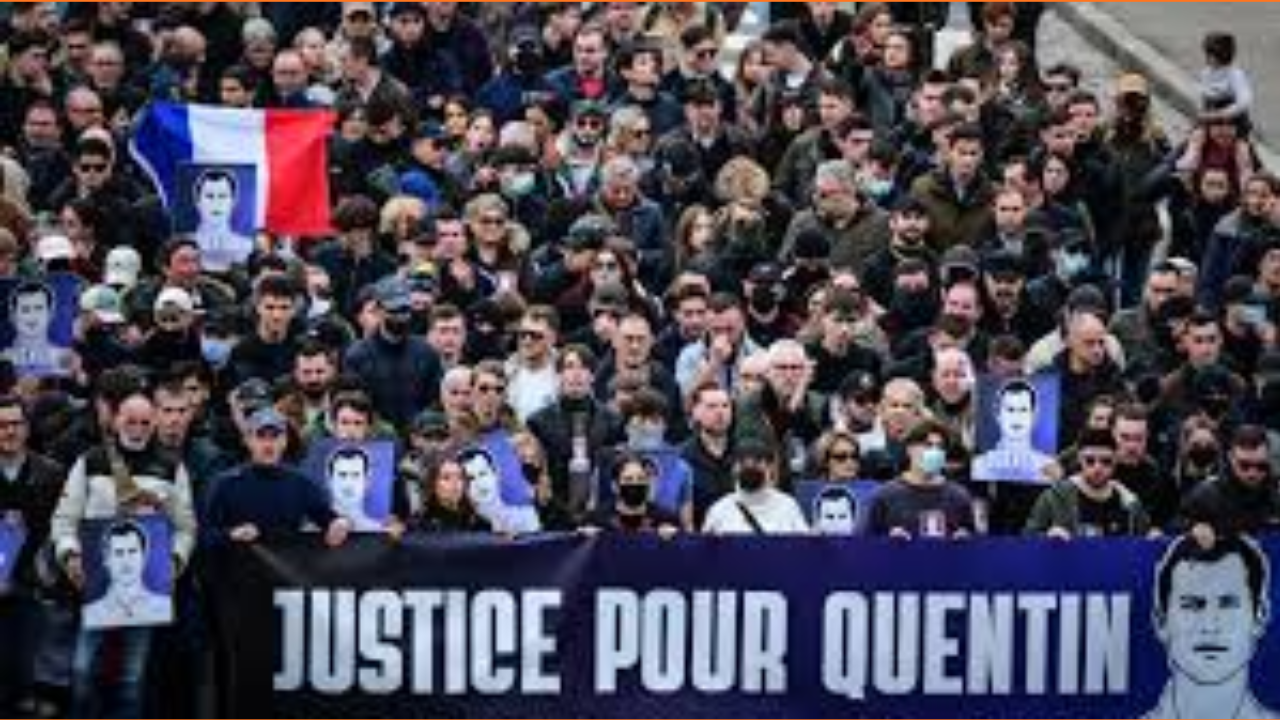
the city of Lyon became the center of France’s deepening political divide. Roughly 3,200 participants gathered for a “white march” to honor Quentin Deranque, a 23-year-old right-wing activist killed during a violent confrontation earlier this month.
Thank you for reading this post, don't forget to subscribe!The Trigger: A Deadly Clash
The march stems from an incident on February 12 at Sciences Po Lyon. Deranque, a mathematics student, was reportedly intervening in a scuffle involving the far-right feminist group Collectif Némésis during a protest against a left-wing conference. He suffered fatal head injuries and died two days later.
Key Highlights of the March
- The Crowd: Protesters dressed in black and white, carrying white flowers and banners reading “Justice for Quentin.”
- Security: Thousands of police officers and drone surveillance were deployed to keep the march separated from potential counter-protesters.
- Controversy: While the march was largely silent, several participants were reported for giving Nazi salutes and shouting racist slurs, prompting new legal investigations by local authorities.
The Political Aftermath
The tragedy has moved beyond Lyon, becoming a centerpiece of national debate:
- The “Militia” Debate: President Macron has called for a high-level review of “violent action groups,” signaling a potential crackdown on both radical left and right-wing organizations.
- Diplomatic Friction: The incident sparked a rare public spat between Macron and Italian PM Giorgia Meloni after she commented on the “European” significance of the killing.
- Family Plea: Despite the political firestorm, Deranque’s parents stayed away from the march, requesting that their son’s death not be used as a political tool.