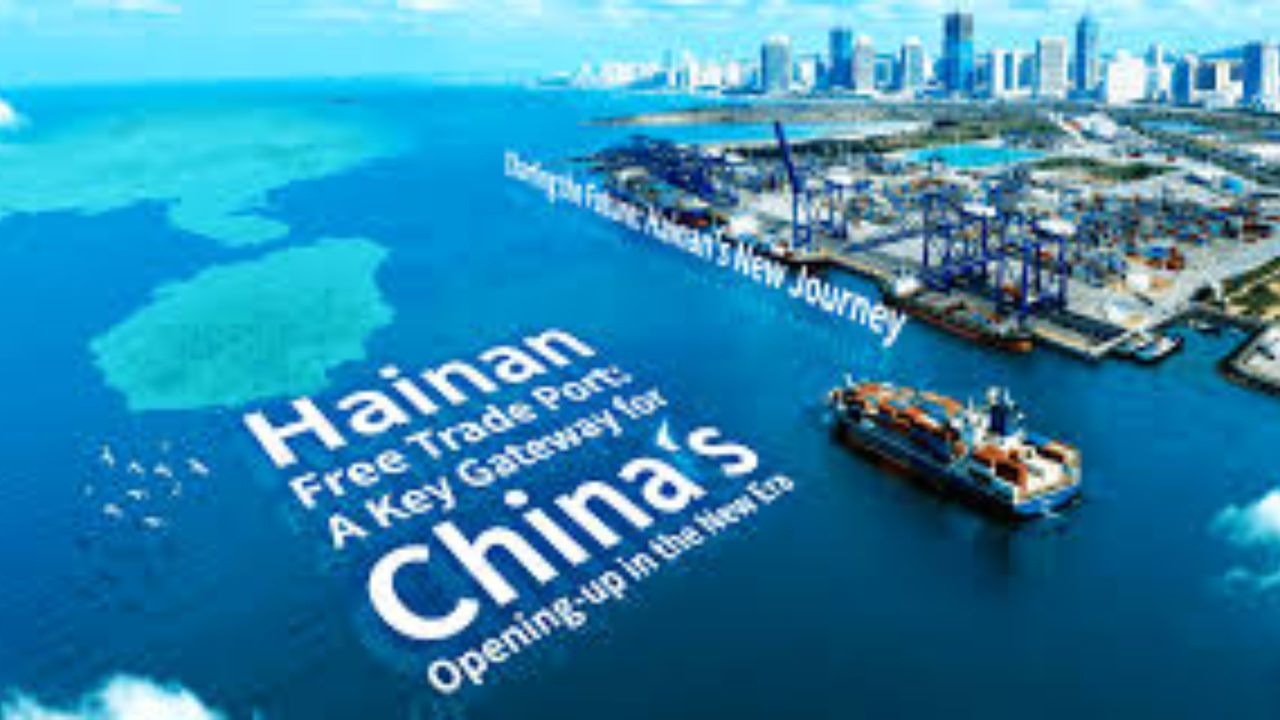
While much of the global economy pivots toward protectionism and heightened tariffs, China is doubling down on liberalization with its most ambitious economic experiment yet: the Hainan Free Trade Port (FTP). Spanning an area 50 times the size of Singapore, the entire island of Hainan has been designated a separate customs jurisdiction, signaling a massive shift in how China interacts with the global supply chain.
Thank you for reading this post, don't forget to subscribe!A “Country Within a Country”: The Logistics of Hainan
Beijing has officially launched island-wide special customs operations this month, effectively turning the island into a duty-free zone with its own set of laws and regulations.
- Massive Scale: At roughly 35,000 $km^2$, Hainan is nearly as large as Taiwan or Belgium.
- Tariff Revolution: The new customs initiative has increased zero-tariff eligibility from 21% to 74% of all goods, covering essential raw materials and industrial equipment.
- The “30% Value-Add” Rule: To prevent the island from becoming a mere transit point, China allows products processed in Hainan to enter the mainland duty-free, provided at least 30% of their value is added on the island. This incentivizes high-end manufacturing over simple transshipment.
Unprecedented Tax Incentives
To compete with established hubs like Hong Kong and Singapore, China has slashed taxes to levels unseen on the mainland:
| Tax Category | Hainan FTP Rate | Mainland China Rate |
| Corporate Income Tax | 15% (for eligible firms) | 25% |
| Top Personal Income Tax | 15% (for skilled talent) | 45% |
| Import Duties | 0% (on 74% of goods) | Standard Tariff Rates |
These incentives have already triggered a surge in activity. Siemens Energy recently broke ground on a gas turbine assembly base in the Yangpu Economic Development Zone, joining over 8,000 foreign-funded companies that have moved to the island since 2020.
Strategic Significance Amid Dropping FDI
The timing of the Hainan launch is not accidental. Following a 10% drop in Foreign Direct Investment (FDI) during the first three quarters of 2025, Beijing is prioritizing the FTP as its top economic project for 2026.
Top Chinese officials, including Vice Premier He Lifeng, have framed the project as a “major strategic decision” meant to counter global trade barriers led by the West. By making luxury goods like iPhones significantly cheaper (potentially by $100 or more) and streamlining customs procedures, China hopes to create an irresistible gateway for international capital.
Key Takeaways for Investors:
- Targeted Industries: The 15% tax rate applies to high-tech sectors including aerospace, desalination, modern farming, and rural tourism.
- Simplified Bureaucracy: The island is removing licensing requirements for most mechanical and electrical products, aiming for a frictionless trade environment.
- Global Connectivity: With investors from 176 countries already present, Hainan is positioning itself as the primary link between the RCEP (Regional Comprehensive Economic Partnership) zone and the Chinese domestic market.