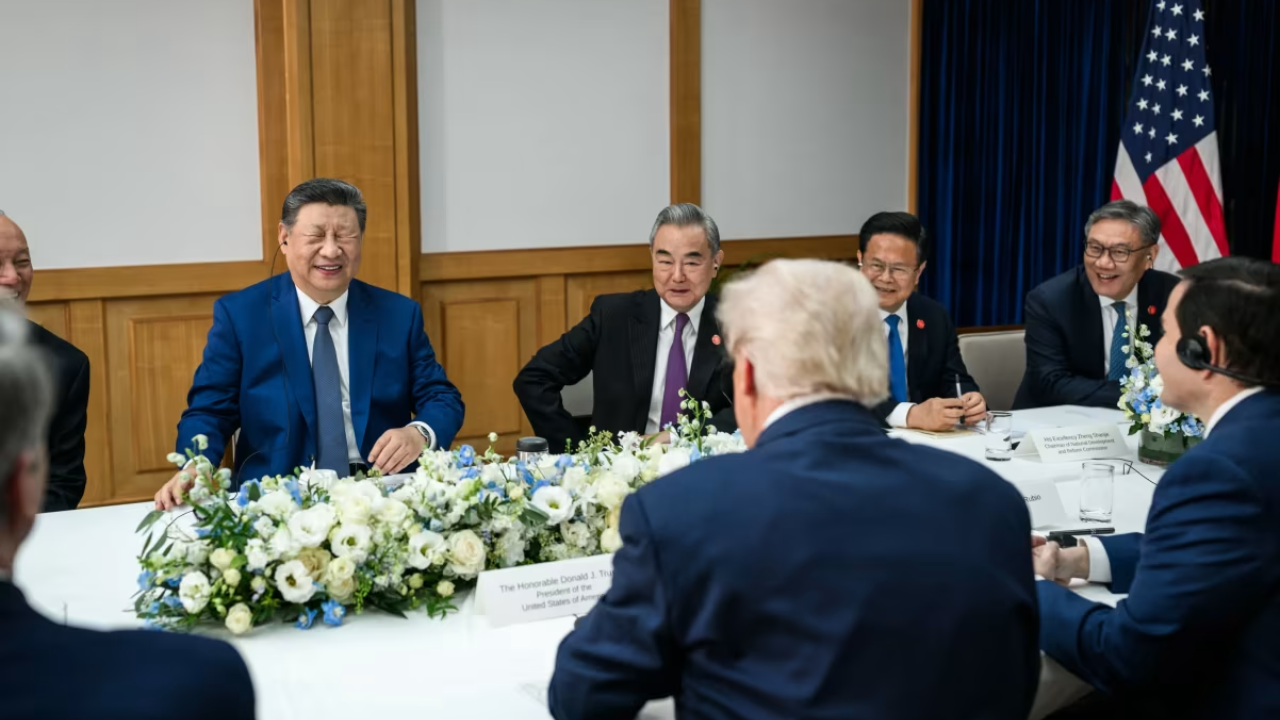
Images released by the White House have offered a rare, candid glimpse of Chinese President Xi Jinping during the recent Asia-Pacific Economic Cooperation (APEC) summit in South Korea—a side of him virtually invisible on China’s tightly controlled state media.
Thank you for reading this post, don't forget to subscribe!Xi Jinping has built a powerful, decades-long reputation at home as a serious, stoic, and steady leader, often shown in formal settings like presiding over a military parade in a Mao suit. However, his recent international appearances revealed unexpected moments of informality:
- Meeting with Donald Trump: A White House photograph captured Xi appearing to grin with his eyes shut, with Foreign Minister Wang Yi laughing alongside him. This image of the usually stern leader was a surprising deviation from his official portrait.
- The “Backdoor” Joke: While exchanging gifts with South Korean President Lee Jae Myung, Xi gave him China-made Xiaomi phones. When President Lee jokingly asked about communication security, Xi laughed and quipped, “You can check if there’s a backdoor.” This spontaneous moment was captured on video.
Censorship at Home: Maintaining the Narrative
These relaxed interactions contrast sharply with the opaque and highly controlled political environment Xi maintains in China. His lighter international moments were barely covered on the mainland’s internet:
- Censors actively remove any coverage of Xi that deviates from the official, serious narrative.
- Footage and images of the gift exchange joke were nowhere to be found on popular Chinese platforms like Douyin or Xiaohongshu, highlighting the strict control over information flow and his public image.
Under Xi, strict control over expression and information means that any clue about China’s direction is fiercely sought after, even by analyzing his hair color. The contrast shows a clear effort to project an image of unwavering political control at home, while allowing for brief moments of flexibility on the global stage.
What aspect of China’s media control or leadership image are you most interested in exploring further?