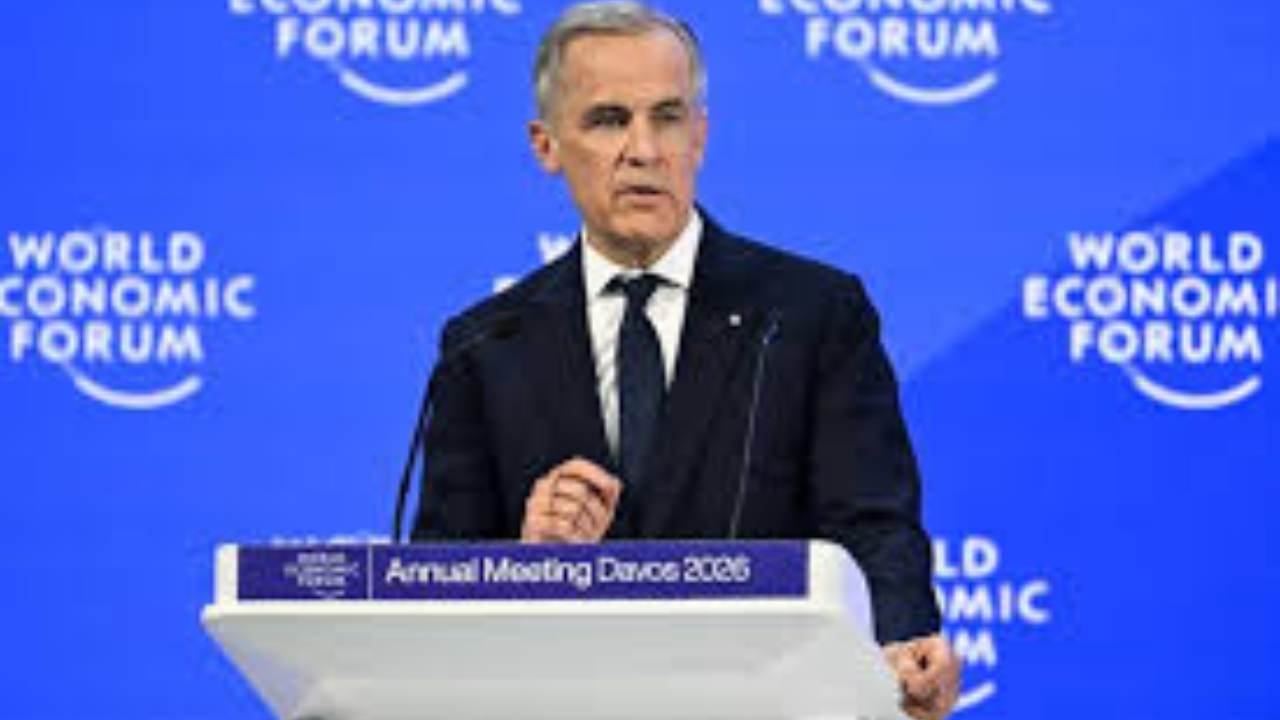
Mark Carney didn’t just give a speech at Davos; he performed an autopsy on the global order. Stepping onto the stage not as a banker, but as a Prime Minister, Carney’s “Manifesto for Middle Powers” has fundamentally shifted the conversation on global trade and security.
Thank you for reading this post, don't forget to subscribe!The Big Idea: Reality Over Performance
Carney’s main argument was that the old era of “pretend cooperation” is over. He used the concept of a “Rupture” to describe the current state of the world:
- The End of the “Greengrocer” Era: He challenged nations to stop pretending that 1990s-style globalization is still working.
- Weaponized Trade: He warned that integration is no longer a path to peace, but a tool for “hegemons” (large powers) to bully smaller nations.
- The Survival Quote: His line, “If we’re not at the table, we’re on the menu,” has become the new rallying cry for nations like Canada, Australia, and the Nordic states.
The Strategy: “Variable Geometry”
Carney didn’t just complain; he offered a blueprint. He proposed that middle powers should stop waiting for the U.S. or China to lead and instead build their own “flexible” alliances.
| Strategy Pillar | What it Means |
| Strategic Autonomy | Reducing dependence on any single superpower for energy or tech. |
| Coalitions of the Willing | Small, fast-moving groups focused on specific goals (e.g., AI ethics or Green Hydrogen). |
| Defense Realism | Doubling down on internal strength and Arctic sovereignty to command respect. |
Why the World Listened
It was honest: He admitted the risks of a second Trump term and Chinese expansionism.
- It was bold: He positioned Canada as a leader of a “Third Way” rather than a junior partner to the U.S.
- It was timely: In a world of chaos, people are desperate for a coherent plan.
The Verdict: Carney transitioned from “The Adult in the Room” to “The Architect of a New Order.” He gave middle-sized nations a reason to stop playing defense and start playing the game.